
If you're about to register for the Praxis Mathematics (5165) exam, the single most expensive mistake you can make is assuming there's one national passing score. There isn't. ETS writes and scores the test, but every state or licensing agency sets its own qualifying number, so the Praxis 5165 passing score by state can differ by more than 15 scaled points from one jurisdiction to the next. Booking your $130 test date before you've confirmed your exact target is like studying for an exam without knowing how many questions are on it.
This checklist walks you through the whole verification: finding your state's official requirement page, making sure 5165 is the right test code for your license, recording your qualifying score and its effective date, understanding how your raw answers convert to a scaled score, and setting a practice-test target that gives you a comfortable margin. Each item is something you can check off in minutes, and by the end you'll know exactly what number you're chasing before a single dollar leaves your account.
Why the 5165 has no single national passing score
ETS is clear about who owns the cut score: not them. On its official Passing Score Requirements page, ETS states that passing scores "vary by state or agency" and are not set by ETS itself. That page lets you select a state and a test code to see the qualifying score in effect. The same principle shows up in the ETS Understanding Your Praxis Scores guide for 2025–2026, which explains that your score report's PASSED or NOT PASSED status is determined by comparing your highest score to the passing score your state or agency had in effect on your test date or report date.
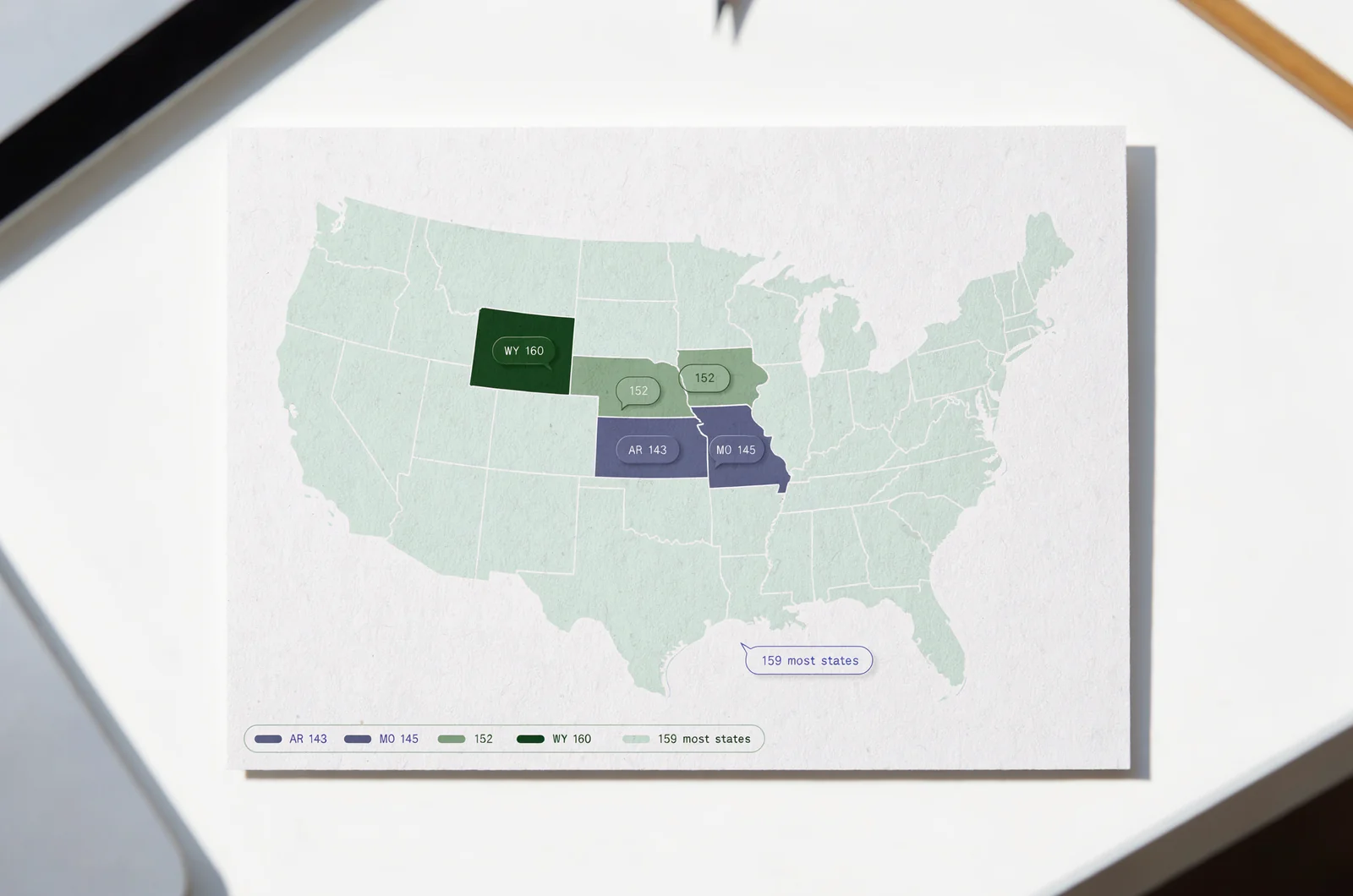
In practice, most jurisdictions have converged on 159 for the 5165 on the 100–200 scaled range, but a meaningful minority have not. Compiled state-by-state data from 240 Tutoring's Praxis score tables shows Arkansas at 143 and Missouri at 145, with Delaware, Kentucky, Mississippi, and Utah at 152, and Wyoming at 160. That spread matters. A candidate in Arkansas who passes with 150 could move across state lines and find that same score doesn't qualify in Wyoming.
There's a second wrinkle: states revise these numbers. In response to teacher shortages, some states have lowered qualifying scores in recent years, and a score that was correct when you started your prep program might not be the score in effect when you test. Treat anything you read on a forum or an old study group post as a hint, not an answer, and verify against the ETS state pages within a few weeks of your registration date.
Confirm 5165 is the test your license actually requires
Before you look up any score, make sure you're looking up the right exam. Praxis codes sit close together, and a one-digit slip sends you to the wrong requirement row entirely.
- Check your certification area on your state page. ETS maintains a dedicated state requirements hub where each state and territory lists which tests it requires by licensure area. Find your state, then your endorsement (for example, secondary mathematics), and read the exact test code listed there.
- Match 5165, not 5164 or 5161. The 5164 is Middle School Mathematics, a different test with different content and different cut scores. The 5161 was the predecessor version of the secondary Mathematics Content Knowledge exam, and many states have retired it in favor of 5165. If your state page still shows 5161 for some license levels and 5165 for others, confirm which one applies to the license you're seeking right now.
- Confirm your state accepts the 5165 at all. The official ETS Mathematics (5165) test page opens with a direct warning: "Make sure your certifying state accepts this test." Some states require alternative assessments or have their own subject-matter exams, so a passing 5165 score is only useful if your agency actually counts it.
- Note every test in your requirement set. Secondary math licensure often involves more than one exam, such as a pedagogy or Principles of Learning and Teaching test. Record the full set now so a missing second test doesn't stall your application later.
The finished state for this check: you have your state's requirement page open or saved, your licensure area located on it, and "Mathematics (5165)" confirmed as the correct code. If anything on the page is ambiguous, call or email your state department of education and get the answer in writing. That's a 20-minute task that can save a $130 registration fee and weeks of misdirected study time.
Record your qualifying score, the fee, and the timeline
With the right test confirmed, capture the numbers that drive your whole plan. Write these down in one place, because you'll refer back to them every time you take a practice exam.
- Your state's qualifying score for 5165. Pull it from the ETS scores page or your state requirements page, and write down the date you checked. If you're testing more than a couple of months out, plan to re-verify two to three weeks before your test date in case the state revised the cut score.
- The registration fee. The 5165 costs $130 per attempt according to the ETS test page. A failed attempt means paying that again, which is exactly why the margin you build in practice matters more than shaving a week off your study schedule.
- The test format you're preparing for. Per the ETS Mathematics Study Companion, the 5165 is 66 selected-response questions in 180 minutes, delivered by computer at a test center or at home online. That works out to roughly 2 minutes 45 seconds per question, so pacing practice is part of your target, not just content knowledge.
- Score-report timing and where scores go. When you register, you can designate score recipients, including your state agency. Check your state page for whether your scores are reported automatically or whether you need to send them, and note the typical reporting window so your licensure application timeline stays realistic.
- Any alternate routes your state allows. Some states accept higher scores on other exams, out-of-state credentials, or equivalent coursework in place of a Praxis score. If any apply to you, it changes whether you need this exam at all.
That five-item audit is the core of this whole checklist. Most candidates skip straight from "I need the Praxis" to "I'll book next month" without ever writing the number down. Don't be most candidates.
Understand what the scaled score means in practice
Your target number (say, 159) is a scaled score on the 100–200 range, not a percentage and not a raw count of correct answers. ETS converts your raw performance into that scale so scores stay comparable across different versions of the test. The practical consequence: you can't translate 159 into "answer X of 66 questions correctly" with precision, because the conversion varies by test form.
Discussions among candidates, like the long-running r/Teachers scoring thread on Reddit, show how much confusion this causes, with test takers trying to reverse-engineer raw-to-scaled conversions from unofficial practice tests. Treat those conversions as rough ballparks only. The safer interpretation: most candidates need to answer comfortably more than half the questions correctly, and the ones who pass consistently are scoring well above two-thirds correct on timed, full-length practice.
Two format details from the ETS Study Companion affect your pacing. First, the 5165 includes multiple selected-response styles: single-answer multiple choice, questions where you select one or more answers, and numeric-entry boxes where you type the answer yourself. Numeric-entry items give no answer choices to work backward from, so they punish shaky fundamentals. Second, roughly a quarter of the questions address the teaching of mathematics, not just mathematics itself, based on prep analyses of the exam's content categories. If you drill only pure algebra and geometry, a quarter of the exam will feel unfamiliar on test day.
For a deeper look at how the 5165 differs from its predecessor, the comparison of the two codes at Education Task's 5165 vs 5161 breakdown lays out which states have adopted the newer exam and how passing scores shifted during the transition, useful context if you're returning to licensure after a break and remember the old test.
Set a practice target with a real margin
Now convert your state's number into a working target. If your state requires 159, aiming for exactly 159 in practice is planning to fail: test-day nerves, an unfamiliar question mix, and a bad morning can each cost you a few scaled points.
A sensible rule is to add a buffer of 8 to 10 scaled points above your state's qualifying score. For a 159 state, that means you should be consistently scoring in the 167–169 range on timed, full-length simulations before you schedule. For Wyoming's 160, aim at 168–170. Consistency is the operative word. One good practice run proves nothing; three consecutive runs above your buffer, spread across at least two weeks, is the signal that you're ready.
Build your practice around realism. The ExamJungle simulator for the Praxis 5165 Mathematics Content Knowledge exam runs timed sessions that mirror the 66-question, 180-minute structure, and every missed question comes with an explanation so you're learning why the correct answer works rather than memorizing a letter. When an explanation doesn't click, Caesar AI can expand it or generate a harder variant of the same concept, which is how you turn one wrong answer into a permanently fixed gap. Use flashcard mode for the formula-heavy topics between full sessions.
Track your scores by content category, not just the total. If your algebra results are strong but your statistics and probability questions keep dragging the total down, your study hours belong there. This is where candidates waste the most time: re-studying what they already know because it feels productive.
One more number to respect: retake cost. At $130 per attempt plus the waiting period before you can sit again, two unnecessary retakes cost more than most full prep programs. The margin you build in practice is the cheapest insurance available. If you're comparing what candidates actually pay across certification exams generally, our breakdown of A10 CPSA exam costs shows the same pattern in another field: the registration fee is only the start once retakes enter the picture.
Book the test only after these green lights
You're ready to register when every one of these is true:
- You've re-verified your state's 5165 qualifying score within the last few weeks, on the ETS scores page or your state agency's site.
- You've confirmed 5165 is the required code for your specific licensure area, and you know any other tests in your requirement set.
- You've scored at or above your buffered target (state score plus roughly 8–10 points) on at least three full-length timed practice runs.
- Your weak content categories have been drilled until they no longer pull your total below target.
- You've decided between test-center and at-home delivery, and you've read the ETS requirements for your chosen format.
- Your score recipients are planned, so results reach your state agency without extra steps.
If any box is unchecked, fix that item first. Registering early doesn't make you more prepared; it just starts the clock. If you're weighing free versus paid prep resources while you close those gaps, our comparison of HESI exam practice question options covers the same tradeoffs that apply to Praxis prep: free questions are fine for volume, but explanation quality is what actually moves your score. And if you want a sense of how exam fees and retake policies stack up across professional certifications, the ACFE CFE exam fee breakdown is a useful reference point for budgeting your own credential.
Keep your study aligned with what's on the test
Reader questions about 5165 scores
Is 159 the passing score for the Praxis 5165 everywhere? No. Most jurisdictions use 159, but ETS does not set passing scores, and states choose their own. Arkansas requires 143, Missouri 145, and Wyoming 160, per compiled state tables from 240 Tutoring. Verify your own state on the ETS scores page before you register.
Does the Praxis 5165 passing score ever change? Yes. States revise qualifying scores, and several have lowered cut scores in recent years amid teacher shortages. Re-check your state's requirement within a few weeks of your test date.
Is the Praxis 5165 the same as the 5161? No. The 5165 replaced the 5161 as the secondary Mathematics Content Knowledge exam in most states. Confirm which code your state currently requires, because the content outline and cut scores differ.
How many questions can I miss and still pass? There's no fixed number. Your raw performance converts to a 100–200 scaled score, and the conversion varies by test form. Aim to answer well above two-thirds of the 66 questions correctly in timed practice.
What happens if my score falls short? Your score report will show NOT PASSED status, and you can retake the exam after paying the $130 fee again and observing ETS's retake waiting period. Scores are reported to you and any recipients you designated.
Can I use my 5165 score if I move to another state? Possibly, but only if your score meets the new state's qualifying score. A 150 that passed in Arkansas doesn't meet Wyoming's 160 requirement, so check the destination state's rules before assuming your credential transfers.
Where to go from here