

If you're about to spend money on a question bank, you're really asking one thing: do these certified medical assistant practice exam questions actually look like the CMA (AAMA) exam? That's the right question to ask, because the market is flooded with sets labeled "CMA" that were written for a different test, a different year, or no test at all. This article answers the question directly using the published exam structure, domain weighting, and question style, so you can judge any practice set in about ten minutes before you commit your study hours to it.
Do most CMA practice questions actually resemble the real exam?
Short answer: some do, many don't, and the difference is easy to spot once you know what the real exam looks like. The CMA (AAMA) exam contains 200 multiple-choice questions, of which 180 are scored and 20 are unscored pretest items, delivered in four 40-minute segments for a total of 160 minutes, according to the exam structure published by the AAMA on its certification preparation page. Each item is a single-best-answer question with four options. A passing result is a scaled score of 425 on a scale of 200 to 800.
That structure gives you a fast filter. If a practice set uses true/false items, fill-in-the-blank, or questions with five or six answer choices, it wasn't built to mirror the AAMA format. If the explanations are one line long ("B is correct because B is correct"), it won't teach you why an answer is right, which is the whole point of practice testing. And if the set claims to cover "the CMA" but is actually written for the NHA CCMA, a different credential with a different blueprint, you'll be drilling content weighted for the wrong exam.
The confusion is common because "CMA" gets used loosely. The AAMA credential is the Certified Medical Assistant. Other bodies certify medical assistants too: the NHA offers the CCMA, and AMT offers the RMA. A question bank labeled generically "medical assistant" may be written to any of these, or to none. Before anything else, confirm which exam a set is aligned to. The AAMA publishes its content outline publicly, so any serious provider can show you the mapping.
One more wrinkle worth knowing: the 20 unscored pretest items on the real exam are mixed in without any label. You can't tell them apart from scored questions, and neither can a practice set that claims to reproduce "the real 200." What a good bank reproduces is the style and the distribution, not the literal items. Anyone promising verbatim exam questions is either guessing or violating exam security policies, and neither helps you.
What does the AAMA content outline say the exam covers?
The CMA (AAMA) exam splits into three content categories: General, Administrative, and Clinical. The AAMA's published outline weights Clinical the heaviest, followed by General, then Administrative. Within those categories, the outline lists specific task areas: psychology and communication, medical law and ethics, medical terminology, scheduling and medical records, coding and insurance processing, anatomy and physiology, infection control, patient intake, pharmacology, and laboratory procedures, among others.
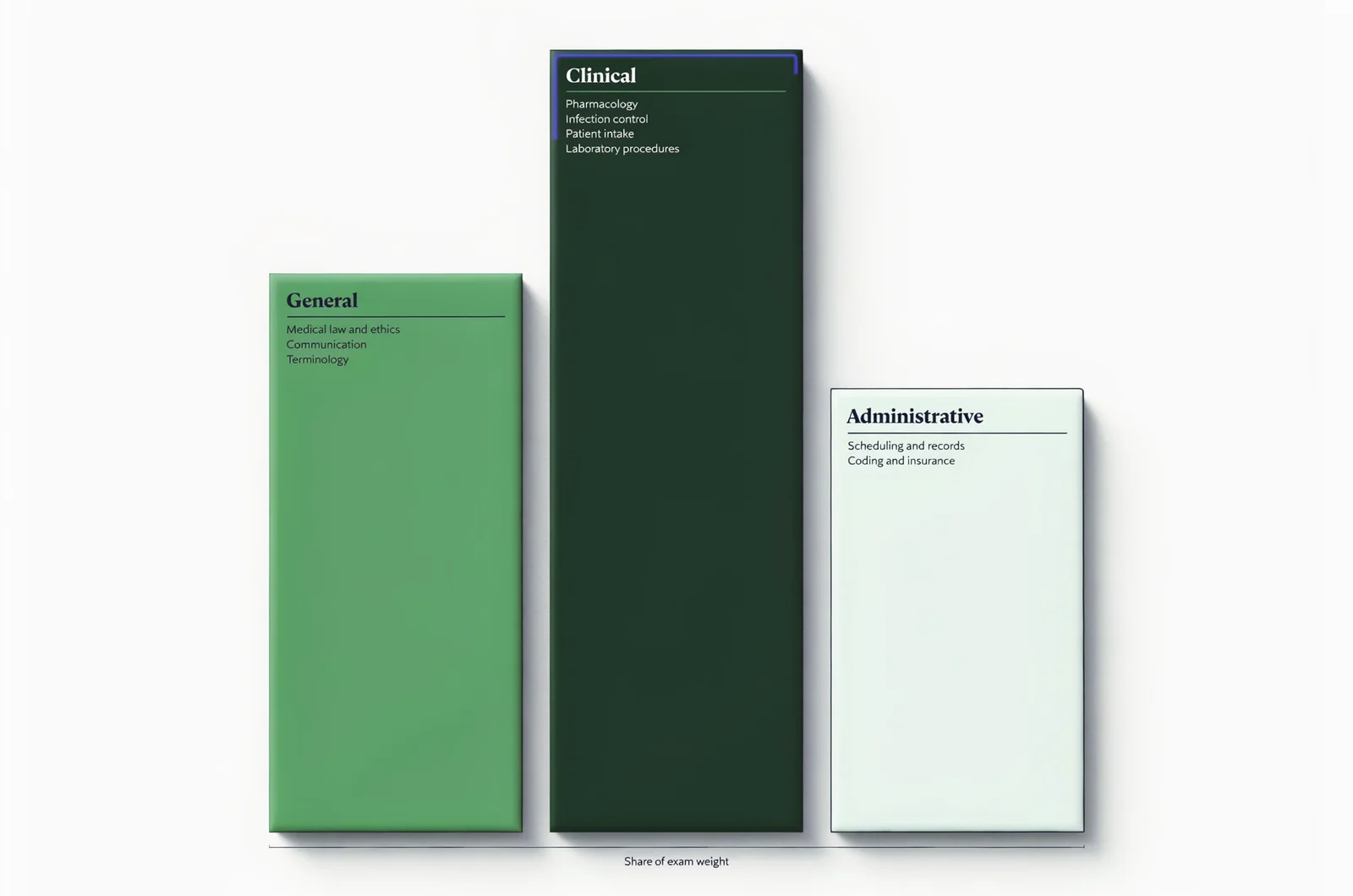
This weighting matters because it tells you where your study time should go. A candidate who drills billing and coding questions for a week and skips pharmacology is practicing against the wrong distribution. Good practice questions mirror the outline's proportions, so a 200-question timed set should feel clinical-heavy, with a meaningful slice of general knowledge (terminology, law, ethics, communication) and a smaller administrative slice.
Here's a practical check you can run on any question bank:
- Ask the provider for a domain breakdown of their item pool. If they can't produce one, the set probably wasn't built from the outline.
- Sample 20 random questions and tag each against the AAMA categories. If more than a third are administrative, the balance is off.
- Check that the hard clinical topics are present in depth: medication administration and dosage, phlebotomy and specimen handling, EKG basics, sterile technique, and patient positioning.
- Verify the general category includes medical law (scope of practice, consent, HIPAA) and professional communication, since these trip up candidates who only drill clinical skills.
- Look for lifecycle coverage inside clinical content. The outline spans pediatrics through geriatrics, so a bank where every vignette is a healthy 30-year-old adult is missing a real slice of the test.
Free sets like the CMA practice test from Mometrix and the medical assistant practice exam from Tests.com are useful for this kind of sampling, because you can see the item style before paying for anything. Use them as a baseline for what a competent item looks like, then judge paid banks against that baseline.
What does a realistic CMA exam question look like?
Real AAMA items tend to be scenario-based or applied-knowledge questions, not pure recall. Instead of "What is the normal range for adult blood pressure?", you're more likely to see a short clinical vignette: a patient presents with certain symptoms or a task needs to be done a certain way, and you choose the best action or the correct term.
A realistic item has a few traits. The stem is one to three sentences. All four answer options are plausible, and the distractors reflect common mistakes a working medical assistant might make, like choosing a slightly wrong needle gauge, misapplying an infection-control step, or confusing two similar terms. The correct answer is defensible from standard practice, and a good explanation cites the reasoning: why the correct option is right and why each distractor fails.
Compare two versions of the same concept. Weak version: "Which needle gauge is used for a standard venipuncture?" with options 18, 21, 25, 27 and no explanation. Stronger version: "A medical assistant prepares to draw blood from an elderly patient with small, fragile veins. Which gauge minimizes hemolysis risk while allowing adequate flow?" Now the question tests judgment, not just recall, and the explanation has something to teach. The AAMA's applied style sits much closer to the second form.
When you evaluate a practice set, read the explanations, not just the questions. Weak banks give you the answer letter and nothing else. Strong ones teach. On ExamJungle, for example, every question carries a written explanation, and when the reasoning still isn't clear, the Caesar AI tutor can expand it, walk through the distractors, or generate a harder variant of the same concept. That matters because understanding why an answer is correct is what transfers to the exam room; memorizing letter patterns doesn't survive a reworded question.
One more authenticity signal: the real exam is linear and non-adaptive, with four timed segments. Practice in the same way. A bank that only offers untimed, one-question-at-a-time review is fine for learning, but you also need full timed runs to build pacing. Roughly 48 seconds per scored question is the rhythm the real test demands.
How many questions and how much time does the real test give you?
The numbers, per the AAMA: 200 total questions, 180 scored, 20 unscored pretest items mixed in without identification, 160 minutes of testing time split into four 40-minute segments, with an optional break between segments (the clock handling depends on current policy, so check the AAMA candidate handbook before test day). The passing scaled score is 425 on the 200 to 800 scale, and you get a preliminary pass/fail at the test center with official results following.
Why does this matter for practice? Two reasons.
First, stamina. Four 40-minute blocks of dense multiple-choice is tiring, and accuracy drops when you're fatigued. If all your practice has been ten-question quizzes on your phone, your first full-length experience shouldn't be the paid exam. Schedule at least two or three full 200-question timed simulations in the final weeks of prep. Timed practice exams are exactly what ExamJungle's simulator mode is built for, and the same principle applies whatever platform you use: replicate the clock, not just the content.
Second, scoring calibration. A 425 scaled pass means you don't need perfection, but you do need consistency across all three content categories. Because pretest items are unscored and unidentified, you can't game which questions to skip. The practical takeaway: aim for a comfortable margin in practice, something like 70% or better across categories, before you book your seat. Retake fees are real money, and walking in with margin beats walking in with hope.
There's a pacing trap hidden in those numbers, too. Forty minutes for roughly 50 questions per segment sounds generous until you hit a cluster of dosage-calculation items that each take two minutes. Build a personal rule during simulations: if a question hasn't cracked after 60 seconds, flag it, move on, and return in the leftover time. Banks that let you flag and revisit questions mirror this habit; ones that force a linear no-return flow don't.
How should you judge a question bank before you buy it?
You now have the raw material for a decision. Here's a concrete evaluation pass you can run on any set of CMA practice questions in under an hour.
Check the alignment claim
Does the provider state explicitly that the bank maps to the current AAMA content outline? The outline does get revised, so a set last updated for an older version may carry retired content. Look for a stated update date within the last year or two. Prep providers like UWorld's CMA practice question bank and TestPrepReview's CMA practice materials describe their coverage openly, which is the transparency you want from any provider.
Check the item quality
Pull ten questions at random. For each, ask: is there a scenario or applied element, are all four options plausible, and does the explanation teach the reasoning? Score it honestly. If half the items are definitional recall with one-line explanations, the bank is a flashcard deck wearing a practice test's clothes.
Check the modes
You need at least three ways to work: untimed review with explanations, domain-filtered drilling for weak areas, and full timed simulation. Flashcard mode is a bonus for terminology. If a bank only offers static PDFs, you lose the timing practice and the analytics that tell you which category is dragging your score down.
Check the price against the risk
The exam itself costs money, and a retake costs more. A quality question bank typically costs a fraction of one retake fee, so the math favors investing in a set that actually matches the outline. But expensive doesn't mean aligned, and free doesn't mean bad. Free sets from established prep sites are often good enough for your first diagnostic run; then upgrade to a fuller bank once you know where you stand.
A small tool idea worth building into your prep: a simple domain-coverage checklist. Take the AAMA outline's task areas, and after each study week, mark which areas you've drilled and what your practice accuracy was in each. Any spreadsheet works. It takes five minutes a week and keeps you from over-studying the topics you already like.
What about CCMA and RMA questions — are they interchangeable?
No, and this trips people up constantly. The AAMA CMA, the NHA CCMA, and the AMT RMA are three separate credentials with separate blueprints. There is overlap, since all three cover clinical and administrative medical assisting, but the weighting and emphasis differ.
The CCMA, for instance, leans heavily into clinical patient care — the NHA's exam guide lays out a test plan where clinical patient care dominates the scored content. The AAMA exam spreads weight more evenly across its three categories and includes stronger general-knowledge and administrative components. If you're sitting for the CMA (AAMA) and you drill a bank built for the CCMA, you'll over-train clinical and under-train law, communication, and administrative processing.
Eligibility differs too, which is worth a footnote here. The CMA (AAMA) generally requires graduation from an accredited medical assisting program, while the CCMA and RMA accept other pathways. That difference shapes each exam's audience and, in turn, its content emphasis. It's one more reason the blueprints don't line up one-to-one.
The fix is simple: match the bank to the credential code, not the job title. If a product page just says "medical assistant exam" without naming AAMA, NHA, or AMT, email the provider and ask. Silence is an answer too.
How do you turn practice questions into a passing score?
Alignment is the entry ticket; how you use the questions decides the outcome. A workable approach for the CMA looks like this.
Start with a diagnostic. Take one full timed simulation early, before you've studied seriously. It'll sting, but it tells you your baseline per category, and baseline data stops you from wasting weeks on content you already know. Candidates routinely over-study their favorite domain and under-study the one that will sink them.
Then work domain-focused blocks. When you miss a question, don't just read the explanation and move on. Write down (or tag) why you missed it: didn't know the fact, misread the stem, or knew the fact but got fooled by a distractor. Each failure type has a different fix. Fact gaps need content review. Misread stems need slower reading practice. Distractor traps need you to articulate why the wrong option was tempting. This is where an AI tutor earns its keep — asking Caesar AI to generate harder variants of a question you missed forces the concept rather than the memorized phrasing.
Space the repeats out. Re-attempting a missed question the next day mostly tests short-term memory. Re-attempting it after a week, and again after two, tests whether the concept actually stuck. Most platforms with progress tracking will resurface weak items on a schedule; if yours doesn't, keep a simple review list and work through it every Friday.
In the final two to three weeks, shift to full timed simulations under exam conditions: 40-minute blocks, no phone, no pausing. Review every miss the same day. By test day, you want the format to feel boring. Boredom is what exam-readiness feels like: no surprises in structure, timing, or question style, so all your attention goes to the content.
Finally, protect your sleep and logistics in the last 48 hours. Confirm your testing center or remote-proctoring setup through your AAMA candidate account, gather your ID, and do nothing heavier than light flashcard review the day before. Cramming new content at that point raises anxiety more than it raises scores.
More ways to sharpen your practice-question instincts