
If you're mapping out a CWM Level 2 exam study timeline, the most useful thing I can give you right now is the current state of the exam itself, followed by a realistic week-by-week plan built backward from test day. As of early October 2026, the AAFM Chartered Wealth Manager (CWM) Level II examination remains an advanced, application-heavy test administered by the American Academy of Financial Management, and prep providers refreshed their syllabus trackers as recently as September 2026. Killexams' syllabus page, for example, shows its CWM_LEVEL_II exam objectives outline checked against the 2026 syllabus defined by AAFM on September 14, 2026.
Here's the complication, and it's worth stating plainly before we build any calendar: third-party prep sources disagree on the exam's current format. PrepRate's study guide describes a 150-question, 3-hour exam with roughly 1.2 minutes per question. Other 2026 prep listings describe a shorter 100-question format. AAFM's own examination page is the authoritative reference, and its scheduling and format details are the numbers you should lock your timeline to. Everything below is built to work under either format, but I'll flag where the difference changes your pacing math.
One more framing note before the timeline. This piece is an editorial update, not an evergreen guide. Where I'm interpreting the evidence rather than reporting it, I'll say so. Dates matter here, and I'll attach them to every claim that depends on them.
Where the CWM Level 2 exam stands in late 2026
The Level II exam sits at the advanced end of AAFM's Chartered Wealth Manager track. It builds directly on the Level I foundation and pushes into applied wealth management: estate planning, tax strategy, alternative investments, portfolio construction, and case-study scenarios where several concepts collide in one question. Study4Exam's AAFM CWM_LEVEL_2 syllabus page tracks the current topic outline, and both it and Killexams confirm the syllabus was refreshed for 2026 with checks logged in September.
On format, the sourcing splits. PrepRate's 2026 guide describes 150 multiple-choice questions in 3 hours, heavy on case studies and scenario problems. Cert Empire's September 20, 2026 update lists a 2.5-hour duration with online-proctored or testing-center delivery in English. A third listing describes a 100-question, roughly one-hour-per-section structure. Because these are commercial prep sources rather than AAFM itself, treat them as directional. The verified takeaway is narrower: the exam is multiple-choice, delivered either online with proctoring or at a testing center, in English, and long enough that pacing is a trained skill, not an afterthought.
One scheduling fact with regulatory weight behind it: AAFM India published an important notice about CWM examinations covering how CWM exams connect to NISM requirements for SEBI-registered investment advisers. If you're pursuing the credential partly for RIA compliance in India, that notice belongs on your reading list before you register, because it can affect which exam windows and pathways apply to you.
Your entry route also shapes your timeline. AAFM publishes two distinct paths: the CWM Compulsory Pathway for candidates working through the full program sequence, and the CWM Experience Pathway for professionals whose prior qualifications and work history let them compress the journey. Experience Pathway candidates typically start Level 2 prep with less Level 1 catch-up, which can shave two to four weeks off the calendar below. Verify which pathway you're on with AAFM before counting weeks.
How long CWM Level 2 preparation actually takes
There is no official AAFM-published study-hour figure in the sources I reviewed, so any hour count is an estimate. What I can do is triangulate from comparable credentials and the exam's structure, and label it as analysis.
The closest public benchmark is the CFA Level II conversation. The top-ranking community threads for level-two study timelines converge on roughly six months of preparation, with the final month reserved almost entirely for mock exams and repeated question drilling. That pattern matches what the CWM Level 2 format demands: scenario questions with multiple moving parts reward candidates who have seen hundreds of worked examples, not candidates who finished the reading the night before.
My working recommendation for a typical candidate, meaning a working professional studying 8 to 12 hours per week:
- 16 to 20 weeks if you're on the Compulsory Pathway and your Level 1 material is reasonably fresh.
- 12 to 14 weeks if you're on the Experience Pathway or you work daily with estate planning, tax, or portfolio concepts.
- Add 4 weeks to either figure if your weekly study time is under 6 hours, or if you're returning to formal exam study after several years away.
Under 12 weeks is possible but tight. The math that bites people: at 150 questions over 3 hours you get about 72 seconds per question, and case-study stems eat 20 to 30 of those seconds before you see the first answer choice. Speed at that pace only comes from timed repetition, and timed repetition needs its own block on the calendar. Compressing the plan usually means cutting exactly the practice phase that builds that speed.
A week-by-week study timeline that works backward from exam day
This is the core of the piece: a 16-week template you can stretch to 20 or compress to 12. Each phase has one job. If a phase's job isn't done, the calendar slips rather than the phase.
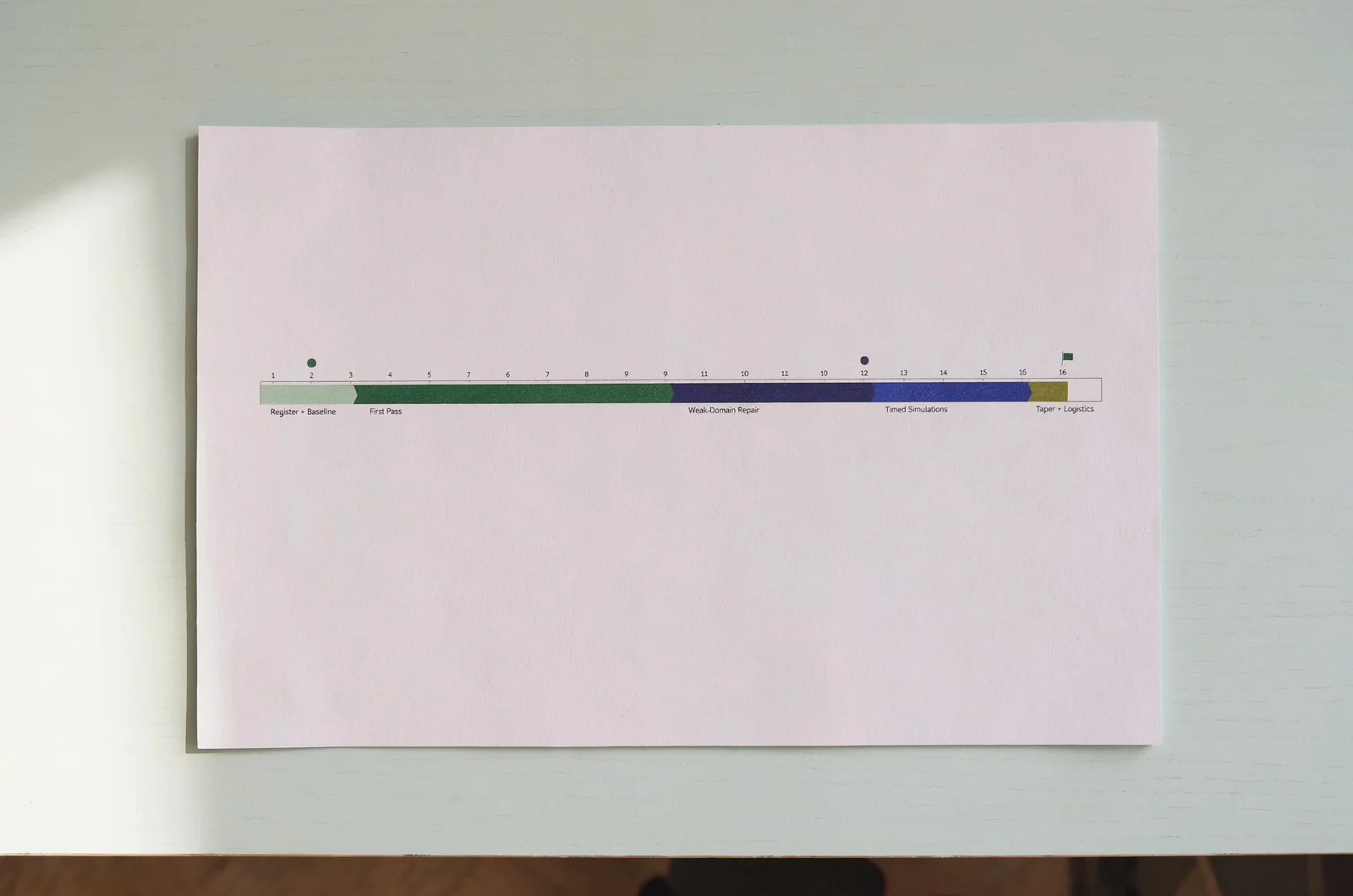
Weeks 1–2: Registration, syllabus mapping, and the baseline check
Register first, study second. A booked exam date converts your timeline from a wish into a countdown, and AAFM's examination page is where you confirm current windows, delivery mode, and fees. Once the date is set, download the official CWM study guide and the current syllabus outline, then build a topic inventory: every syllabus domain, rated by your honest confidence level, one line each.
End week 2 with a baseline practice exam under timed conditions. Yes, before you've studied. The score will sting, and that's fine. Its job is to tell you which domains get extra weeks. On ExamJungle, a free timed practice exam gives you that baseline with per-question explanations, so your first diagnostic doubles as your first study session.
Weeks 3–8: First pass through the material
Six weeks, one domain cluster per week. The sequence that works for most candidates starts with the areas that other topics build on: portfolio theory and asset allocation first, then tax, then estate planning, then alternatives and the remaining specialized domains. Case-study questions at Level 2 blend these constantly, so front-loading the connective tissue pays off later.
Two rules for this phase. First, every study session ends with 10 to 15 questions on what you just covered, not next week. Second, keep a running error log. Write down each question you miss and the reason: concept gap, misread stem, or time pressure. The log becomes your week 13 agenda. If you want a model for matching question sets to an official outline during this phase, the approach in our piece on outline-matched practice questions transfers directly.
Weeks 9–12: Second pass, weak-domain repair
Now the error log drives the schedule. Rank your domains by miss rate and give the worst two a full week each. This is also where understanding replaces recognition. When you miss a question, don't just read the explanation; interrogate it. Ask why the correct answer is correct and why each wrong option is wrong. This is where a tool that can expand an explanation on demand, like ExamJungle's Caesar AI, earns its place: when a written rationale doesn't land, you can ask for a harder variant of the same question and test whether the concept actually stuck.
By the end of week 12, your untimed accuracy across all domains should sit comfortably above your target pass threshold. If any domain still lags, that's your signal to shift the exam date rather than gamble the registration fee.
Weeks 13–15: Timed practice exam block
Three weeks, and this is the phase the CFA community threads describe as the "final month slog" for good reason. Two full timed simulations per week, same session length as the real thing, no pausing, no notes. Between simulations, review every missed and guessed question. Guessed-and-right counts as missed for review purposes, because luck isn't a strategy.
Track two numbers across these six simulations: overall score and average seconds per question on case-study items. If the real exam is the 150-question, 3-hour format, you need to hold roughly 72 seconds per question. If AAFM's current format is shorter, your per-question budget shrinks, so confirm the live format on the examination page before week 13 and set your timer accordingly. Candidates who've never sat a full-length simulation routinely report that mental fatigue, not knowledge, is what fails them in the final hour. The only fix is rehearsal.
Week 16: Taper and logistics
Final week: light review only. Reread your error log's recurring themes, redo the 20 questions you missed most often, and stop taking full simulations by midweek. Confirm your testing-center route or your online-proctoring setup (ID requirements, room scan, system check) at least 72 hours out. The night before, close the books early. Sleep is worth more than one last chapter.
Timing your registration so the calendar holds
A timeline only works if the exam date and the study plan agree with each other. Three scheduling realities to plan around.
Exam windows and availability. AAFM runs CWM examinations through scheduled windows and on-demand delivery modes depending on your region and pathway. The examination page is the live source; check it at the start of week 1, not after you've studied for a month. Window availability can add weeks to your timeline if you miss a registration cutoff, so register as early as your pathway allows.
Retake risk has a cost beyond money. I won't quote fee figures here because they vary by region and pathway and change over time; confirm current numbers with AAFM directly. What I will say: a failed attempt costs the fee plus four to eight more weeks of waiting and re-prepping. If budget planning matters to you, our certification cost breakdown for a fellow finance credential shows the fee categories to expect. Padding your timeline by two weeks is cheaper than a retake by a wide margin.
Life happens in the middle. Weeks 5 through 10 of any 16-week plan are where work deadlines and family obligations ambush candidates. Build one fully slack week into the calendar before you need it. If nothing goes wrong, that week becomes an extra simulation week, which is the single highest-value place for surplus time.
Where practice exams fit, and where they don't
Practice exams are the backbone of the timeline above, but they're not the whole skeleton. Used at the wrong moment, they waste time; used at the right ones, they're the difference between knowing the material and performing it.
The three moments that matter: the week 2 baseline, the per-session question sets during weeks 3 through 12, and the timed simulation block in weeks 13 through 15. Outside those moments, reading and worked examples should dominate. A candidate who takes a full simulation every weekend from week 3 burns through quality question banks and trains test-taking stamina before they've built the knowledge the test measures.
Quality of questions matters as much as timing. The 2026 prep ecosystem around CWM Level 2 is crowded, and a recent community thread captured the overwhelm well: books, videos, notes, websites, question sets, and everything looks important at first. The filter I'd apply is simple. Use question sets that explain every answer, right and wrong, and that track the current syllabus. On ExamJungle, that standard shows up as per-question explanations, flashcard drilling for quick review between long sessions, and a timed simulator that mirrors real exam pacing. If you're cross-shopping credentials or advising colleagues on other finance tracks, our CFA Level I practice test shows the same timed-simulator approach applied to the closest comparable exam.
If you like planning tools, one idea worth building into your own workflow: a simple backward-planner where you enter your exam date and weekly available hours, and it returns phase boundaries, simulation dates, and a flag when your hours-per-week can't support the remaining weeks. A spreadsheet does this fine; the value is seeing the crunch before you're inside it.
Questions candidates ask about the CWM Level 2 timeline
How many hours a week do I actually need? For a 16-week plan, 8 to 12 hours weekly is the working range for most professionals. Below 6 hours, extend the calendar rather than squeeze the weeks. The total hour count matters more than any single week, so consistency beats weekend heroics.
Is three months enough to prepare? For Experience Pathway candidates with strong Level 1 retention and daily exposure to wealth management work, 12 weeks is feasible. For everyone else, it's the floor, not the target. The constraint is the simulation block: you need at least three weeks of timed full-length practice before test day, and that only leaves nine weeks to learn and repair the material.
When should I take my first full practice exam? Week 2, before deep studying starts. A cold baseline tells you where your hours should go and removes the fear of the unknown format early. Expect a low score; the number is information, not a verdict.
What's the current exam format, 100 questions or 150? Third-party 2026 sources conflict, with some describing 150 questions over 3 hours and others describing shorter formats. AAFM's examination page is the authoritative source, and you should confirm the live format there before locking your per-question pacing budget in week 13.
Should I finish all the reading before doing timed practice? No. Interleave short question sets with study sessions from week 3 onward, and reserve full timed simulations for the final three weeks. Mixing retrieval practice with reading produces better retention than reading everything first, and it keeps your error log fed with real data.
What if my second-pass review shows a domain still failing at week 12? Move the exam date if your registration terms allow it. Two weeks of targeted repair on a weak domain is a small cost compared to a retake fee and a lost testing window. The error log will tell you exactly which weeks of material to redo.
Keep building your study plan