

Sitting down for an exam that costs hundreds of dollars in registration and retake fees creates genuine pressure. When preparing for the AAPC Certified Professional Biller credential, that tension often comes from the unknown. Memorizing glossary definitions does not prepare you for what appears on the testing screen: multi-paragraph chart notes, dense remittance advices, and disputed insurance claims. Reviewing the cpb exam format and question types gives you a clear tactical plan, making sure every study session builds skills that count toward your passing score.
The examination measures practical decision-making across standard medical billing domains. AAPC writes its items to mirror the daily choices of a revenue cycle specialist rather than passive recall. Below is a complete walkthrough of every question format you encounter, complete with worked examples, operational rationales, and test-taking strategies.
Format and Structure of the CPB Certification Exam
The Certified Professional Biller examination consists of 135 multiple-choice questions administered during a single 4-hour testing block. Candidates can test through live remote proctoring or at an in-person testing center. AAPC requires a passing threshold of 70 percent, meaning you must answer at least 95 of the 135 questions correctly to earn your credential, according to official guidance on taking the CPB exam.
To budget your testing time effectively, compare general logistics with individual question demands. Reviewing an overall exam format and question types outline helps you design a balanced schedule, but the CPB requires a specialized pacing plan tailored to its mix of quick recall items and extended case evaluations.
Total duration: 240 minutes (4 hours)
Total questions: 135 multiple-choice items
Passing score threshold: 70% (95 correct answers)
Average time per item: 106 seconds (1 minute 46 seconds)
Reference books allowed: CPT, HCPCS Level II, and ICD-10-CM coding manuals
AAPC distributes test items across core revenue cycle competencies, as outlined in Janine Mothershed's review of AAPC CPB exam tips. Case analysis accounts for roughly 25 percent of the test, representing approximately 34 questions. The remaining questions cover insurance categories, billing regulations, reimbursement processes, and claim resolution workflows.
Reference Materials and Per-Item Pacing
The CPB is an open-code-book exam. You may bring current-year editions of standard coding manuals: ICD-10-CM, CPT, and HCPCS Level II. You cannot bring billing guidelines, payer policy handbooks, or compliance manuals into the testing room.
Four hours sounds generous until you divide 240 minutes by 135 items. You have roughly 106 seconds per question. Quick compliance questions should take 30 to 45 seconds, leaving three to four minutes for complex case studies that require verifying patient encounters across multiple documents. Candidates who struggle often run out of time because they spend five minutes searching code books on single-point regulatory items, according to Brookline College's guide to passing the CPB.
Regulatory Compliance and Federal Billing Guidelines
AAPC places significant weight on federal healthcare regulations, fraud and abuse statutes, and patient privacy standards. These questions present brief, direct scenarios that test your understanding of federal healthcare law without requiring external reference books.
Regulatory questions test your knowledge of the False Claims Act, the Anti-Kickback Statute, the Physician Self-Referral Law (Stark Law), the Health Insurance Portability and Accountability Act (HIPAA), and guidelines from the Office of Inspector General (OIG). Payer rules and compliance form a primary foundation of the test, as detailed in the Health Exams' exam content domains breakdown. AAPC writes distractors using related legal terms or penalties from different statutes.
Federal compliance items focus on intent and financial relationships behind medical claims. You need to know the civil and criminal liability associated with submitting claims for services not rendered, upcoding service levels, unbundling procedure codes, and offering financial incentives for patient referrals.
Worked Example: Federal Compliance Item
A physician practice routinely waives copayments and deductibles for Medicare Part B patients without evaluating documented financial hardship. The practice advertises this policy on social media to attract new patients from local competitors. Which federal law does this practice violate?
A. Physician Self-Referral Law (Stark Law)
B. Emergency Medical Treatment and Labor Act (EMTALA)
C. Federal Anti-Kickback Statute and Civil Monetary Penalties Law
D. Truth in Lending Act
Correct Answer: C
Rationale: Routinely forgiving patient cost-sharing amounts for federal healthcare beneficiaries without an individualized assessment of financial need violates the Federal Anti-Kickback Statute and the Civil Monetary Penalties Law. The Office of Inspector General considers routine copayment waivers an unlawful inducement to encourage patients to choose a specific provider for services billed to Medicare. Option A applies to physician financial relationships and prohibited self-referrals. Option B governs hospital emergency department screening obligations. Option D regulates consumer credit disclosures when charging interest or installment fees.
Tactics for Legal and Privacy Scenarios
When answering compliance questions, identify the parties involved and determine whether federal healthcare program funds are at stake. Commercial insurance disputes follow state contract law, whereas Medicare, Medicaid, and TRICARE trigger federal statutory authority.
Watch for qualifying phrases like "routine waiver" versus "case-by-case financial hardship." Under federal guidelines, hardship waivers are permitted when documented properly, but universal waivers constitute fraud. Committing this distinction to memory eliminates incorrect choices immediately.
Pay equal attention to HIPAA privacy and security rules. You see questions asking about the minimum necessary standard, business associate agreements, and patient access timeframes. Covered entities must provide copies of records within 30 days under standard federal rules, with one allowable 30-day extension when justified in writing.
Payer Guidelines and Insurance Category Questions
Insurance category questions evaluate your understanding of specific payer policies across commercial managed care, Medicare, Medicaid, TRICARE, CHAMPVA, and workers' compensation. These items test eligibility rules, covered benefits, timely filing limits, and Coordination of Benefits determinations. AAPC expects billers to know which payer is primary when a patient holds multiple active policies.
You need to know the distinct parts of Medicare. Medicare Part A covers inpatient hospital stays, skilled nursing facility care, and hospice. Medicare Part B covers outpatient physician visits, diagnostic tests, and durable medical equipment. Medicare Part C (Medicare Advantage) allows private insurers to administer Part A and Part B benefits. Medicare Part D provides outpatient prescription drug coverage.
Worked Example: Coordination of Benefits Item
A 10-year-old dependent child visits a clinic for medical care. Both parents work and carry employer-sponsored group health insurance that covers the child. The father was born on October 14, 1985, and his policy has been active for six years. The mother was born on March 22, 1987, and her policy has been active for two years. Neither parent is separated or divorced. Which insurance plan is primary under standard Coordination of Benefits guidelines?
A. The father's plan, because his policy has been active longer.
B. The father's plan, because he is older.
C. The mother's plan, because her birthday occurs earlier in the calendar year.
D. Both plans split the primary charges equally at 50 percent each.
Correct Answer: C
Rationale: Under the standard birthday rule adopted by commercial payers and group health plans, when a dependent child is covered by two working parents who live together, the plan of the parent whose birthday falls earlier in the calendar year is primary. The year of birth and the length of coverage are irrelevant. Because the mother's birthday is March 22 and the father's is October 14, the mother's insurance is primary.
Navigating Commercial and Government Payer Rules
To prepare for payer-specific questions, keep clear operational boundaries in mind:
- Medicare timely filing is 12 months from the date of service, whereas commercial payers often require submission within 90 to 180 days.
- Medicaid is the payer of last resort, with narrow exceptions such as Indian Health Service programs.
- TRICARE covers active-duty service members, military retirees, and their families, whereas CHAMPVA covers spouses and children of veterans with permanent, total service-connected disabilities.
- Workers' compensation claims do not involve patient copayments or deductibles for authorized treatment, and the initial report must document the injury date and employer verification.
Medicaid eligibility must be verified for each month of service because beneficiary income levels fluctuate. For Medicare, you need to recognize when an Advance Beneficiary Notice of Noncoverage (ABN) is required. An ABN must be issued before delivering outpatient services whenever the provider believes Medicare will deny payment based on medical necessity.
Claim Completion and CMS-1500 Form Placement
A professional biller must know the technical layout of the CMS-1500 paper claim form and the corresponding 837P electronic transaction standard. AAPC tests this knowledge by presenting field numbers and asking which data element belongs in each box.
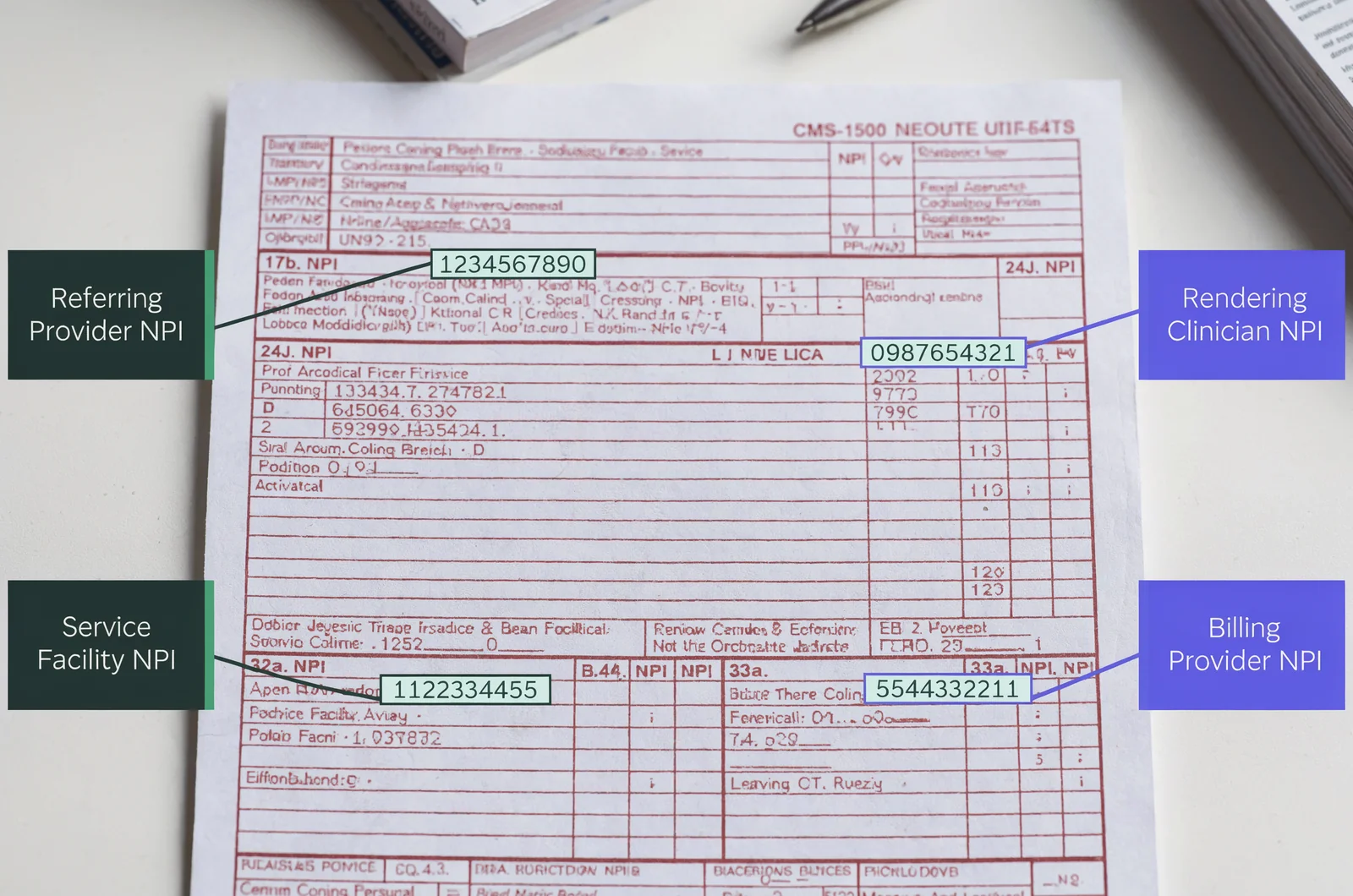
These questions do not require code books. They test whether you know where to place billing provider data, rendering clinician identifiers, referring physician qualifiers, diagnosis pointers, and prior authorization numbers.
The form contains 33 numbered blocks divided into patient demographics and billing details. Blocks 1 through 13 identify the patient, insured policyholder, secondary coverage, and assignment of benefits. Blocks 14 through 33 contain clinical encounter data, charges, provider signatures, and billing identifiers.
Worked Example: CMS-1500 Field Placement
A medical practice submits a professional claim for a minor surgical procedure performed in an outpatient clinic. Where should the biller enter the National Provider Identifier (NPI) of the clinician who performed the procedure?
A. Box 17b
B. Box 24J
C. Box 32a
D. Box 33a
Correct Answer: B
Rationale: Box 24J on the CMS-1500 claim form contains the rendering provider NPI for each service line. Box 17b reports the NPI of the referring or ordering physician. Box 32a reports the NPI of the service facility location where services were rendered. Box 33a reports the billing provider NPI, which represents the legal entity or group practice receiving payment.
Box 17b: Referring or ordering provider NPI
Box 24J: Rendering provider NPI on individual service lines
Box 32a: Service facility location NPI
Box 33a: Billing provider NPI for the corporate group
High-Yield Form Fields to Memorize
Memorizing the CMS-1500 layout is an efficient way to earn straightforward points. Pay close attention to Box 24, which contains six service lines divided into split fields. The top unshaded area reports local qualifiers or supplemental identifiers, while the bottom shaded area carries the actual CPT code, modifier, and rendering NPI.
You need to know the difference between Box 14 (date of current illness, injury, or pregnancy) and Box 15 (other date, such as accident date or date of initial treatment). Learn the meaning of qualifier codes like DN for referring provider, DK for ordering provider, and DQ for supervising provider in Box 17.
Diagnosis pointers in Box 24E link procedural codes to the diagnoses listed in Box 21. Up to 12 diagnosis codes can appear in Box 21 using letter references A through L. In Box 24E, the biller enters the letter pointing to the specific condition justifying that individual service line. Entering an actual ICD-10 code instead of a letter reference causes clearinghouse rejections.
Coding Accuracy and Modifier Crosswalk Items
The CPB is not an exhaustive coding exam like the CPC, but billers must understand how diagnostic and procedural codes interact. AAPC tests whether you can spot coding discrepancies that trigger claim rejections, justify medical necessity, and append billing modifiers correctly.
These questions require opening your ICD-10-CM, CPT, and HCPCS Level II code books. The goal is rarely to find an obscure code. Instead, you evaluate whether a code pair makes sense on a billing claim. Billers must determine whether diagnosis codes provide sufficient clinical justification for the procedural codes submitted. If a claim reports an MRI of the knee paired with a diagnosis of tension headache, the claim fails medical necessity checks.
Worked Example: Modifier Selection Item
A patient established with a cardiology practice visits the clinic for a scheduled follow-up on stable hypertension. During the visit, the patient mentions a new, painful lesion on their forearm that appeared two days earlier. The physician evaluates the lesion, makes a diagnosis of an inflamed epidermal cyst, and performs an unscheduled surgical excision during the same visit. The practice bills established patient office visit code 99214 and excision code 11402. How should the biller append modifiers to secure reimbursement for both services?
A. Append modifier 59 to code 99214.
B. Append modifier 25 to code 99214.
C. Append modifier 51 to code 11402.
D. Append modifier 76 to code 11402.
Correct Answer: B
Rationale: Modifier 25 identifies a significant, separately identifiable evaluation and management (E/M) service performed by the same physician on the same day as a minor surgical procedure. It is appended to the E/M code (99214), not the procedure. Modifier 59 is used on procedural codes to indicate distinct procedural services, not on E/M codes. Modifier 51 indicates multiple procedures, but commercial and Medicare payers use automated fee schedules rather than requiring manual submission of modifier 51. Modifier 76 denotes a repeat procedure by the same physician on the same date.
Code Book Navigation on Test Day
When facing coding questions on the CPB, check whether the question tests coding rules or billing rules. Billers must know National Correct Coding Initiative (NCCI) edits, Medically Unlikely Edits (MUEs), and modifier usage:
- Modifier 25 applies to Evaluation and Management services performed on the same date as a minor procedure.
- Modifier 59 indicates distinct procedural services that are not normally billed together.
- Modifiers RT and LT indicate anatomical location on bilateral structures like arms, legs, or eyes.
- Modifier 26 indicates the professional component of a diagnostic service, while modifier TC designates the technical component.
Avoid spending excessive time looking up common definitions. Use your book index efficiently, verify parenthetical instructions beneath CPT codes, and confirm that your diagnosis code supports medical necessity for the billed procedure.
Pay close attention to NCCI column 1 and column 2 edit tables. Column 2 codes bundle into column 1 codes unless a valid modifier like 59 or XE, XP, XS, or XU is allowed by the modifier indicator. If the modifier indicator is 0, the codes cannot be billed together under any circumstances. If the indicator is 1, an appropriate modifier bypasses the edit when clinical documentation supports distinct services.
Payment Posting, Remittance Advice, and Denial Management
A biller's primary responsibility starts after the claim leaves the clearinghouse. Remittance advice and denial questions test your ability to interpret an Explanation of Benefits (EOB) or Electronic Remittance Advice (ERA), recognize standard denial codes, and file appeals.
These questions present claim adjustment data and ask you to calculate patient financial responsibility, write-offs, and next steps for recovery. You must calculate accounts receivable aging metrics, days in accounts receivable, and net collection ratios. Mathematical questions on the CPB require straightforward arithmetic, but they demand accurate accounting logic.
Worked Example: Remittance Calculation Item
A clinic bills code 99213 with a charge of $150 to a commercial payer. The remittance advice arrives with the following breakdown:
- Allowed Amount: $100.00
- Paid Amount: $0.00
- Group Code and Reason Code: PR-1 with an amount of $100.00
- Group Code and Reason Code: CO-45 with an amount of $50.00
What action should the medical biller take upon receiving this remittance advice?
A. Appeal the claim with medical records because the insurance company paid nothing.
B. Write off the entire $150 balance as an uncollectible bad debt.
C. Post a contractual adjustment of $50.00, post $0.00 insurance payment, and bill the patient $100.00 for their unmet deductible.
D. Resubmit the claim with modifier 25 to force payment of the $100 allowed charge.
Correct Answer: C
Rationale: Code CO-45 indicates a contractual provider write-off based on the participating provider agreement; this $50 cannot be billed to the patient. Code PR-1 indicates patient responsibility resulting from a deductible. The payer processed the claim correctly under the patient's benefit design: the practice must write off the contractual discount ($50) and invoice the patient for the allowed amount ($100) applied to their deductible. Filing an appeal or resubmitting the claim is unnecessary.
Contractual Adjustment: $50.00 (CO-45 non-billable provider write-off)
Insurance Payment: $0.00
Patient Responsibility: $100.00 (PR-1 patient deductible)
Total Balance Accounted For: $150.00
Action Steps for CARC and RARC Codes
To solve remittance questions quickly, familiarize yourself with Claim Adjustment Reason Codes (CARCs) and Remittance Advice Remark Codes (RARCs):
- Group Code CO (Contractual Obligation) protects the patient from balance billing; these amounts must be written off.
- Group Code PR (Patient Responsibility) denotes cost-sharing amounts that transfer to the patient statement.
- Group Code OA (Other Adjustment) indicates that the claim was reduced because another payer was involved or an administrative adjustment occurred without a contractual requirement.
- Common reason codes include PR-1 for deductible, PR-2 for coinsurance, PR-3 for copayment, CO-16 for missing claim information, and CO-97 for inclusive procedures.
When you see a CO code, never bill the patient unless a valid Advance Beneficiary Notice or financial waiver is on file.
Appeals processes represent another recurring topic in this domain. Recognize the difference between a simple claim correction and a formal appeal. If a claim was denied for a missing modifier or incorrect date of service, resubmit a corrected claim. If a claim was denied for lack of medical necessity or experimental treatment, file a formal written appeal accompanied by medical records and supporting clinical literature.
Multi-Page Case Analysis Questions
Case analysis items form the core of the CPB examination. According to the Health Exams' question count and duration guide, approximately 34 questions are built around detailed patient scenarios. Much like working through multi-layered scenario practice questions in other professional exams, complex billing prompts require methodical deconstruction.
These questions reflect real billing operations. You receive a complete packet of documentation: an encounter note, an operative report, a patient registration summary, a CMS-1500 claim form, or a prior remittance advice. You must synthesize this information to find errors, verify codes, and identify billing discrepancies.
Case questions often present a complete claim workflow from beginning to end. You must determine whether the patient's insurance was verified properly, whether precertification was obtained, whether the services were coded accurately, and how the resulting reimbursement or denial should be posted in the practice management software.
Worked Example: Comprehensive Billing Scenario
Review the following case documentation:
Patient Documentation:
- Patient: Sarah Jenkins, 48-year-old female
- Payer: Blue Cross Blue Shield PPO (Participating Provider)
- Date of Service: April 12
- Chief Complaint: Left knee pain and swelling after a fall
Physician Encounter Summary:
"Patient presents with left knee swelling. Focused exam reveals moderate effusion over the patella. Arthrocentesis performed under sterile conditions; 25 ml of synovial fluid aspirated. Depo-Medrol 40 mg injected into the joint space for pain management. Patient tolerated procedure well."
Claim Submitted:
- Line 1: 20610-LT (Arthrocentesis, major joint; with injection) - Charged $220.00
- Line 2: J1030 x 1 (Injection, methylprednisolone acetate, 40 mg) - Charged $45.00
- Line 3: 99213-25 (Office visit, established patient) - Charged $140.00
Remittance Advice Received:
- Line 1 (20610-LT): Allowed $180.00, Paid $144.00, PR-2 (Coinsurance) $36.00
- Line 2 (J1030): Allowed $40.00, Paid $32.00, PR-2 (Coinsurance) $8.00
- Line 3 (99213-25): Denied completely with code CO-97 (The benefit for this service is included in the payment/allowance for another service/procedure that has already been adjudicated).
Question: Why did the payer deny service line 3 (99213-25), and what is the appropriate follow-up action?
A. The payer requires modifier 59 on code 20610; resubmit the claim with corrected modifiers.
B. The physician note does not document a significant, separately identifiable evaluation and management service beyond the work inherent to the arthrocentesis; the biller must accept the denial and write off the charge.
C. The biller should bill the denied $140 charge directly to Sarah Jenkins.
D. The claim was denied because HCPCS code J1030 was billed with an incorrect unit count; correct the units to 4 and appeal.
Correct Answer: B
Rationale: Code 99213 was billed with modifier 25, which requires documentation of a significant, separately identifiable E/M service. The encounter note only describes the left knee assessment and the arthrocentesis procedure itself. The examination of the knee is part of the pre-procedure evaluation included in code 20610. Because the documentation does not support a separate service, modifier 25 was invalid. Because the provider participates with the payer and the denial code is CO-97, the practice cannot balance-bill the patient; the $140 charge must be written off.
Strategies for Multi-Document Scenarios
Case analysis questions test both your knowledge and your reading stamina. Use this structured approach to work through cases efficiently:
- Read the final question stem and answer choices before reading the chart.
- Note the specific service line, provider, or code mentioned in the stem.
- Scan the medical record specifically for that service line.
- Check payer participation status to confirm participating versus non-participating obligations.
- Review the remittance codes for CO versus PR designations.
Reading the question stem first prevents you from getting bogged down in operative notes or encounter details that have no bearing on the question being asked.
Interactive tool idea: CPB Case Time-Allocation Estimator. Candidates can calculate their case-study pacing buffer by entering their average reading speed, their targeted accuracy threshold (70 percent or higher), and the remaining question count. The tool calculates an optimal split between 45-second direct regulatory questions and 3-minute case document reviews.
Study Roadmap and Practice Strategy for the CPB
Preparing for the CPB exam requires deliberate practice rather than passive reading. Reading study guides cover to cover rarely builds the pattern recognition needed to analyze complex billing cases under strict time limits.
When you align your study schedule with the actual cpb exam format and question types, you avoid wasting study hours on content that will not appear on test day. Structuring your preparation around an official blueprint helps focus your efforts. A disciplined preparation plan, supported by AMBCI's Certified Professional Biller study guide, should include the following core components:
- Tab your code books thoroughly. Label sections for evaluation and management, surgery subheadings, modifiers, and diagnostic categories to save time during case evaluations.
- Create flashcards for CMS-1500 form fields. Practice box numbers, allowed qualifiers, and date formats until you can recall every box without looking at a diagram.
- Memorize primary remittance remark and reason codes, focusing on definitions for PR-1, PR-2, PR-3, CO-16, CO-45, and CO-97.
- Complete timed practice sets under realistic test conditions to build the focus required for a four-hour exam.
Structure your preparation across an eight-week timeline:
Week 1–2: Master CMS-1500 boxes, HIPAA privacy rules, and federal fraud statutes.
Week 3–4: Focus on commercial payer guidelines, Medicare parts, and Coordination of Benefits rules.
Week 5–6: Drill coding crosswalks, NCCI edits, and modifier applications using code books.
Week 7–8: Work through full-length case studies, remittance notices, and timed practice blocks.
To bridge the gap between reading billing textbooks and passing the exam, consider testing yourself on interactive platforms like ExamJungle. Its realistic exam simulator replicates the interface and pacing of actual certification tests. When you miss a question on an unclear remittance advice or an unfamiliar modifier, ExamJungle's AI tutor (Caesar AI) explains why the distractor was incorrect and generates similar practice scenarios on demand. This approach helps you understand the underlying billing mechanics rather than relying on memorization.
Clarifying Common CPB Testing Concerns
Are you allowed to bring electronic coding software or laptops into the exam?
AAPC prohibits electronic devices, personal laptops, tablets, and digital encoding software. Candidates must bring physical, printed paper editions of their CPT, HCPCS Level II, and ICD-10-CM code books. You can use any publisher edition, such as AAPC, AMA, or Optum 360, provided the books are current-year editions and do not contain loose papers or unattached notes.
What happens if you get stuck on a difficult case analysis question?
Mark the item and move forward immediately. Spending six or seven minutes trying to unravel a difficult operative report costs you points on easier recall questions later in the exam. Every question on the CPB carries equal point weight. Answer every quick compliance and CMS-1500 question first, then return to flagged case analyses during your remaining time.
How many questions can you miss and still pass the exam?
You can miss up to 40 questions and still pass. With 135 total questions and a 70 percent passing cutoff, you must score at least 95 correct answers. Focusing on accuracy across foundational domains like compliance, payer rules, and form completion provides a solid scoring buffer for the case analysis section.
Does the CPB exam test hospital facility billing forms like the UB-04?
The primary focus of the CPB is professional physician practice billing using the CMS-1500 form and the 837P electronic transaction format. While the curriculum introduces institutional billing and hospital reimbursement concepts like Diagnosis-Related Groups, the vast majority of form-based questions test professional clinic billing rather than UB-04 hospital claims.
Guides for Allied Health and Certification Exams