

Free CRCST Practice Test Checklist: 7 Study Resources
Kendra left her sterile processing shift on a Tuesday and opened her laptop to search “free crcst practice test.” She had six weeks until exam day. Two hours later she had 14 browser tabs open, three Quizlet sets that contradicted each other, and a growing knot in her stomach. That knot isn’t about a lack of free material — it’s about having no filter for what’s actually built to match the HSPA exam. This checklist is that filter.
A good crcst exam practice test doesn’t just quiz you on trivia. It forces you to apply the same domain thinking you’ll need inside a Prometric testing room: interpreting an IFU, picking the right sterilization parameter when the steam indicator fails, deciding whether a tray can move from decontam to prep. The seven resources below are the ones that get closest to that — and I’ll show you how to weave them into a study plan that doesn’t leave you memorizing flashcard answers without understanding why an item got rejected from the OR.
What You’re Up Against on Test Day
Before sorting through free practice tools, it helps to see the exam for what it actually is. The CRCST exam blueprint from HSPA lays out six domains: Cleaning and Decontamination, Preparation and Packaging, Sterilization, Storage and Distribution, Quality Assurance, and Departmental Considerations (including regulations and standards from FDA, CMS, AAMI, and AORN) — exactly the categories outlined in the Exam Content Outline. You’ll sit for 150 multiple-choice questions at a Prometric center, with 125 scored and 25 unscored pretest items, and you get three hours to finish.
Think about that pacing. It’s roughly 72 seconds per question, and many items include layered scenarios — a surgical tray layout, an autoclave printout, a biological indicator result — that demand more than a quick recall of a textbook term. The pass rate has been slipping. HSPA’s public numbers show about one in three candidates walked out without a passing score in recent testing windows, so treating the CRCST as a vocabulary test is the fastest way to donate $140 to a retake.
Free practice questions can help — but only when they mimic the structure and rigor of the real test. A 10-question quiz that only asks “What temperature does a prevacuum sterilizer reach?” won’t prepare you for a question that shows a load record from cycle 3, asks you to identify the excursion, and then choose the corrective action according to AAMI ST79. That’s the difference between a time-waster and a genuine rehearsal.
The Certified Registered Central Service Technician certification is the industry’s entry-level credential for sterile processing professionals, and HSPA builds the exam to test applied knowledge — interpreted IFUs, traffic-flow logic, immediate-use steam sterilization benchmarks, and documentation trails, not rote memorization.
Seven Free CRCST Practice Resources That Add Real Value
The free practice landscape splits into two camps: resources that are basically glorified multiple-choice quizzes cut from an outdated textbook, and resources that actually train you to read exam-style scenarios. This list includes both, but I’ve ranked them by how close they get to the real thing — not by how many questions they throw at you.
1. The Sterile Guy — Free CRCST Practice Tests
A staple in SPD Facebook groups, The Sterile Guy’s free question bank covers all six domains and gets updated when HSPA releases new content outlines. Questions often include a brief “why this answer” note, which helps you spot reasoning gaps without clicking into a separate explanation page. The downside: no timed mode, so you won’t feel 72-seconds-per-question pressure here. Use it early, not in the last week.
2. OpenExamPrep — 600+ Free CRCST Practice Questions
OpenExamPrep’s free set is one of the larger collections publicly available, and the questions are tagged by domain. The real advantage is the AI tutor that can walk you through why a wrong answer is wrong — useful when you’re stuck on a concept like wet pack causes in sterilization. However, the free tier limits how many AI explanations you can access in a day, so plan to stretch this across several sessions.
3. Practicetestgeeks — CRCST Practice Test July 2026
This page delivers a full-length free practice test with instant scoring, and it’s one of the few free options that mirrors the exam’s 125-scored-question length. The explanations reference specific AAMI standards and HSPA domain tags, so you can map your weak spots directly to the content outline. The trade-off: the page is ad-heavy, which can break your concentration during a timed run. Still, as a baseline diagnostic a month out, it’s one of the stronger free tools. Many candidates take it cold, then use the results to build the rest of their study calendar, as the 💯 CRCST Practice Test 2026 page suggests.
4. SterileTechPrep — Free CRCST Exam Questions (9th Edition)
SterileTechPrep’s free questions are designed to match the latest HSPA exam edition, and the platform adds a few scenario-based items — the kind that give you a tray photo or load log and ask you to identify the error. Free access is limited to a rotating sample each visit, so it’s not a grindable question bank. Use it as a “spot check” twice a week to see if your scenario-reading speed is improving.
5. Quizlet — The Ultimate IAHCSMM CRCST Practice Test Quiz
Community-built Quizlet sets can be hit or miss, but the popular “Ultimate IAHCSMM CRCST Practice Test” deck gets consistently positive feedback in sterile processing forums for covering niche regulatory trivia (think OSHA formaldehyde exposure limits or CDC hand-hygiene guidelines). The risk: some older decks still reference retired HSPA standards, so check the “last updated” date before drilling. Flashcards are helpful for regulation recall, but they don’t build the decision-chain thinking that the exam rewards, so treat this as a supplement, not a primary prep tool.
6. VoltExam — CRCST Sterile Processing Exam Prep (Free Web Preview)
VoltExam’s free preview gives you a handful of questions across each domain with parameter references baked into the explanations — steam times, pressure ranges, biological indicator read-out windows. If you’re the kind of learner who wants to see the exact specs listed next to every answer, this is a good reference-style practice. The full version is paid, but even the free preview can help you memorize the parameter tables that show up in prep-and-packaging and sterilization sections.
7. YouTube — CRCST Practice Test Walkthroughs
Several channels (StudywithPracticeTest and others) publish 30-question mock exams with voiced-over explanations. Listening to someone talk through why option B is wrong while you’re commuting or folding instrument count sheets can reinforce reasoning patterns you’ll need on test day. The limitation: video quizzes are passive — you’ll want to pause, answer first, then resume, rather than just letting the host do the thinking for you.
A Study Plan That Puts Free Practice to Work
Having seven resources isn’t the same as having a plan. Most candidates collect a pile of links, do a few random quizzes, and arrive at exam day with no honest picture of their weak domains. Here’s a simple three-phase approach that turns free practice into a measurable readiness signal.
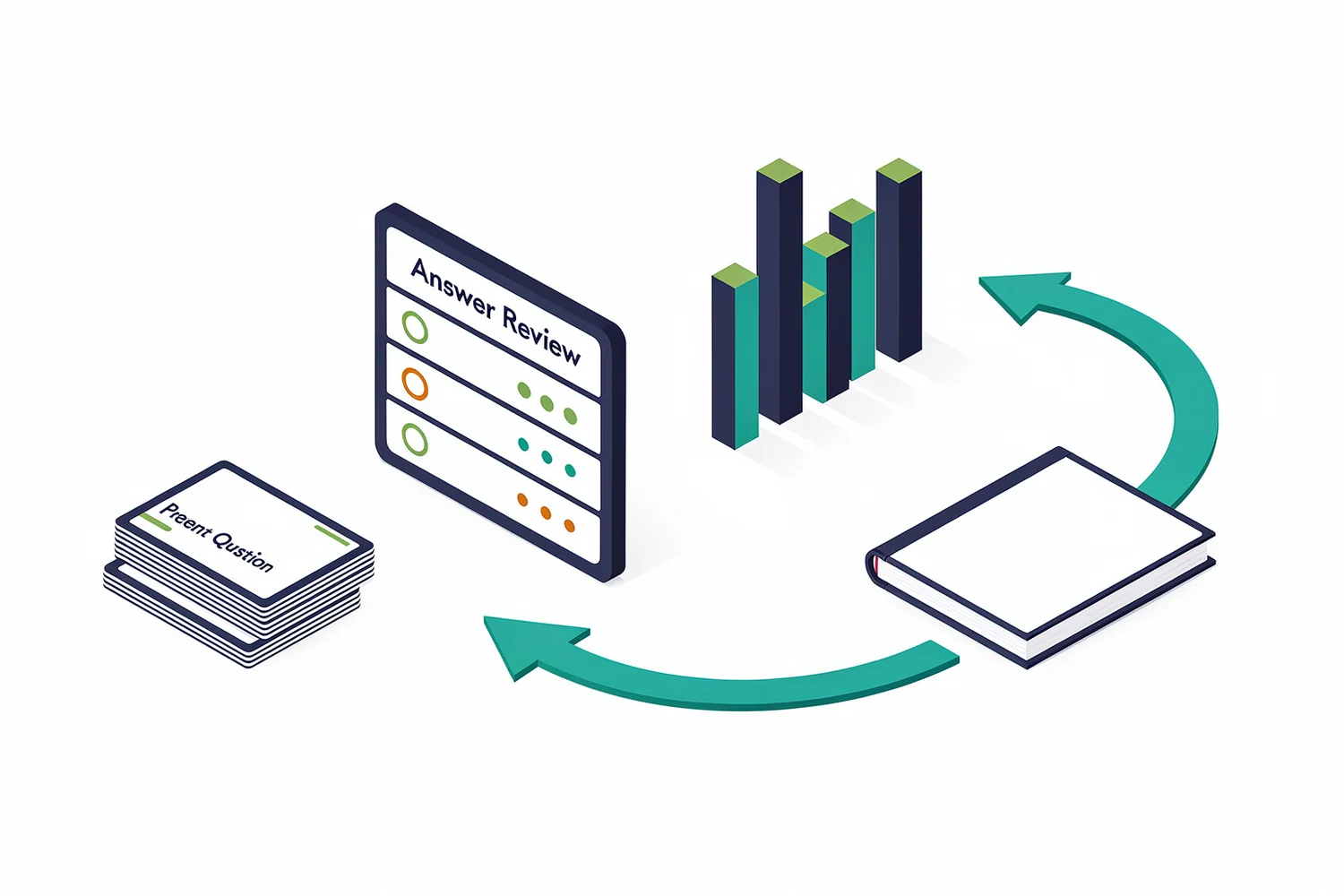
Phase 1: Baseline Diagnostic (Week 1)
Pick one full-length resource — Practicetestgeeks or The Sterile Guy’s longer set — and take it under timed conditions. Use the results to produce a domain hit list: if you scored under 70% in Quality Assurance, that’s your priority for the next phase. Write down the exact topics that tripped you up (e.g., IUSS documentation requirements, tray audit benchmarks), not just the domain name. This is where many candidates realize they’ve been over-studying decontamination while ignoring distribution and storage, which can show up heavily in the exam’s later sections.
Phase 2: Targeted Domain Drills (Weeks 2–4)
Rotate through the remaining resources, but only within your weak domains. If Cleaning and Decontamination is your trouble spot, you might start a session with 10 OpenExamPrep questions tagged “Cleaning,” then switch to the VoltExam free preview to drill parameter recall, then end with a Quizlet round on SDS and chemical safety. Keep a simple log: domain, resource used, score, and one insight. After three weeks, that log will tell you exactly when you crossed the readiness line — or if you’re still wobbling.
Phase 3: Mixed-Rehearsal Weeks (Weeks 5–6)
Now mix all six domains in every session, just like the real exam. Use the SterileTechPrep rotating sample as a surprise element and supplement with a YouTube walkthrough once or twice a week as a low-stakes way to stay sharp. If you can hit the 70-75% range consistently across mixed sets, you’re likely ready to schedule your exam — or to move up to a paid practice exam that adds detailed performance analytics.
Throughout this process, you might notice that free tools give you exposure but rarely give you depth. There’s a reason many successful candidates eventually supplement with a structured practice test bank. The decision often comes down to whether you need more quantity of questions or more quality of feedback — a tradeoff I’ve explored in more detail when comparing free vs paid A+ practice tests. The same logic applies here: free tools are great for volume and baseline building, but they won’t simulate the timed pressure of a proctored exam or explain why you keep missing the same decontam scenario three weeks in a row.
And if you thrive on checklist-style prep, you might find the approach in this study checklist for a different certification adaptable to your CRCST calendar — the underlying principle of mapping domains to weekly drills works across any exam blueprint.
How to Spot a Free Practice Test That’s Wasting Your Time
Not every free CRCST question set deserves a spot in your study rotation. Here’s my quick four-point litmus test to weed out the junk before you invest an hour.
Check the source references — If a question mentions “per AAMI ST79,” does the explanation actually quote the standard, or does it just repeat the same sentence you’d find in a 2015 textbook? Real exam questions are anchored to current guidelines, and a practice set that can’t name its sources probably isn’t aligned to the current HSPA outline.
Watch for obvious answer patterns — If every third question is “All of the above” or if the wrong answers are laughably off-topic (“Sterilize by humming loudly?”), you’re not training test-day discernment. The exam’s distractors are designed to be plausible, so practice questions should make you pause, not snort.
Beware of outdated regulation numbers — Any practice set that still asks about “NFPA 99 from 2012” without the current edition or references “IAHCSMM” instead of HSPA (the organization rebranded in 2023) is recycling old content. One or two stale questions can plant wrong numbers in your head that cost you points.
Value scenario length over trivia count — Short, single-fact questions (“What color is the biohazard label?”) are useful for Quizlet drills only. If a free resource leans heavily on those, it’s not building the multi-step reasoning you need. Look for resources where at least a third of the questions include a mini-case — “A tech finds a wet pack in the sterilizer at 8:15 a.m. The load was run overnight. What should the tech do first?”
When you apply this filter, you’ll probably cut your tab count from fourteen to four or five — and that’s exactly the point. A smaller set of high-signal questions beats a sprawling pile of noise every time.
Questions Sterile Processing Candidates Ask About Practice Tests
How soon before exam day should I start using free practice tests? Start your baseline diagnostic at least six weeks out. That gives you a full month to drill weak domains and still leaves two weeks for mixed rehearsal without rushing. If your test date is closer, compress the phases but don’t skip the baseline — even a two-week timeline needs a clear starting score.
Can I pass the CRCST using only free practice tests? Some candidates do, especially if they’re already working in an SPD and getting hands-on experience with the equipment daily. But for most people, free tools don’t provide enough high-fidelity scenario practice. They’re excellent for building familiarity and spotting knowledge gaps; pairing them with a structured paid resource that mimics the Prometric interface often makes the difference between a bare pass and a confident score.
How do I know when I’m ready to schedule the exam? Two signals: you’re scoring consistently above 75% on mixed-domain practice sets that include scenario questions, and you can explain — out loud — why each wrong answer in a scenario is wrong, not just why the right one is right. If you freeze when someone asks “why not B?” on a quality assurance item, you still have reasoning gaps to close.
Are the free resources on the HSPA website enough? HSPA provides a content outline and sample questions, but the sample set is very small. Use it to confirm you understand the style of the exam, not as your main practice volume. Think of it as the reference standard: if a third-party freebie feels nothing like HSPA’s samples, drop it.
What’s the one mistake you see candidates make with free practice tests? They take the same test three times, memorize the answers, and then believe they’ve mastered the domain. Spaced repetition across different question sources is far more effective than repeating a single set. If you’ve seen a question before, the score it gives you that day is no longer diagnostic — it’s just a memory check.
- Free vs paid A+ practice tests — what actually prepares you
- How to build a study checklist that maps exam domains to weekly goals
- EC-Council CEH Exam Voucher Price Hike: New 2026 Fees & Effective Date
Start a free practice exam on ExamJungle