
Free or Paid A+ Practice Tests? What Actually Prepares You
The $253 exam fee is already on your credit card. Now you're staring at dozens of practice test options, and the real question hits: will free questions get you ready, or are you throwing away money on a retake?
Most A+ candidates face this exact fork in the road. Free resources promise zero risk. Paid platforms promise deeper preparation. But "free" can cost you $253 if the questions don't match what CompTIA actually asks. And "paid" only helps if the money buys something textbooks and videos can't.
This comparison breaks down how free and paid A+ practice tests differ on the dimensions that matter for passing: question fidelity to current exam objectives, explanation depth that fixes knowledge gaps, performance analytics that show where you're actually weak, and the test-day simulation that calms nerves. By the end, you'll know which investment—time, money, or both—matches your study stage and budget.
What CompTIA Actually Tests (and Why Practice Questions Must Match)
The A+ certification requires passing two exams. Current versions are 220-1101 (Core 1) and 220-1102 (Core 2), though CompTIA has begun rolling out the V15 series with 220-1201 and 220-1202. Per the A+ Core Certification V15 (New Version), Core 1 covers hardware, networking, mobile devices, and virtualization. Core 2 covers operating systems, security, software troubleshooting, and operational procedures. Each exam allows up to 90 questions mixing multiple-choice, drag-and-drop, and performance-based formats.
Here's where many free practice tests stumble. CompTIA updates objectives every three years, and question styles evolve with them. The 220-1002 objectives published in CompTIA's official PDF differ measurably from the 220-1102 and 220-1202 versions. Free question banks often lag behind these updates, sometimes by years. A question drilling BIOS settings from 2019 won't help you troubleshoot Windows 11 BitLocker issues on test day.
Paid platforms typically refresh content faster, but "paid" alone doesn't guarantee alignment. The key signal is whether the provider publishes which exam version their questions target and how recently they updated. If you can't find that information, the questions might be training you for an exam that no longer exists.
How Free A+ Practice Tests Actually Work
Free practice tests fall into three categories, and their usefulness varies dramatically.
Vendor-provided free samples are the gold standard for free resources. CompTIA offers A+ Core (V15) Practice Questions directly on their site. These questions match current objectives, use authentic phrasing, and include explanations. The catch: volume. CompTIA typically provides 10-20 sample questions per exam. That's enough to familiarize yourself with format, not enough to identify weak domains or build test endurance.
Community question banks aggregate user-contributed content. Sites like Exam Compass and forum threads on Reddit's r/CompTIA offer hundreds of free questions. The trade-off is quality control. Some questions are outdated, some explanations are wrong, and some "correct" answers contradict CompTIA's own documentation. These banks work best for quick drilling when you already know the material and just need repetition.
YouTube walkthroughs and PDF dumps (the legitimate kind, not braindumps) provide question exposure without interactive testing. They're useful for seeing how experienced technicians think through problems. They're less useful for simulating the timed pressure of the real exam, where you have roughly 90 seconds per question.
Marcus, a help desk technician I spoke with, used free questions exclusively for his first A+ attempt. He scored 82% on every free practice test he took. On exam day, he faced performance-based questions he'd never seen before and finished Core 1 with a 655—five points below passing. His free prep had trained him on multiple-choice recognition, not on thinking through hands-on scenarios under time pressure.
What Paid A+ Practice Test Platforms Deliver
Paid platforms typically charge $30-$100 for comprehensive A+ question banks. The value proposition rests on four features that free resources rarely match.
Larger, curated question pools let you retake tests without memorizing answers. A 500-question bank with randomized delivery prevents the false confidence of seeing the same 50 questions repeatedly. More importantly, paid platforms usually organize questions by exam objective domain, so you can target weak areas specifically rather than hoping random practice hits them.
Detailed explanations with remediation separate memorization from understanding. The best paid platforms explain why the correct answer works, why each distractor is wrong, and which objective the question maps to. Some, like ExamJungle's Caesar AI, go further: you can ask for expanded explanations, harder variants of the same concept, or clarification on specific technical details. This matters because CompTIA tests conceptual understanding, not just fact recall. Two questions might test the same TCP/IP concept but frame it in entirely different scenarios.
Performance analytics and progress tracking reveal patterns you'd miss manually. A dashboard showing you consistently miss subnetting questions but ace hardware troubleshooting tells you exactly where to spend final review hours. Without analytics, you're guessing at your weaknesses based on gut feel.
Timed exam simulation builds the mental stamina the real test demands. The A+ exams run 90 minutes. Free practice often happens in distracted bursts—five questions during lunch, ten before bed. A full-length timed simulation forces you to maintain focus, manage pacing, and handle the psychological pressure of watching the clock. This is where paid platforms earn their money for anxious test-takers.
Sarah, a career changer from retail, paid $60 for a practice test platform after failing Core 1 on her first try. The timed simulations revealed she spent four minutes on early questions, leaving her rushed on performance-based scenarios at the end. Three weeks of paced practice fixed her timing. She passed Core 1 with a 740 and Core 2 with a 712.
The Hidden Cost of "Free"
Free practice tests carry costs that don't show up on your credit card statement.
Time cost is the biggest. Outdated questions train obsolete knowledge. Wrong explanations cement misconceptions. When Marcus retook Core 1 after his failure, he spent two weeks unlearning incorrect information from a free question bank before he could productively study correct material. Those two weeks cost him study momentum and delayed his job search.
Confidence calibration suffers with low-quality questions. Free tests that are too easy create false security. Free tests that are arbitrarily hard create unnecessary anxiety. Neither prepares you accurately for the real exam's difficulty curve. CompTIA designs questions with specific psychometric properties—paid platforms that license or reverse-engineer these properties provide more accurate readiness signals.
Format familiarity gaps are expensive. The A+ exam includes performance-based questions where you interact with simulated operating systems, configure network settings, or troubleshoot hardware in a virtual environment. Free multiple-choice practice doesn't touch these. Walking into the exam without having performed a timed, simulated performance-based question is like showing up for a driving test having only read the manual.
That said, free resources aren't worthless. They're genuinely useful at specific study stages: early concept exposure, quick mobile review, or final warm-up questions the day before. The mistake is relying on them as primary preparation for a $253 exam that determines your job prospects.
Decision Framework: When Free Works, When Paid Wins
Your optimal mix depends on where you are in your study cycle and what you're trying to improve.
| Your Situation | Best Approach | Why |
|---|---|---|
| Just starting, building concept familiarity | Free vendor samples + textbook study | Low cost, authentic questions, enough to learn format |
| Identified weak domains after initial study | Paid platform with objective-targeted practice | Focused drilling where you actually need it |
| Scoring 80%+ on practice but nervous about test day | Paid timed simulations | Builds stamina and reduces anxiety through familiarity |
| Failed once, retaking | Paid platform with analytics + explanation depth | Fixes specific gaps, not just more random questions |
| Tight budget, strong self-assessment discipline | Free community banks + strict weak-area tracking | Possible with rigorous error logging, but high effort |
The pattern is clear: free resources excel at early exposure and supplemental review. Paid platforms earn their cost when you need targeted improvement, accurate readiness measurement, or psychological preparation for exam conditions.
What to Look for in Any Practice Test (Free or Paid)
Regardless of price, evaluate practice tests against these criteria before trusting your preparation to them.
Version alignment comes first. The provider should explicitly state which exam version their questions target—220-1101, 220-1102, 220-1201, or 220-1202. "A+ practice questions" without a version number is a red flag. CompTIA's A+ Core Certification V15 (New Version) documentation shows how significantly objectives shift between versions.
Explanation quality matters more than question count. A thousand questions with "B is correct because it is correct" explanations teach less than a hundred questions with detailed reasoning. Look for explanations that cite official objectives, explain distractor logic, and connect to broader concepts.
Performance-based question simulation is increasingly critical as CompTIA weights these higher. Even basic drag-and-drop or command-line simulation beats pure multiple-choice for preparation. Ask whether the platform includes these before purchasing.
Update transparency indicates maintenance quality. When did the provider last refresh their question bank? How do they incorporate CompTIA's periodic objective updates? Providers that don't answer these questions publicly may be selling stale content.
For Core 1 specifically, you can find targeted practice at ExamJungle's 220-1101 practice test or the newer 220-1201 practice test. Core 2 candidates have parallel options for 220-1102 and 220-1202.
How to Combine Free and Paid for Maximum Efficiency
The most cost-effective approach uses both strategically rather than treating them as either/or.
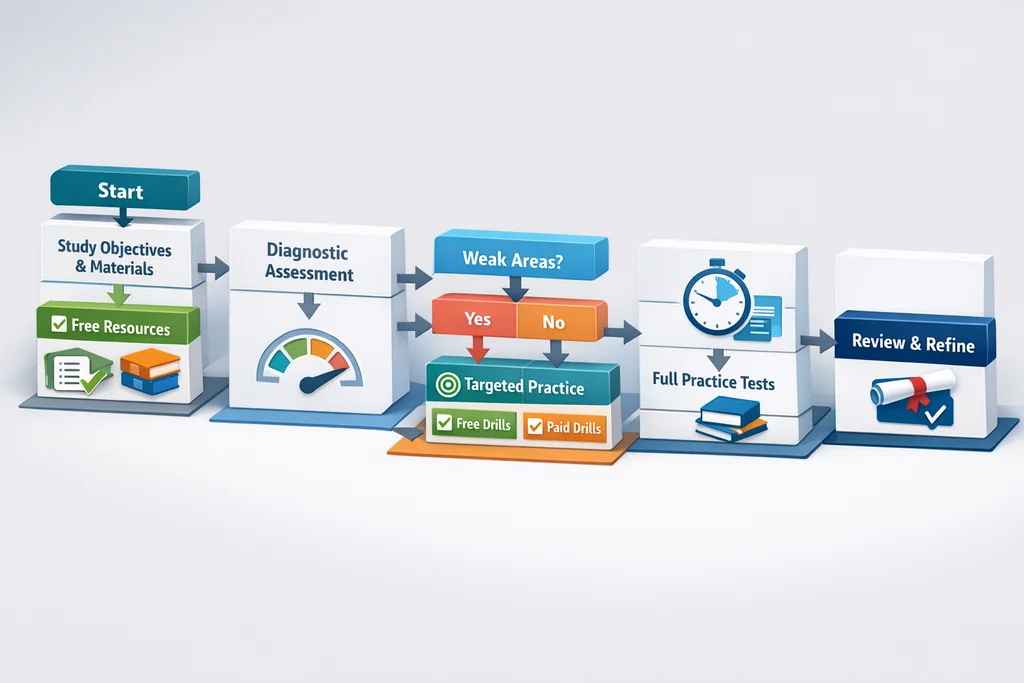
Phase 1: Foundation (weeks 1-3)
Study official objectives and textbook material. Use free vendor samples sparingly—just enough to understand question format. Don't worry about scores yet. Focus on learning.
Phase 2: Assessment (week 4)
Take one full paid practice exam under timed conditions. Use analytics to identify your three weakest objective domains. This diagnostic is worth the platform cost alone; it prevents wasting time on material you already know.
Phase 3: Targeted improvement (weeks 5-7)
Drill weak domains using paid platform questions with detailed explanations. Supplement with free community questions for additional repetition on specific topics. Log every error with the concept tested, not just the correct answer.
Phase 4: Simulation and readiness (week 8)
Take 2-3 full timed simulations on the paid platform. Your scores should trend upward and stabilize above the passing threshold (typically 700 on CompTIA's 100-900 scale). Use free vendor questions for light review two days before the exam—familiar, confidence-building material.
This phased approach spends money where it matters most: accurate diagnosis, targeted improvement, and realistic simulation. Free resources fill gaps without requiring premium access for every study hour.
ExamJungle's Approach: What Paid Looks Like with AI Tutoring
Most paid platforms stop at explanations. A smaller subset adds adaptive features that personalize your study.
ExamJungle's model combines timed exam simulation with per-question AI tutoring through Caesar AI. When you miss a subnetting question, you can ask Caesar to explain the binary math differently, generate a harder variant testing the same concept, or walk through why each distractor fails. This targets the fourth pain point most candidates face: understanding why an answer is correct, not just memorizing that it is.
The platform also tracks performance across attempts, showing whether you're improving on weak domains or just getting lucky with question randomization. For candidates who've failed once and need precise diagnosis, this granularity matters more than another 500 generic questions.
For A+ specifically, ExamJungle offers practice tests aligned to current exam versions. The 220-1101 practice test and 220-1201 practice test cover Core 1 hardware and networking objectives. Core 2 operating systems and security content is available through the 220-1102 and 220-1202 practice tests.
Making the Final Call
Your decision ultimately hinges on two variables: your confidence in self-diagnosing weaknesses, and your tolerance for retake risk.
If you're disciplined at logging errors, identifying patterns, and finding authoritative explanations for concepts you don't understand, free resources plus a single paid diagnostic exam might suffice. You'll spend more time curating your study but less money.
If you prefer structured guidance, need help understanding why answers are wrong, or get anxious about exam conditions, a paid platform with analytics and simulation pays for itself if it prevents even one retake. At $253 per exam attempt, a $60 practice platform breaks even if it improves your pass probability by just 24%.
The candidates who struggle most are those who assume all practice questions are equivalent. They're not. The gap between a 2019 free question bank and a current, objective-aligned, explanation-rich practice platform is the gap between recognizing an answer and understanding a concept. CompTIA tests the second.
FAQ
How many practice questions should I complete before the real exam?
There's no magic number. Quality and coverage matter more than volume. A candidate who thoroughly understands 200 well-explained questions across all objective domains is better prepared than one who speed-drills 1,000 without error analysis. Most successful candidates report 300-500 quality questions with detailed review.
Can I pass A+ using only free practice tests?
Possible, but risky. Free vendor samples are authentic but too few for comprehensive coverage. Community banks are numerous but variable in quality. Candidates with strong textbook preparation and excellent self-assessment discipline sometimes succeed with free resources alone. Those who struggle with test anxiety or specific technical domains usually need paid structure.
How do I know if a practice test matches the current exam version?
Check the provider's documentation for explicit version numbers (220-1101, 220-1102, 220-1201, or 220-1202). Verify that performance-based questions are included if the exam version uses them. Cross-reference sample questions against CompTIA's published objectives for that version. If the provider won't specify their target version, assume misalignment.
What's the difference between a practice test and an exam simulator?
A practice test is a set of questions, often untimed, focused on learning. An exam simulator replicates test-day conditions: strict timing, randomized question delivery, and interface matching the real exam. Simulators build psychological readiness; practice tests build knowledge. Both have roles in preparation.
When should I take my first full practice exam?
After you've completed initial study of all objective domains, typically 3-4 weeks into preparation. Taking it too early wastes a diagnostic opportunity and creates discouragement. Taking it too late leaves insufficient time for targeted improvement. Use the results to guide final weeks of study, not to predict your score.
Further Reading