HESI Exam Practice Questions: Free vs Paid Prep Compared
You typed a quick search for hesi exam practice questions and got pages of results — free tests, paid courses, YouTube walkthroughs, Quizlet decks. It feels like you could study for weeks without spending a dollar. But nursing schools don't hand out admission letters for effort; they look at your HESI A2 score, and many programs demand at least 75–80% per section. So the real question isn't whether you can find free questions. It's whether those questions teach you to apply knowledge under a clock, show you why an answer is correct, and reveal exactly where you're weak before test day.
This comparison works through what separates the free HESI practice question landscape from paid prep that costs anywhere from a one-time $39 to a monthly subscription. By the end, you'll know which path matches your study style, time budget, and score target.
What the HESI A2 Actually Demands from Your Prep
Before comparing free and paid resources, it helps to understand what the exam itself is measuring. The HESI A2 (Admission Assessment) is built by Elsevier and administered at nursing and allied health programs. It can include up to eight sections: Math, Reading Comprehension, Vocabulary, Grammar, Biology, Chemistry, Anatomy & Physiology, and Physics. Your specific program decides which sections you take, and it also sets the minimum score per section — not just a composite.
That matters because each section tests different cognitive demands. Math is heavy on ratios, conversions, and basic algebra under a strict timer. Reading requires you to extract main ideas and inferences from passages you've never seen. Anatomy & Physiology asks you to map function to structure and recognize interdependencies, not just recall names.
The HESI A2 covers up to 8 sections; your program picks which you take, with academic sections running roughly 55 questions each and science sections around 30 each. — Free HESI A2 Practice Test 2026 | 310 Questions
Effective practice question sets mirror that mix: they throw you into a timed environment, vary difficulty within a section, and explain each answer in enough depth that you learn the underlying concept, not just the correct letter. A random pile of vocabulary multiple-choice won't build that skill unless it includes the "why" and a way to track progress across days.
Those are the criteria we'll use to evaluate the free and paid paths.
Free HESI Practice Questions: Strengths and Hidden Gaps
Free resources are everywhere, and they do solve one problem right away: they get you started. You can pull up a Free HESI A2 Practice Test from NurseHub right now and work through 50 math questions to see where you stand. Mometrix offers a 310-question free practice test that covers the core sections. Union Test Prep and Career Employer have free banks with hundreds of questions and lightweight study guides. Quizlet is full of user-made HESI A2 flashcards.
These free sources share a few real strengths:
- Zero cost. If money is tight, you can get a broad initial assessment without spending anything.
- Instant baseline. A diagnostic quiz immediately flags topics you need to review, like dosage calculations or cell biology.
- No commitment. You can sample multiple styles and find what clicks — text, video, or quiz — before buying.
But here's where free practice questions tend to fall short for students who need to move from a 70 to an 85 per section.
Explanations are thin or missing. Many free tests tell you that you chose the wrong answer but don't walk through the reasoning. NurseHub's free diagnostics, for instance, are designed to "pinpoint your strengths and weaknesses" so you can focus study time, but the deeper answer explanations and full course content sit behind a paid plan. Mometrix's free test gives you a starting point; the detailed review and video lessons are part of their paid course. A Quizlet deck might have no explanations at all.
Performance tracking fades between sessions. Most free question banks don't save your results, show you improvement over time, or highlight your mistake patterns by subsection. You might ace a free grammar quiz today and forget which constructions you missed three days later. That makes it harder to allocate study hours to your actual weak areas.
Question fidelity varies. Elsevier periodically updates the HESI A2 question pool and formats. Free tests may not refresh at the same cadence, and some include questions that are either far easier or far harder than the real exam. You can build false confidence or unnecessary panic.
Limited full-length simulation. A handful of 50-question quizzes doesn't prepare you for the mental fatigue of a 3-to-5-hour test with multiple sections back-to-back. The real exam tests pacing as much as knowledge, and free resources rarely give you that pressure cooker.
For someone who just needs a quick readiness check, free diagnostics are a smart first move. But for a person who's failed the HESI once already, or whose program cuts applicants with a section score below 80, the gaps in free prep become expensive.
Who Offers the Best Paid HESI A2 Prep?
Paid HESI prep flips the economics: you're buying time-to-competence, deeper explanations, and a more faithful exam simulation. The market splits roughly into one-time purchase question banks and subscription platforms that bundle video courses, study guides, and tutoring.
BoostPrep HESI A2 Prep Course
hesi prep course takes the one-time-purchase approach. For $39 (Core) or $59 (Pro), you get access to a bank of over 2,800 practice questions, each with a detailed answer explanation. The Core plan includes 24 full-length practice exams and subject-specific question banks covering all eight HESI sections. The Pro plan layers on a complete prep course with 200+ learning modules and study tools.
The model has two advantages for a nursing school applicant. First, it's a flat fee, not a recurring subscription — if you plan to study over three or four months, you won't rack up monthly charges. Second, the question volume is high. Working through 2,800 questions gives you exposure to a wide range of scenarios and reduces the chance of seeing the same question twice until you've genuinely learned it.
BoostPrep also offers a 7-day risk-free trial and a pass guarantee. If you're the type of learner who wants to drill hard, review explanations, and skip passive lectures, the $39 Core plan provides a pure practice path.
Where a purchase like BoostPrep may not suit everyone: it's a self-service tool. You won't find live tutoring, instructor office hours, or a structured curriculum with scheduled modules unless you choose the Pro tier. The value you get depends on your ability to self-pace and review explanations carefully.
Paid platforms like NurseHub Premium and Study.com take a different route. They wrap practice questions inside a guided course with video lessons, chapter quizzes, and progress dashboards. Study.com, for example, pairs 1,000+ practice questions with on-demand video lessons and tracking tools that show your mastery by topic — a structure that benefits visual learners and those who struggle to organize solo study. These run as monthly subscriptions, typically in the $30–$60 range.
The choice between a one-time question bank and a subscription course comes down to whether you need the content delivery or just the practice repetition.
Head-to-Head: How Free and Paid HESI Practice Questions Compare
To make the tradeoffs concrete, here is a side-by-side look at what you can expect from a typical free resource (like the Mometrix or NurseHub free tests), a one-time paid bank (BoostPrep), and a full subscription platform (Study.com or NurseHub Premium). These categories are drawn from publicly available product pages and test descriptions as of July 2026.
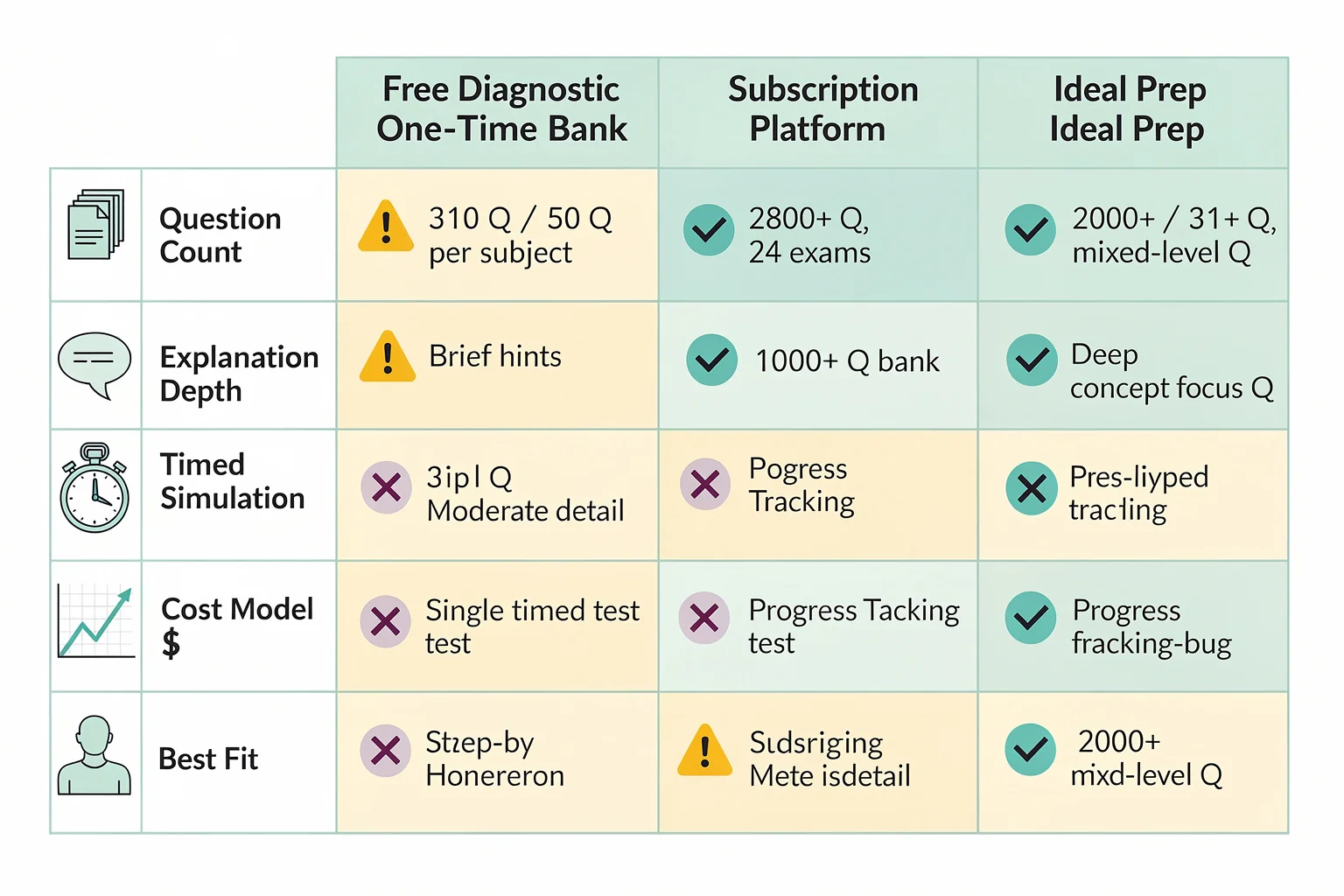
| Feature | Free Resources (Mometrix, NurseHub diagnostics) | BoostPrep (Paid, one-time) | Subscription Platforms (Study.com, NurseHub Premium) |
|---|---|---|---|
| Question count | 50–310 | 2,800+ | 1,000–4,000+ |
| Answer explanations | Basic or absent | Detailed for every question | Detailed, often with video |
| Timed full-length simulation | Rare | 24 full-length exams | Varies; some include timed modes |
| Performance tracking across sessions | None | Yes, by topic | Yes, with dashboards and progress bars |
| Structured study plan | None | Available in Pro tier | Built-in lesson sequences |
| Cost | Free | $39–$59 one-time | $30–$60/month |
| Best for | Initial baseline | Self-motivated drillers | Those who need guided video instruction |
The numbers in the table are drawn directly from the providers' own pages. Mometrix lists 310 questions in its free practice test, and NurseHub's free diagnostic offers 50-question quizzes per subject. Study.com advertises 1,000+ practice questions alongside its video library, visible on its HESI exam test prep page. BoostPrep discloses 2,800+ questions and 24 full exams on its HESI course product page.
This is not a list of "good, better, best." It's a map of which attribute each option prioritizes. Free resources optimize for zero-dollar access. BoostPrep optimizes for question volume and full-test repetition. Subscription platforms optimize for guided learning.
What the Best Prep Option Looks Like, Regardless of Price
However you pay, the prep that works for the HESI A2 tends to share a few common features. When you evaluate any resource — free or paid — ask these three questions:
Does it simulate the real test's timing and question mix? You need section-specific timers, no pause-and-resume loopholes, and question sets that match the real section lengths. Without that, you're practicing recall, not test-day performance.
Does it explain answers well enough that you never make the same mistake twice? A "wrong" flag is worthless if you don't know why you were wrong and what reasoning leads to the correct choice. Look for explanations that reference the underlying concept — the formula, the grammatical rule, the physiological mechanism — not just the option letter.
Can you see your weak spots at a glance and drill into them? A dashboard that shows "you're at 68% in Anatomy & Physiology, and the specific gap is in the cardiovascular subsection" lets you spend the next hour on exactly that, instead of re-reading broad chapters.
Some newer platforms take those principles further. A few offer AI-powered tutoring that can expand an explanation on demand, vary the difficulty of a question so you're not memorizing, or generate fresh question variants on the same concept. For instance, a practice test engine might let you click a "Why?" button next to any answer and get a paragraph of context that a human tutor would give.
That kind of feature matters because it addresses the biggest risk with practice questions: that you start recognizing answers instead of understanding concepts. When you face an unfamiliar question on exam day that tests the same principle from a different angle, you can still reason your way through if the learning was built on comprehension, not memory.
Of course, no tool replaces a solid study plan. Pairing a rich question bank with an anatomy and physiology textbook, a grammar workbook, and consistent daily practice will outperform any single product, free or paid.
Is It Possible to Pass with Only Free HESI Practice Questions?
The short answer: yes, some people do. Students with strong recent coursework, disciplined self-study habits, and access to a good textbook or lecturer notes sometimes score well using free diagnostics, Quizlet, and open practice tests. They supplement the free questions with their own study resources and don't rely on the platform for structure or explanation.
The problem is that most nursing school applicants are juggling a job, prerequisites, and family obligations. They study in short, distracted blocks and can't spend hours hunting down supplemental explanations for every missed question. In that scenario, the gaps in free resources — no tracking, thin explanations, no full-length simulation — add weeks to prep time and introduce uncertainty about actual readiness.
If you're in the first camp, start with free diagnostics and see how far your baseline is from your program's cutoff. If you're within 5 percentage points, targeted free practice might be enough. If you're 10 or more points adrift, or you've already taken the HESI once and fell short, investing in a paid tool that tightens the feedback loop is a sensible hedge against the cost of a delayed admission cycle.
Common HESI Prep Questions Straight Talk
How many practice questions should I do before test day?
There is no magic number, but a useful target is to work through at least 300–500 questions per section you're required to take, spread over several weeks. Dive deeper — 1,000+ total — if you need to improve by a wide margin. Volume alone doesn't help unless you review every missed question and understand the explanation, so treat that review time as part of the question count.
Are free HESI practice tests updated for 2026?
Some are, some aren't. NurseHub and Mometrix both label their free tests as updated for 2026. Other sites, especially smaller ones, may not refresh their question pools annually. Check the page footer or description for the last update date. If you can't find one, assume the questions may be older and cross-reference with a current test blueprint from your program or Elsevier.
What's the single most important feature in a paid HESI prep course?
Beyond question count, look for detailed answer explanations available for every question. That one feature converts a quiz into a learning session. If you can't review why an answer is correct — and why the distractors are wrong — you're practicing guessing, not mastery.
Do any paid courses include a pass guarantee?
Yes. BoostPrep, for instance, advertises a 100% pass guarantee alongside its 7-day trial. Other platforms like Study.com also include a score-improvement guarantee in their terms. Be sure to read the conditions: most require you to complete a certain amount of the course before the exam to qualify.
Can I use a free trial to get enough practice for free?
Most free trials are designed to give you a short evaluation window, not full exam prep. A 7-day trial can be useful for sampling the interface, question quality, and explanations. Trying two or three paid platforms this way before committing your study budget is a smart move. But don't expect to complete a thorough prep course inside a trial window.
More Prep Comparisons Worth Your Time
- Free or Paid A+ Practice Tests? What Actually Prepares You
- PMP Mock Exams Compared: Which Simulator Feels Most Real
- CFP Exam Practice Questions That Actually Match the Real Test Format
Start a free practice exam on ExamJungle