
How Employers Are Paying for Your Next Tech Certification
Maria had been eyeing the AWS Solutions Architect Associate exam for six months. The $150 fee wasn't the problem. It was the $1,200 training course, the practice labs, and the fear of failing and paying twice. Then she noticed something buried in her benefits portal: a Learning & Development stipend she'd never used. Six weeks later, her manager approved the full amount. Maria passed on her first attempt and moved from help desk to cloud operations within the year.
Her story is becoming routine. Employer funding for professional credentials has shifted from a nice-to-have perk to a strategic workforce investment. In 2026, that shift is accelerating fast enough that missing it means leaving money and career momentum on the table.
The Real Reason Employers Opened Their Wallets
The post-pandemic skills shortage never really ended. It mutated. Employers now face a specific, expensive problem: the technology they bought requires people who can run it, secure it, and extend it with AI. Those people are scarce, and hiring them away from competitors costs 50-150% more than growing your own.
Pearson's 2026 Value of IT Certification Employer Report, released in April, puts numbers to this anxiety. 78% of employers now choose professional certification as their leading upskilling investment, ahead of internal training programs, conference attendance, and graduate degree sponsorship. The report frames certification as a "license to operate" in an environment where unvalidated skills create measurable business risk.
This isn't theoretical. CompTIA's Workforce and Learning Trends 2026 study found that a net 83% of HR professionals and IT leaders agree skills improvement is imperative. Yet only 34% of companies have formal, organized programs to deliver it. That gap between recognized need and structured response is where individual employees can step in and shape the conversation.
The financial logic is equally stark. Foote Partners' IT Skills and Certifications Pay Index for Q1 2026 shows cash pay premiums for 663 IT certifications jumping at their strongest rate in roughly a decade, while noncertified skills posted their steepest quarterly decline since 2002. Employers are reassessing which capabilities they trust enough to pay extra for. Certification has become a sorting mechanism.
The shift away from graduate degrees is particularly notable. Financial News reported in May 2026 that companies are increasingly allocating education budgets to short, vendor-issued tech certifications rather than graduate degrees. The math is straightforward: a $2,000 certification that takes three months to complete and maps directly to a deployable skill outperforms a $30,000 master's degree that takes two years and may not address immediate operational needs.
How Section 127 Actually Works
Most employer paid IT certification programs in the United States rest on a single tax provision: Section 127 of the Internal Revenue Code. Understanding its mechanics lets you navigate your benefits conversation with precision rather than hope.
Section 127 allows employers to provide up to $5,250 per calendar year in educational assistance without that amount counting as taxable income to the employee. The IRS updated its guidance in April 2026, confirming that this includes tuition, fees, books, and supplies for instruction or training that improves or develops your capabilities in your current role or prepares you for a new role within the same employer. Critically, certification exam fees paid to testing centers or certifying bodies qualify, as do preparation course costs paid to separate training providers.
The $5,250 cap is scheduled to adjust for cost-of-living increases after 2026, per IRS Publication 5993. For now, it covers most single certifications comfortably. A CompTIA Security+ SY0-701 exam voucher runs roughly $400. Premium training courses range from $800-$2,500. Even with practice tests and study materials, you're typically well under the annual limit.
What Section 127 does not cover: tools or equipment you keep, meals, lodging, or transportation to training locations. Some employers layer additional reimbursement above the tax-free cap, but amounts beyond $5,250 become taxable wages unless another exception applies.
The key requirement is that your employer must have a written educational assistance program. If yours doesn't, the conversation starts with HR or your manager about creating one. The IRS provides sample plan language in Publication 5993, which lowers the administrative barrier considerably.
A common point of confusion: Section 127 is not the same as tuition reimbursement for college coursework. It explicitly covers non-degree instruction, including professional certification programs, bootcamps, and vendor-specific training. This is why the provision has become so relevant for IT credentials specifically.
Where the Money Lives: Four Funding Paths
Not all employer programs look alike. Recognizing which structure your company uses helps you frame your request correctly.
Direct reimbursement is the simplest model. You pay upfront, pass the exam, submit proof, and receive payment. This is common at smaller companies or for first-time certification requests. The risk sits with you until completion, which creates pressure but also demonstrates commitment.
Pre-approved sponsorship shifts the risk to the employer. Your manager or L&D team approves the expense before you register, often with a commitment to remain employed for 12-24 months or repay prorated amounts. This is standard at enterprises with formal talent pipelines.
Third-party skills platforms are growing rapidly. Companies like Pluralsight, Coursera for Business, and Udemy Business negotiate bulk access that includes certification vouchers. If your employer has one of these contracts, your path may already be paved; you just need to map the right learning plan to your role.
State and federal incentive programs add another layer. Ohio's TechCred program, for example, reimburses employers directly for credential costs, effectively making the certification free to both parties. Similar programs exist in varying forms across Texas, Michigan, and several other states. Your HR team may not advertise these because the application burden falls on them, not you. Asking specifically can unlock funds that would otherwise go unused.
Each path has different documentation requirements. Direct reimbursement typically needs an exam pass report and payment receipt. Pre-approved sponsorship may require a business case document and manager sign-off. Third-party platforms usually handle their own tracking. State programs often need proof of credential completion, payment invoices, and wage information at time of submission. Knowing which path you're on lets you prepare the right paperwork before you start.
Which Certifications Employers Prioritize in 2026
The credentials getting funded reflect where organizations feel the most acute pain. Based on Pearson's employer research and Foote Partners' pay premium data, four clusters dominate sponsorship conversations.
Cloud infrastructure and AI operations sit at the top. AWS, Microsoft Azure, and Google Cloud certifications are no longer specialty requests; they're standard expectations for infrastructure and platform teams. The newer wave includes AI-specific credentials like the Oracle AI foundations certification (1Z0-1122-25) and the Google Cloud generative AI leader (GCP-GAIL), which employers increasingly view as necessary for teams deploying production AI systems. The Oracle generative AI professional (1Z0-1127-25) extends this into advanced implementation roles.
Foote Partners' May 2026 data confirms AI engineering, cybersecurity, governance, and data architecture skills now command the highest cash pay premiums in IT. Employers are paying premium bonuses equal to 20-24% of base salary for these capabilities, with leading certifications earning even more. This creates a direct incentive to fund credentials that validate strategic capability rather than routine operational knowledge.
Cybersecurity fundamentals remain heavily funded because the downside of unstaffed security roles is catastrophic. Entry-level sponsors often start with CompTIA A+ Core 1 (220-1001) and Core 2 (220-1002) for support staff building toward security specializations. More advanced roles see investment in the Cisco cybersecurity fundamentals exam (210-250 SECFND) and governance credentials like the ISACA AI audit certification (AAIA) and AI security management (AAISM).
AI-infused networking and infrastructure represents the fastest-growing sponsorship category. Traditional network engineering roles now require understanding of AI-driven traffic management, automated provisioning, and intelligent monitoring. The Cisco cloud networking certification (500-560), Oracle cloud networking professional (1Z0-1124-25), and VMware cloud networking exam (3V0-25.25) all sit at this intersection. For operations-focused roles, the VMware cloud operations certification (3V0-22.25) offers a parallel path.
Data analytics and business automation round out the funded set, particularly for employees who need to justify their request to non-technical managers. The business data analytics certification (IIBA-CBDA) translates technical capability into business outcomes. The IBM Cloud Pak automation certification (C1000-150) serves platform-specific automation roles. Framework credentials like the ITIL high-velocity IT certification help operations teams quantify efficiency gains.
The common thread across all four clusters: each credential maps to a specific, measurable business outcome. Employers fund what they can defend in a budget review. "This certification lets us migrate to cloud infrastructure without hiring three external consultants" is a stronger argument than "this would help my career."
Building the Business Case Your Manager Can't Ignore
Getting to "yes" requires translating your career goal into your employer's language. Managers approve what reduces their risk and advances their objectives. Here's how to frame the conversation.
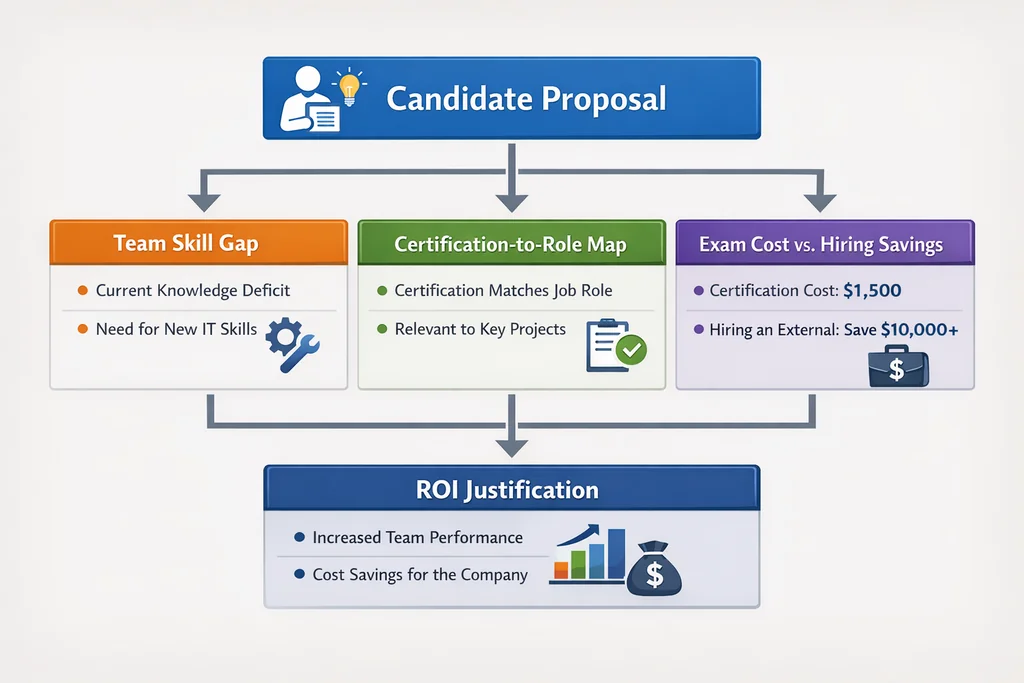
Lead with the skills gap, not your resume. Your organization has a problem that certification solves. Reference the specific technology your team adopted, the project delayed for lack of qualified staff, or the compliance requirement approaching. Pearson's research emphasizes that employers fund certification to close "high-risk, high-impact" gaps. Map your credential directly to one of those.
Quantify the alternative. Hiring a certified professional externally costs more than funding your development. Recruiting fees, onboarding time, and salary premiums for external hires typically exceed $15,000 for mid-level technical roles. Your $2,000 certification investment is a bargain by comparison. If you can find a specific job posting your employer has open, the math becomes concrete.
Address retention explicitly. Managers fear funding your development only to lose you. Propose a written commitment: 12-18 months post-certification in your current role, or prorated repayment. This converts their risk into a retention tool. Many employers already require this; offering it proactively signals maturity.
Propose a knowledge transfer. Offer to present your learnings to the team, document the certification path for colleagues, or mentor the next person through. This multiplies the employer's return and positions you as a leader before you even sit for the exam.
Time it to budget cycles. L&D budgets often refresh in January or at fiscal year-start. Requests made six weeks before that cycle have better odds than mid-year appeals when funds are committed. If your company does quarterly planning, align your ask with the next planning window.
Prepare for the "what if you fail" question. This comes up more often than candidates expect. Have a specific preparation plan that includes practice exams, study schedules, and contingency timelines. The ISTQB AI testing certification (CT-AI) illustrates how even niche specializations benefit from structured preparation that you can describe in advance.
What to Do When the First Answer Is No
Not every organization moves fast. Some have rigid policies, exhausted budgets, or managers who see certification as a stepping stone out of their department. Persistence and reframing matter.
Probe for the real objection. "We don't have budget" often means "I don't see the urgency" or "I need cover if this fails." Ask what would change the calculation. A pilot program for one person? A commitment to a specific project deliverable tied to the new skills? A delayed start to the next fiscal quarter?
Find an internal champion outside your chain of command. Someone in another department who has successfully navigated the process can offer tactical advice or even advocate directly. Cross-functional mentorship programs, Slack communities, or employee resource groups are good starting points.
Consider partial funding or sequencing. If the full certification path is too expensive, propose funding just the exam voucher now, with training costs self-funded or deferred. Alternatively, start with a lower-cost foundational credential that builds toward your target. The CompTIA A+ Core 1 exam at roughly $250 including voucher and basic prep materials can establish a track record that makes the larger ask easier next year.
Document your self-investment. If you proceed without employer funding, keep meticulous records of costs, study time, and performance improvements. This becomes evidence for future reimbursement conversations and demonstrates the initiative that employers claim they value.
Escalate strategically, not emotionally. If your manager declines without clear reasoning, ask for specific criteria that would justify approval. Then meet those criteria and return with a stronger proposal. If the barrier is policy-level, ask HR whether the policy has exceptions or is under review. Sometimes being the person who asks forces the organization to confront its own inconsistencies.
Preparing So You Pass on the First Attempt
Employer funding often comes with visibility. Failing wastes more than money; it wastes political capital. The candidates who pass consistently share specific preparation patterns.
They start with the exam objectives published by the vendor, not with a generic course. CompTIA, Cisco, AWS, and Oracle all publish detailed domain breakdowns that define exactly what the exam covers. These are free and authoritative. Any study plan that doesn't reference them directly is guessing.
They simulate test conditions before the real event. Timed practice exams reveal whether you know the material or merely recognize it in familiar formats. The gap between comfortable study scores and passing exam scores is often 15-20% for candidates who haven't practiced under pressure. Using a realistic exam practice platform with per-question explanations helps you understand why an answer is correct, not just that it is.
They use AI tutoring selectively, not as a crutch. When an explanation is unclear, tools that can expand reasoning, increase question difficulty, or generate variants help you understand the underlying concept rather than memorizing a specific question. This matters because vendor exams increasingly use scenario-based questions that test application, not recall.
They schedule the exam before they feel fully ready. A fixed date creates productive urgency. The candidates who study indefinitely without committing to a test date often over-prepare in familiar areas while neglecting weaker domains.
They build study groups, even informal ones. Explaining concepts to colleagues surfaces gaps in your own understanding. The person who can teach a topic typically retains it longer than the person who only consumed it.
Questions Candidates Ask About Employer Funding
Does my employer have to offer Section 127 benefits? No. Section 127 is permissive, not mandatory. However, the tax advantage is substantial enough that most mid-size and larger employers participate. If yours doesn't, the conversation about creating a program starts with the CFO or HR director, not your immediate manager.
Can I use Section 127 for certification if I'm not in an IT role? Yes, if the certification prepares you for a role within the same employer. The IRS requires the education to maintain or improve skills required in your current role, or to meet express requirements for advancement. A marketing analyst seeking a business data analytics certification to support technical projects qualifies. A warehouse worker seeking an unrelated credential likely does not.
What if I fail the exam? Policies vary. Some employers absorb the cost as a learning expense. Others require repayment or withhold reimbursement until passing. Clarify this before you register. The most defensible position: you're more likely to pass with quality preparation, which is why you're requesting funding for training materials and practice exams, not just the voucher.
Can I combine employer funding with other programs? Often yes. State workforce development grants, veteran benefits, and vendor scholarship programs can stack with employer assistance. The Ohio TechCred reimbursement structure explicitly allows packaging with federal training funds. Your HR team should know which combinations are permissible.
How do I find out what my employer actually offers? Start with your employee handbook or benefits portal. Search for "educational assistance," "tuition reimbursement," "professional development," or "Section 127." If the policy is unclear, schedule 15 minutes with HR to walk through it. Frame the conversation as information-gathering, not a request; you'll make the actual ask later with full knowledge of the process.
Does certification guarantee a raise or promotion? No. Certification validates skills; it does not create positions that don't exist. However, CompTIA's May 2026 analysis shows tech occupation employment increased by 69,000 workers in May alone, with an estimated 5.9 million people in tech occupations nationwide and unemployment at 3.1%. In this market, certified professionals have measurable negotiating leverage.
Making the Money Work for Your Career
The landscape for employer paid IT certification has shifted decisively. What was once a discretionary perk for senior staff is now a strategic workforce tool that organizations use to close skills gaps, retain talent, and avoid expensive external hiring. The employees who benefit most are those who recognize this shift and approach it systematically.
That means understanding Section 127's mechanics, mapping your certification to a specific business problem, building a proposal that addresses your manager's real concerns, and preparing rigorously enough to pass on the first attempt. It also means persisting through initial resistance, because organizations with immature L&D functions often fund the first credible request that forces them to engage with their own policies.
The certification you pursue shapes what doors open next. The certification vendor catalog spans 150+ providers, from foundational credentials like CompTIA A+ Core 2 through advanced specializations like the Dell EMC cloud services expert track. The right choice depends on your current role, your team's technology stack, and the trajectory you want to establish.
What doesn't vary is the value of starting the conversation now. Budget cycles, policy windows, and project timelines all create natural moments to make your case. Waiting for the perfect moment usually means missing the current one.
Learn more — Start a free practice exam on ExamJungle
Certifications Worth Exploring Next