
How to Overcome Exam Anxiety for IT Certifications
Struggling with exam nerves? You’re not alone - 40% of IT certification test-takers face anxiety that impacts performance. But here’s the good news: with the right preparation and proven techniques, you can stay calm, focused, and confident on exam day.
Key Takeaways:
- Understand anxiety triggers: Negative self-talk, physical symptoms, or avoidance behaviors often fuel stress.
- Practice smarter, not harder: Answering 500+ practice questions can reduce anxiety by up to 60%.
- Use relaxation techniques: Methods like deep breathing or muscle relaxation can calm your mind in minutes.
- Adopt test-day strategies: Manage time effectively, flag tough questions, and focus on one task at a time.
- Reframe anxiety as readiness: Shift your mindset to see stress as a tool for sharper focus.
From identifying triggers to mastering test-day strategies, this guide equips you with actionable steps to tackle exam anxiety and perform at your best. Let’s dive in!
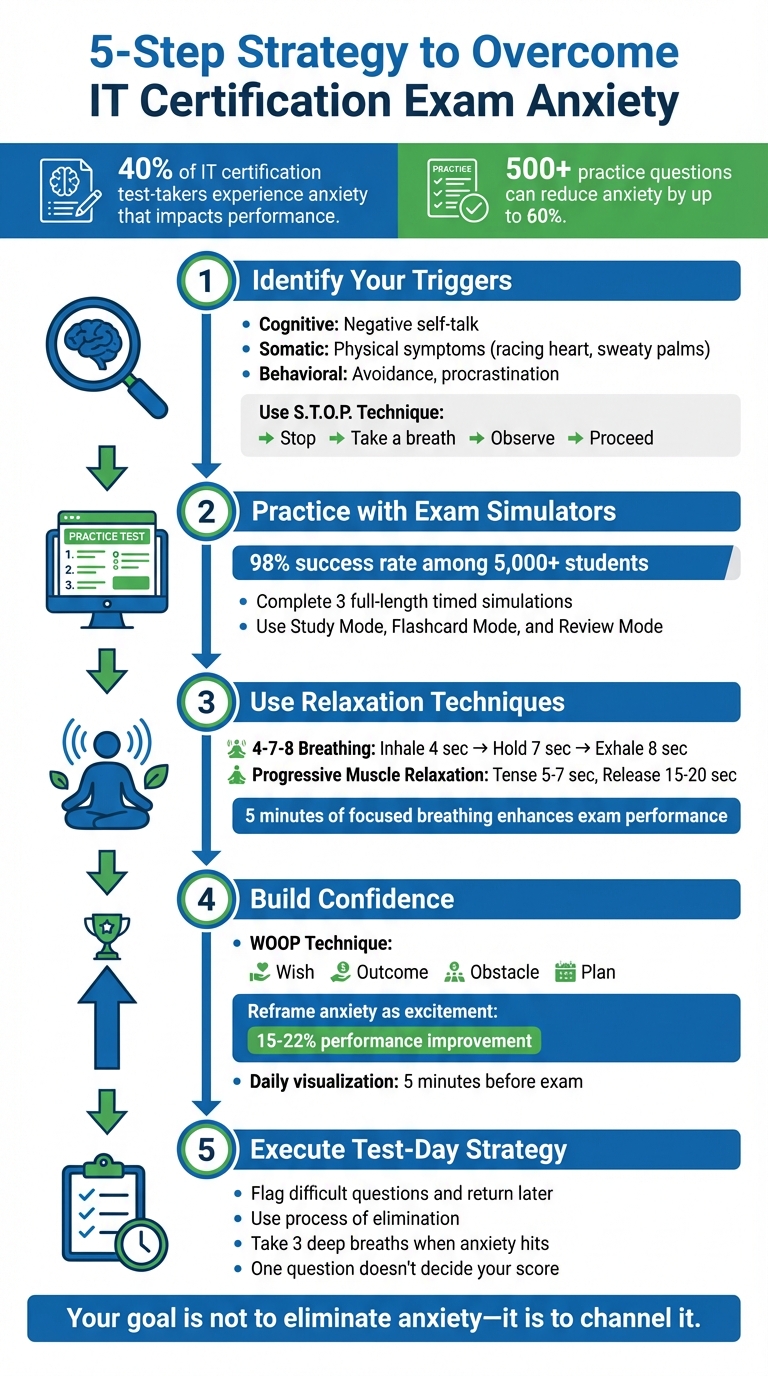
5-Step Strategy to Overcome IT Certification Exam Anxiety
"Overcoming IT Certification Test Anxiety" | Tim's IT Straight Talk
Identify Your Anxiety Triggers
Understanding what triggers your anxiety is key to managing stress before it spirals out of control [3]. Anxiety triggers often fall into three categories: cognitive, such as negative self-talk like "I’m not good enough for this"; somatic, involving physical symptoms like a racing heart or sweaty palms; and behavioral, including avoidance behaviors like procrastinating on study sessions or practice exams [2].
For IT certification exams, common stressors include the hefty exam registration fees, pressure from employers tied to career growth, and the sterile testing environment - with its ever-present countdown timer ticking away [2]. Psychological factors like fear of failure, perfectionism, and memories of past poor performances often add fuel to the fire [5]. Even your study habits can be a trigger - cramming, not dedicating enough time to preparation, or feeling uncertain about whether you’ve studied "enough" are frequent sources of stress [2].
Recognize Your Personal Stressors
Pay attention to your body and mind during study sessions or practice tests. Physical signs like a racing pulse, stomach butterflies, clammy hands, headaches, or chest tightness often show up first [1][5]. Then, look for cognitive and emotional patterns. Are you catastrophizing with thoughts like, "If I fail, I’ll lose my job"? Are your thoughts racing, or is it hard to focus? These are signs that anxiety might be creeping in [2][5].
Behavioral patterns are another clue. Are you skipping study sessions, arriving late, or rushing through questions just to finish? These habits can signal avoidance [2]. When you notice these stress indicators, try the S.T.O.P. Technique: Stop, Take a breath, Observe your feelings without judgment, and Proceed with self-compassion [3]. This brief pause can help prevent stress from escalating.
Understand Productive vs. Unproductive Stress
Not all stress is harmful. The Yerkes-Dodson Law suggests that moderate anxiety can actually enhance focus and performance [2]. The trick is staying in the "optimal zone", where you feel alert, focused, and able to recall information quickly. Crossing into the "danger zone", however, can flood your brain with cortisol, impairing memory and causing you to freeze or obsess over threats like the countdown timer [2].
Here’s how to spot the difference: productive stress keeps you focused on the task at hand, while unproductive stress makes you fixate on fears and feel mentally stuck. If you catch yourself spiraling into negative self-talk or replaying worst-case scenarios, your anxiety has likely crossed the line. The good news? You can reframe anxiety as excitement. Since both emotions share similar physical symptoms - like a racing heart and adrenaline rush - telling yourself, "I’m excited to show what I know" instead of "I’m nervous" can improve performance by 15–22% [2].
"Anxiety is not your enemy... moderate anxiety actually improves performance. Your goal is not to eliminate anxiety - it is to channel it." - Open Exam Prep [2]
Up next, learn how PlanetCert Practice Tools can help you tackle these triggers and build confidence.
Prepare with PlanetCert Practice Tools
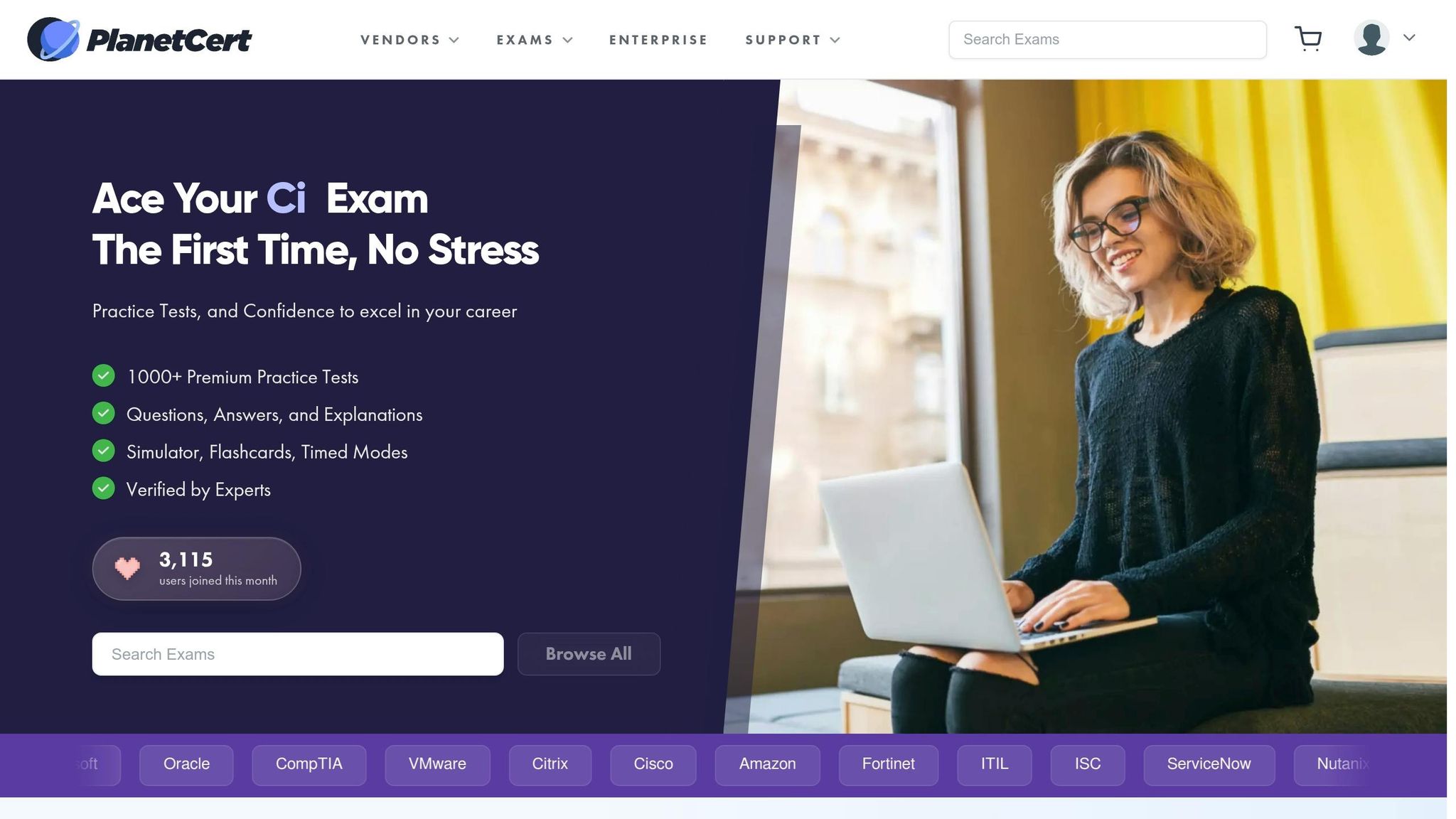
Once you’ve pinpointed what triggers your exam anxiety, the next step is to tackle it head-on with focused practice. Studies reveal that candidates who answer 500+ practice questions can cut their exam-day anxiety by up to 60% compared to those who stick to passive study methods [2]. PlanetCert’s practice tools are specifically designed to ease test-day nerves while reinforcing your knowledge.
By diving into these practice modules, you can turn moments of stress into opportunities for confidence - a key ingredient for passing your IT certification exam.
Use the Exam Simulator for Realistic Practice
The Exam Simulator is built to mimic the exact conditions of your certification exam, including timing and interface. This isn’t just practice - it’s performance training [7]. The more you expose yourself to the test environment, the less likely you are to feel overwhelmed by countdown timers or unfamiliar layouts. Psychologists call this the "novelty threat", and repeated exposure helps eliminate that initial panic [2].
"The web exam simulator reproduces timing and interface conditions found in vendor exams, turning practice into performance training." - PlanetCert Team [7]
To maximize its benefits, aim to complete three full-length, timed simulations without breaks. This builds both stamina and procedural fluency, so when test day comes, navigating the software feels second nature [9]. The simulator is accessible directly from your browser - on desktop or mobile - making it easy to practice anywhere, without worrying about complicated setups [6][8]. Plus, you can use the promo code "hello26" to save 15% on all exams [7].
Use Study Modes for Flexible Preparation
Not every study session needs to feel like the real exam. That’s where PlanetCert’s Study Mode comes in. It allows you to work at your own pace, with instant explanations provided for each question. This creates a low-pressure environment perfect for building foundational knowledge [6]. For quick memory boosts, there’s Flashcard Mode, which is ideal for reviewing technical details on the fly [4]. And when it comes to pinpointing weak areas, Review Mode lets you focus on the questions you got wrong, helping you close knowledge gaps and build confidence [7].
Each mode serves a specific purpose:
- Start with Study Mode to develop a solid understanding.
- Use Flashcard Mode for quick recall of essential facts.
- Transition to the Exam Simulator when you’re ready to simulate real test conditions.
The platform’s mobile-friendly design means you can study anytime, anywhere, fitting preparation into even the busiest schedules [6][7].
PlanetCert Study Modes Comparison
| Mode | Timing | Explanation Availability | Key Benefit |
|---|---|---|---|
| Exam Simulator | Timed | After completion | Builds familiarity with exam |
| Study Mode | Self-paced | Immediate | Reinforces understanding |
| Flashcard Mode | Self-paced | Limited | Enhances quick recall |
| Review Mode | Self-paced | Full | Closes knowledge gaps |
PlanetCert boasts a success rate of over 98% among its 5,000+ students [6]. And if you don’t pass within 14 days of purchase, they offer a money-back guarantee [6]. This removes the financial stress, letting you focus entirely on preparing for success.
With these tools at your fingertips, the next step is learning how to stay calm and focused during the actual exam.
Use Relaxation Techniques to Stay Calm
Even with thorough preparation, exam day can stir up stress. Studies show that around 40% of professional certification test-takers experience noticeable anxiety that affects their performance [2]. The good news? You can teach your body to respond differently using straightforward relaxation techniques that work in just minutes. These methods help shift your body from a heightened state of stress to a calmer, more focused mode [2]. Below are some practical techniques to help you stay composed and perform your best during the exam.
Practice Deep Breathing Exercises
Deep breathing is one of the quickest ways to regain control when anxiety hits. Stress often causes shallow, rapid breathing, but slowing it down can signal safety to your nervous system and reduce tension [12]. The 4-7-8 breathing method is a powerful tool - it can lower your heart rate in about 90 seconds [2]. Here’s how it works:
- Inhale through your nose for 4 seconds.
- Hold your breath for 7 seconds.
- Exhale fully through your mouth for 8 seconds.
Repeat this cycle 3–4 times. For a simpler option, try Box Breathing: inhale for 4 counts, hold for 4, exhale for 4, and hold for 4 again [12]. Research suggests that just 5 minutes of focused breathing can enhance exam performance [11]. To amplify the benefits, practice diaphragmatic breathing - letting your abdomen expand with each breath instead of just your chest. This technique can interrupt the fight-or-flight response, helping you feel more grounded [10].
Try Progressive Muscle Relaxation
If anxiety leaves you feeling tense, Progressive Muscle Relaxation (PMR) can help. This technique targets physical symptoms like tight muscles, clammy hands, or a heavy chest. The process involves tensing a specific muscle group for 5–7 seconds and then releasing that tension for 15–20 seconds. It’s a way to teach your body the difference between stress and relaxation [2].
"The contrast between tension and release teaches your body what 'relaxed' actually feels like." - Open Exam Prep [2]
To get started, clench your hands into fists, then gradually move to your biceps, shoulders, face, core, and legs [2]. A full PMR session takes about 5 minutes and may require 4–5 practice runs to become second nature [2]. On exam day, you can discreetly apply this technique by tensing and releasing your hands or feet to stay calm [2].
sbb-itb-119ea25
Manage Your Time and Test-Taking Strategy
Struggling with time management can make exam anxiety spiral out of control. The difference between staying composed or panicking often boils down to having a solid plan - both during preparation and on the exam day itself. By managing your time effectively, you not only streamline your study process but also tackle one of the biggest stressors: uncertainty.
Create a Realistic Study Schedule
Many IT professionals underestimate how much preparation they truly need. While some guides suggest 30–40 hours of study, those who pass Cisco certifications often dedicate closer to 110 hours [15]. Start by downloading the official exam blueprint to understand the weight of each domain. As Mubasher Nawaz, Engineering Leader at Cisco, suggests:
"I recommend learners look at the exam blueprint and see what topics it covers and how they're weighted" [15].
Once you know the exam date, plan backward. Account for holidays, work obligations, and personal commitments, then divide your study sessions by difficulty: "Easy", "Medium", and "Hard." Treat these sessions like appointments and add buffer days for unexpected interruptions [13][14]. Focus on challenging topics when your energy levels are at their peak [13][14].
To retain what you learn, use spaced repetition. For example, review new material on Day 1, then revisit it on Days 2, 4, 7, and 14 [2]. Even short breaks, like a 15-minute commute or lunch, can become productive study moments [13][14].
With a clear schedule in place, it’s time to shift your attention to exam-day strategies.
Use Smart Test-Taking Approaches
When it’s time to take the test, having the right approach can make all the difference. The first five minutes are critical - they set the tone for the rest of the exam. Start by reading the first question carefully. If you know the answer, respond immediately to build momentum. If not, flag it and move on [2].
For multiple-choice questions, use the process of elimination to narrow down options. This reduces the mental load of facing several unfamiliar answers and helps you stay focused [2].
Time management is key. For instance, the SIE exam allows about 1.5 minutes per question, while the PMP exam gives you roughly 1.27 minutes across 180 questions [2]. If a question slows you down, flag it and return later - no single question determines your final score [16][2]. And remember, most IT exams don’t penalize guessing, so never leave a question blank. Use elimination to make an educated guess if time is running out [2][17].
Before exam day, practice with full-length tests in a quiet environment. Simulate the test conditions - no snacks, no music - to build the mental endurance you’ll need for the real thing [4][15].
Build Confidence with Visualization and Positive Affirmations
Once you’ve got solid study and test-taking strategies in place, it’s time to focus on building inner confidence to help keep exam anxiety in check.
Your brain processes vivid mental images as though they’re real experiences. This is why visualization can activate the same brain regions you’ll use during the actual test, creating neural pathways that encourage calm, focused behavior [18]. By mentally rehearsing the entire exam day - from sitting at your desk to confidently clicking "Submit" - you can train your mind to feel prepared and composed.
Positive affirmations complement visualization perfectly. These short, powerful statements help break negative thought patterns and rewire your brain through neuroplasticity. To get the most out of them, start practicing weeks before your exam and pair them with vivid mental imagery for lasting impact.
Visualize Exam Day Success
The WOOP technique is a great way to combine visualization with practical planning. It’s been shown to outperform simple positive thinking by 20–30% [2]. Here’s how it works:
- Wish: Define your goal (e.g., passing a certification exam).
- Outcome: Picture the best result (like advancing your career).
- Obstacle: Identify what might hold you back (e.g., "I panic on labs").
- Plan: Create an "if-then" plan (e.g., "If I get stuck on a lab, then I’ll take a breath and recheck the requirements") [2].
This approach not only boosts mental readiness but also reinforces the confidence built during your practice sessions.
In the week leading up to your exam, spend 5 minutes each evening visualizing the entire process. Imagine yourself arriving at the testing center feeling prepared, sitting down at the terminal, taking a deep breath, and calmly working through each step - methodically answering questions, flagging tricky ones for later, and finally seeing "Pass" on the screen [2].
For a quick confidence boost during practice exams, try micro-rehearsals. Take 60–90 seconds before starting a practice block to visualize yourself staying calm while tackling the first tough question [18]. This helps your brain associate exam-related cues, like the "Start Exam" button, with focus instead of fear [18].
Pair these mental exercises with affirmations to solidify your confidence.
Use Positive Affirmations
Affirmations work best when they feel achievable and are stated in the present tense. For example, swap "I won’t fail" with "I am prepared and capable." If a thought like "I don’t know enough" creeps in, counter it with "I’ve passed exams before; I can do this" [19][3].
Research from Harvard Business School shows that reframing anxiety as excitement can improve performance by 15–22% [2]. Since both emotions share similar physical symptoms - like a racing heart - the difference lies in how you interpret them. Try telling yourself, "I’m excited to show what I know" instead of "I’m so nervous" [2].
Here are some affirmation examples to try:
- "I am a problem-solving wizard."
- "My focus is laser-sharp today."
- "I approach each technical challenge with clarity and confidence" [20].
Repeat these affirmations during study breaks or while practicing relaxation techniques like Progressive Muscle Relaxation to help your body associate these statements with a calm, focused state.
| Anxious Thought | Positive Reframe |
|---|---|
| "I don’t know this - I’m going to fail." | "I’ll flag this and come back. One question doesn’t decide my score." [2] |
| "Everyone else is finishing faster." | "Speed doesn’t mean accuracy. I’ll use my full time." [2] |
| "My mind is going blank." | "This is temporary. I’ll breathe, skip it, and return later." [2] |
"Confidence is not pretending you're perfect; it's trusting you can handle what comes." - Residency Advisor [18]
When anxiety strikes, use the S.T.O.P. technique to pause, reset, and reorient yourself [3].
Stay Focused During the Exam
You've put in the time, practiced, and visualized success - now it's time to put it all into action. Once you're at the testing station, staying calm and focused is key. Even with solid preparation, anxiety can creep in, and you're not alone. Around 40% of professional certification test-takers report experiencing anxiety that impacts their performance [2]. The good news? There are straightforward strategies to help you stay grounded and in control when stress tries to take over.
Pace Yourself During the Test
Start smart by pacing yourself from the very beginning. Take the first five minutes to read the initial question carefully. If you know the answer, go ahead - it builds confidence and momentum. If you’re unsure, flag it and move on. Tackling the test one question at a time keeps you from feeling overwhelmed [19].
When you hit a tricky question, use the exam software's "flag" or "skip" feature. This allows you to save your mental energy for easier questions and revisit the harder ones later [2][19]. Pay attention to keywords like "always", "never", "most likely", or "least likely" - these can help you eliminate wrong answers quickly. For multiple-choice questions, cross out obviously incorrect options to streamline your decision-making. Keep an eye on the clock, but don’t let it distract you. If your focus starts to waver, try the recovery techniques below to get back on track.
Regain Focus When Anxiety Hits
If anxiety starts to creep in, remember the S.T.O.P method you practiced earlier. Pause, take a breath, and reset. For a quick calming effect, take three slow, deep breaths. You can also use the 4-7-8 breathing technique you’ve rehearsed to bring your stress levels back down [19].
If your mind goes blank, don’t panic. Recognize it as a temporary hiccup. Take a few deep breaths, then shift to another section of the exam to help jog your memory [2][3]. Replace negative thoughts like "I'm going to fail" with constructive ones like "I’ll come back to this question - it’s just one part of the test" [2].
For a subtle physical reset, try Progressive Muscle Relaxation. Clench your hands into fists or press your feet firmly into the floor for five seconds, then release for 15 seconds. This simple action signals your body to relax without drawing attention [2].
"Nothing diminishes anxiety faster than action." - Walter Anderson [3]
Conclusion
Turn exam anxiety into a stepping stone for success. This guide has shared practical strategies - from focused practice sessions to relaxation techniques - that can help you perform at your best. Together, these methods tackle the three types of test anxiety: cognitive (negative thoughts), somatic (physical symptoms), and behavioral (avoidance) [2].
Preparation is key. Working through 500+ practice questions isn't just about memorizing facts - it’s about becoming comfortable with the exam format. Familiarity reduces stress and makes the test feel manageable [2]. Once your preparation is solid, the next steps are shifting your mindset and managing stress effectively.
A positive mindset paired with relaxation techniques can elevate your performance. Reframing anxiety as excitement has been shown to boost performance by 15–22% [2]. When you interpret a racing heart as readiness instead of panic, it changes how your brain retrieves information. On top of that, techniques like the 4-7-8 breathing method and Progressive Muscle Relaxation offer quick, effective stress relief. These tools help deactivate the fight-or-flight response, keeping cortisol levels in check so your working memory stays sharp [2][3]. If anxiety creeps in during the exam, these strategies can help you regain focus and maintain the alertness you need to succeed.
FAQs
How do I know if my stress is helping or hurting my score?
Stress can be a double-edged sword. On one hand, it can sharpen your focus and push you to prepare more effectively. On the other, too much stress can backfire, leaving you feeling overwhelmed, unable to concentrate, or even experiencing physical symptoms like a racing heart or nausea.
How can you tell if stress is working for or against you? If you find yourself blanking on answers or constantly distracted, it’s a sign stress might be doing more harm than good. But if it’s keeping you alert and motivated without tipping into excessive worry, it’s likely working in your favor. If it feels like too much, it may be time to explore stress management techniques to regain balance.
When should I switch from Study Mode to the Exam Simulator?
When you’ve wrapped up your study sessions and feel comfortable with the material, it’s time to move on to the Exam Simulator. This tool mimics the test environment, allowing you to pinpoint areas where you might need extra practice while boosting your confidence. The best time to make this switch is after reviewing the exam objectives and ensuring you’re familiar with the content. It’s a great way to gear up for the real exam day.
What can I do if my mind goes blank mid-exam?
If your mind suddenly goes blank during an exam, don’t panic - there are simple techniques that can help. Try calming yourself with controlled breathing exercises, such as the 4-7-8 method. This involves inhaling for 4 seconds, holding your breath for 7 seconds, and exhaling slowly for 8 seconds. It’s a quick way to relax your nervous system and regain focus.
Another helpful approach is writing down your exam-related worries for 10 minutes before the test begins. This practice can ease anxiety and clear mental clutter, making it easier to concentrate. Stay composed, rely on relaxation techniques, and trust that these strategies can help you regain your memory and focus when you need them most.