A CPC certified professional coder turns a patient visit into the codes that get it paid. That's the short version. The longer version is what most people searching this credential actually want to know: which code sets you're tested on, how the open-book exam is structured, why your first certificate says CPC-A instead of CPC, and what you have to do every two years to keep the letters.
This walkthrough covers the credential end to end. You'll see what the exam tests, how the apprenticeship designation gets removed, what the CEU cycle demands, and which jobs the credential actually opens. If you're deciding whether to spend the money, the sections below give you enough to make that call without guessing.
What the CPC Credential Actually Certifies
The CPC is a coding proficiency credential issued by AAPC, and it's built around one specific job: coding services performed by physicians and non-physician providers such as nurse practitioners and physician assistants. That's a narrower scope than it sounds. A hospital inpatient coder and a physician office coder work from different code sets, different guidelines, and different payer expectations, and the CPC targets the second group.
AAPC describes the credential as the gold standard for medical coding in a physician office setting, and the exam tests the competencies required to do that job rather than general healthcare knowledge. According to the Certified Professional Coder (CPC)® certification overview, holders have demonstrated expertise in provider documentation review, abstracting professional encounters, and coding with CPT, HCPCS Level II, and ICD-10-CM.
Three things sit at the center of that work:
- CPT codes for procedures and services
- HCPCS Level II codes for supplies, drugs, and equipment
- ICD-10-CM codes for diagnoses
You need all three on every claim, and they have to agree with each other. A correct procedure code paired with a diagnosis that doesn't support medical necessity gets denied just as fast as a wrong code does. That relationship is what the exam keeps testing, in scenario after scenario.
One thing worth separating early: the CPC is not a degree, a license, or a state requirement. It's a private certification. Nothing legally stops someone from doing medical coding without it. What the credential does is signal to an employer that you've been tested on the code sets and guidelines they use daily, which matters most when you have no work history to point to.
Inside the CPC Exam: Format, Sections, and Open-Book Rules
The exam is 100 multiple-choice questions covering 17 areas of knowledge, and it's open book. You bring your own code manuals. That single detail changes how you should prepare, because the test isn't asking you to recall a code from memory. It's asking whether you can find the right code, apply the right guideline, and sequence everything correctly under time pressure.
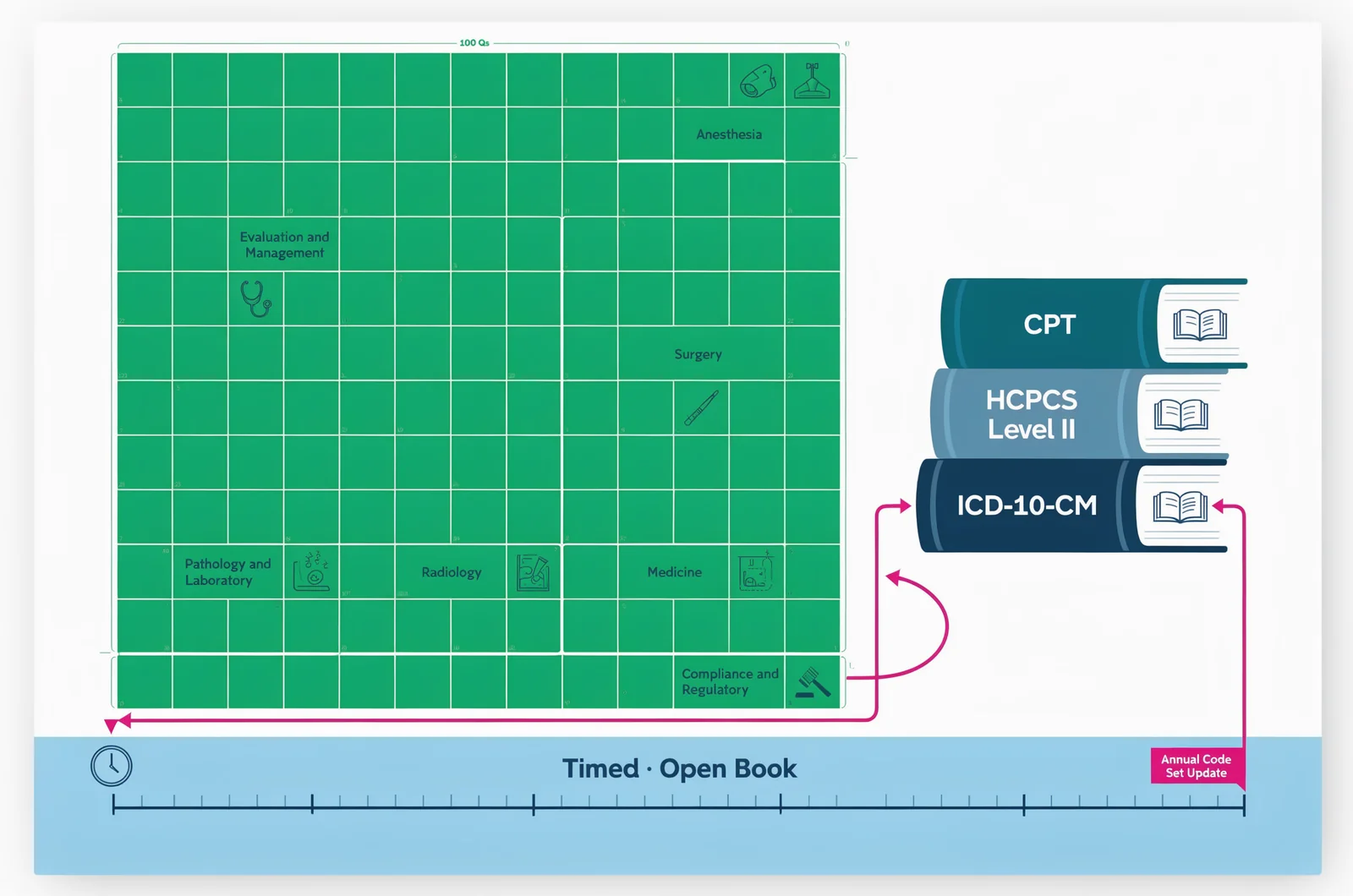
The knowledge areas span evaluation and management, anesthesia, surgery, radiology, pathology, and medicine, plus the compliance and regulatory rules that govern physician services. AAPC's How to get CPC certified? page lays out the full expectation: correct application of CPT, HCPCS Level II, and ICD-10-CM codes, proper modifier use, and a working command of coding guidelines and regulations.
That list is why people underestimate this exam. Open book sounds forgiving until you realize the manuals run to thousands of pages and the clock doesn't care. Coders who pass comfortably tend to have practiced navigating their books, not memorizing them.
What the questions actually look like
Most items give you a short clinical scenario, then ask for the correct code or code combination. You read the documentation, identify the procedure and diagnosis, check the guidelines for that section, and select from four options. Some questions hinge on a modifier. Some hinge on whether a service is bundled into another. A few test straight guideline knowledge with no scenario at all.
The trap is that two answer choices often look defensible. The difference usually comes down to a guideline note buried in the section you're working in, which is exactly the skill the credential is meant to verify.
Timing and the open-book reality
Because you're working from manuals, time management becomes the real constraint. Experienced test-takers build a rhythm: read the scenario, decide which code set applies, look it up, verify with the guidelines, move on. Questions that stall you get flagged and revisited.
This is also where practice testing earns its keep. Sitting a timed, 100-question simulation before exam day tells you whether your lookup speed holds up in the last twenty minutes, when fatigue sets in and small guideline details start slipping. ExamJungle's simulator runs full-length timed sets with per-question explanations, and Caesar AI can expand on why a distractor is wrong when the official rationale leaves you guessing. That's the difference between learning a code and learning the reasoning behind it.
Code set updates and what they mean for your study materials
Here's a detail that catches people mid-prep: the code sets change every year, and the exam follows them. As of March 1, 2026, the CPC exam is based on the current year's code sets, so studying from last year's manuals puts you at a real disadvantage.
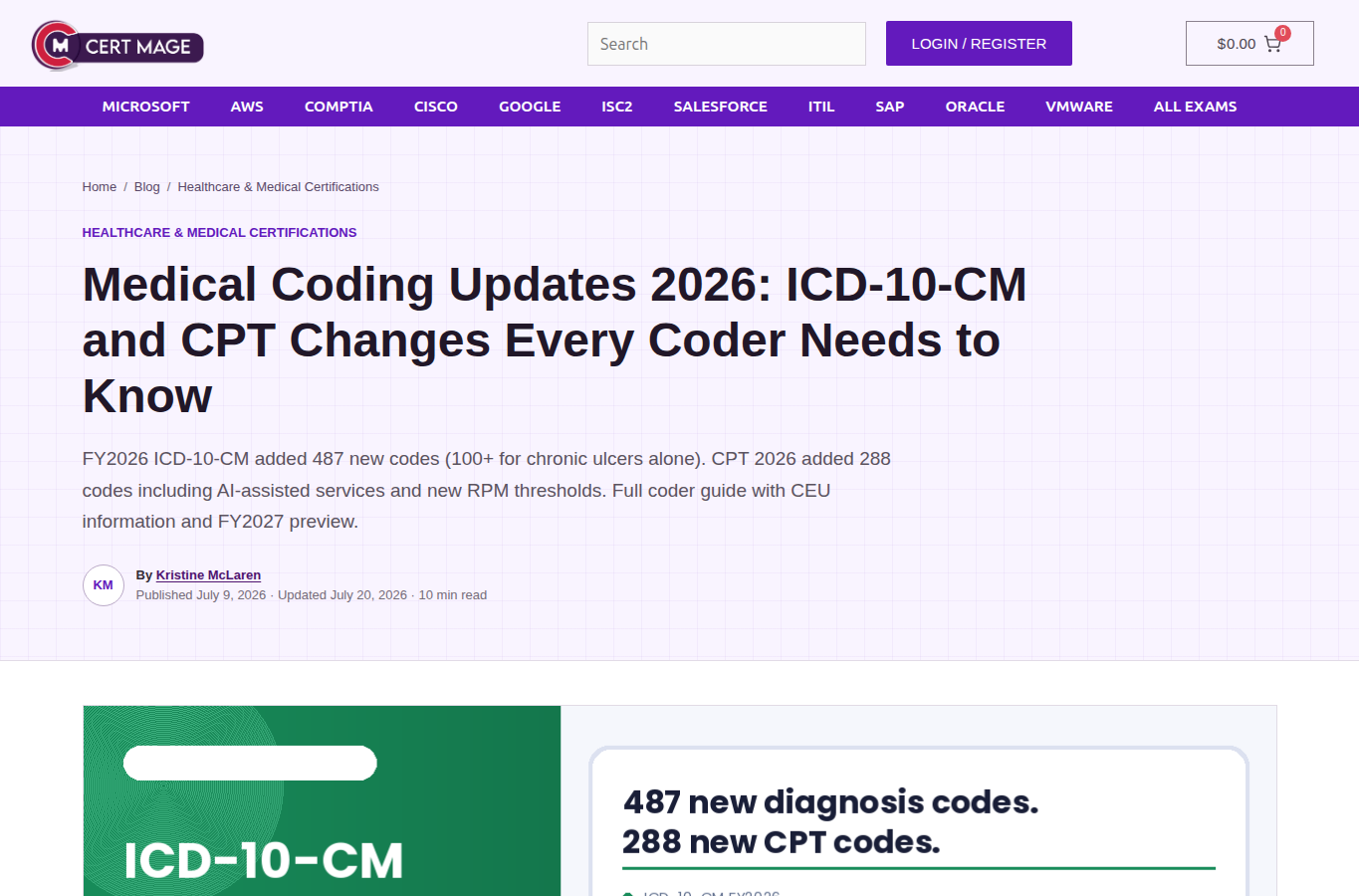
The scale of those updates is worth seeing. The CPT 2026 code set added 288 new procedure codes, deleted 84, and revised 46, while the FY2026 ICD-10-CM update added 487 diagnosis codes, deleted 28, and revised 38, according to a medical coding updates summary. The AMA has since released the CPT 2027 code set with 299 new codes among 453 total editorial changes, per the AMA's CPT 2027 announcement.
Two calendars, two update cycles, and a moving target for anyone studying. Buy current-year manuals, and check the effective dates before you assume a code is still valid.
Why Your Certificate Says CPC-A First
Pass the exam and you don't get CPC. You get CPC-A, where the A stands for apprentice. It's the same exam and the same knowledge base, but AAPC withholds full standing until you can show real-world coding experience.
The reasoning is straightforward. A test can verify that you know how to code. It can't verify that you've coded actual charts, worked against actual payer rules, or handled the messy documentation that never shows up in a clean exam scenario. The apprenticeship period exists to close that gap.
Removing the A typically requires documented work experience in medical coding, submitted to AAPC for verification. The exact hour requirements and acceptable experience categories are set by AAPC and do change, so confirm the current standard on their site before you plan around a number you read somewhere else.
What the A means practically:
- You can still list the credential on a resume and apply for coding roles
- Some employers hire CPC-A candidates deliberately, treating the apprenticeship as a training period
- Others screen for full CPC, which makes the A a real obstacle in certain markets
- The designation comes off once your experience is verified, and it's not a permanent mark
If you're career-changing into medical coding, plan for the A period. It's usually the difference between "certified and job hunting" and "certified and hired," and it's the part of the credential most people discover only after they've paid for the exam.
Keeping the Credential: CEUs, Renewal, and What Lapses Cost You
A CPC doesn't expire the way a driver's license does, but it does require maintenance. AAPC runs a two-year certification cycle, and you need continuing education units plus a renewal fee to stay current.
The CEU requirement is the part that surprises working coders. You're not just paying a fee every two years. You're earning credits, and a portion of them typically has to come from approved specialty areas rather than general topics. AAPC publishes the current cycle requirements and the breakdown of which CEUs count toward which category.
Staying current with annual code updates does double duty here. The same CPT and ICD-10-CM changes that affect your exam prep also generate CEU opportunities through AAPC-approved training, so the work you do to keep your coding accurate can feed the renewal requirement.
Let the credential lapse and you're not permanently locked out, but reinstatement usually costs more than renewal and may involve additional requirements. Calendar the renewal date. It's an easy thing to lose track of when you're heads-down on claims.
Where CPC Holders Actually Work
The credential points at physician and non-physician provider coding, but the job titles vary more than the certification name suggests.
Physician office and group practice coder. The core CPC role. You review provider documentation, assign CPT, HCPCS Level II, and ICD-10-CM codes, and get claims out the door accurately. This is the setting the exam is built around.
Outpatient facility coder. Similar skill set, different guidelines and often different code sets layered on top. Many CPCs move here after a few years.
Auditing and compliance. Once you know how coding should work, you can spot when it doesn't. Auditors review charts for accuracy, educate providers, and help organizations avoid payer takebacks. Denial rates topped 10% industry-wide in 2026, with deleted codes still in use and missing modifiers among the most common triggers, per a 2026 medical coding trends report. That environment keeps auditors busy.
Revenue cycle and denial management. Coders who understand why claims get rejected are valuable on the back end, working denials and payer disputes.
Risk adjustment and quality coding. A growing niche that applies the same documentation-review skills to different reporting programs.
Education and training. Experienced coders move into teaching, either for AAPC-approved programs or inside health systems onboarding new staff.
The credential also stacks. AAPC launched the Certified Professional Coder Master (CPC-M) credential in July 2026, aimed at senior coders who want to validate advanced judgment and leadership rather than entry-level proficiency. If you're mapping a long career, the CPC is the entry point, not the ceiling.
One adjacent path worth knowing: the CPB, or Certified Professional Biller, covers the claims and reimbursement side of the same workflow. Coders and billers work shoulder to shoulder in most practices, and some professionals hold both. If you're weighing which side of the revenue cycle fits you better, the CPB Certified Professional Biller credential is the natural comparison point.
How to Study for a Scenario-Based Coding Exam
The CPC rewards a specific kind of preparation, and it isn't the kind most people default to.
Reading the guidelines is necessary but not sufficient. You need to practice applying them to scenarios, because that's what the exam does. The gap between "I understand this guideline" and "I can pick the right code from four close options in 90 seconds" is where most failed attempts live.
A study approach that holds up:
- Work through the code sets section by section. Don't skip the low-volume sections. Anesthesia and radiology questions are worth the same as E/M questions.
- Practice with your actual manuals. Tab them the way you'll tab them on exam day. Your lookup speed is a scored skill.
- Run timed full-length sets. Partial practice doesn't reveal the fatigue problem. A 100-question timed simulation does.
- Review every wrong answer for the reason, not the code. If you missed a question because of a guideline note, that's the lesson. If you missed it because you misread the scenario, that's a different lesson.
- Re-test the domains you keep missing. Track which of the 17 knowledge areas produce your errors and drill those specifically.
That last point is where a diagnostic practice tool beats a stack of questions. If 60% of your misses come from three domains, you know exactly where the next two weeks go. ExamJungle's practice sets track performance by domain and let you drill a weak area directly, with explanations attached to each question so you're learning the reasoning rather than the answer key.
A simple readiness check before you book: score consistently above the passing threshold on full-length timed sets, across multiple attempts, with your error pattern spread thin rather than concentrated. If your misses cluster in one or two domains, you're not ready yet, no matter what the overall percentage says.
Questions Candidates Ask Before They Register
Do I need to be an AAPC member to take the CPC exam? Yes. AAPC requires current membership before you can schedule the exam, and renewing members also need an active membership to sit for a certification exam. Factor the membership cost into your total budget alongside the exam fee.
Is the CPC exam open book? Yes. You bring your own CPT, ICD-10-CM, and HCPCS Level II manuals. The exam tests your ability to find and apply codes correctly, not to recall them from memory.
How many questions are on the CPC exam? 100 multiple-choice questions spanning 17 areas of knowledge, most of them built around clinical coding scenarios.
What's the difference between CPC and CPC-A? CPC-A is the apprentice designation you receive after passing. The A comes off once you've documented the required coding work experience and AAPC verifies it.
Do I need medical coding experience before I take the exam? No. You can sit for the exam without prior work experience, which is why the CPC-A designation exists. Some background in medical terminology, anatomy, and pathophysiology helps considerably, and AAPC recommends it.
How often do I need to renew? AAPC runs a two-year certification cycle requiring continuing education units and a renewal fee. Check AAPC's current cycle requirements for the exact CEU count and category breakdown.
Does the CPC expire if I let it lapse? The credential lapses if you don't renew, and reinstatement typically costs more than a standard renewal and may carry additional requirements. Put the date on your calendar.
What to Do With This Information
The CPC certified professional coder credential covers a defined slice of healthcare: physician and non-physician provider coding, tested through 100 scenario-based questions across 17 knowledge areas, with an apprenticeship period standing between you and full standing.
The decision in front of you comes down to three questions. Do you want to work in physician-office coding specifically? Can you absorb the exam fee, membership cost, and current-year code manuals? And are you prepared to earn the experience that removes the A?
If the answers line up, the next step is figuring out where your coding knowledge actually stands. A timed practice set will tell you more in an hour than a week of reading guidelines, because it exposes the gap between recognizing a concept and applying it under pressure. That gap is what the exam measures.
More on Healthcare Credentials and Exam Prep