
PMHNP-C Sample Questions & Answers
Free Psychiatric Mental Health Nurse Practitioner (PMHNP) Certification Examination practice questions with worked answers and explanations. See how the ExamJungle simulator prepares you — then jump into the full test.
Launch the full PMHNP-C simulator →Showing 6 of 12 free samples.
- Question 1Intermediate
Assess · Perform mental status exam and a comprehensive risk assessment
A 34-year-old patient with major depressive disorder reports feeling "hopeless" and states, "Everyone would be better off if I weren't around." When the PMHNP conducts a comprehensive risk assessment, which finding indicates the highest imminent risk of suicide requiring immediate acute crisis intervention?
Show answer & explanation
Correct answer: C
Imminent suicide risk is defined by explicit intent, a concrete lethal plan, and available means, mandating immediate emergency containment.
- Question 2AdvancedSelect 2
Assess · Perform mental status exam and a comprehensive risk assessment
A PMHNP in an outpatient community behavioral clinic conducts a violence risk assessment on a 42-year-old client diagnosed with paranoid schizophrenia. Which TWO clinical features represent the strongest dynamic risk factors for imminent violence toward others? (Select TWO)
Show answer & explanation
Correct answers: B, D
Active command hallucinations directed at an identified target and concurrent substance intoxication are potent dynamic risk factors for imminent violence.
- Question 3Beginner
Plan · Manage psychiatric emergencies and crises
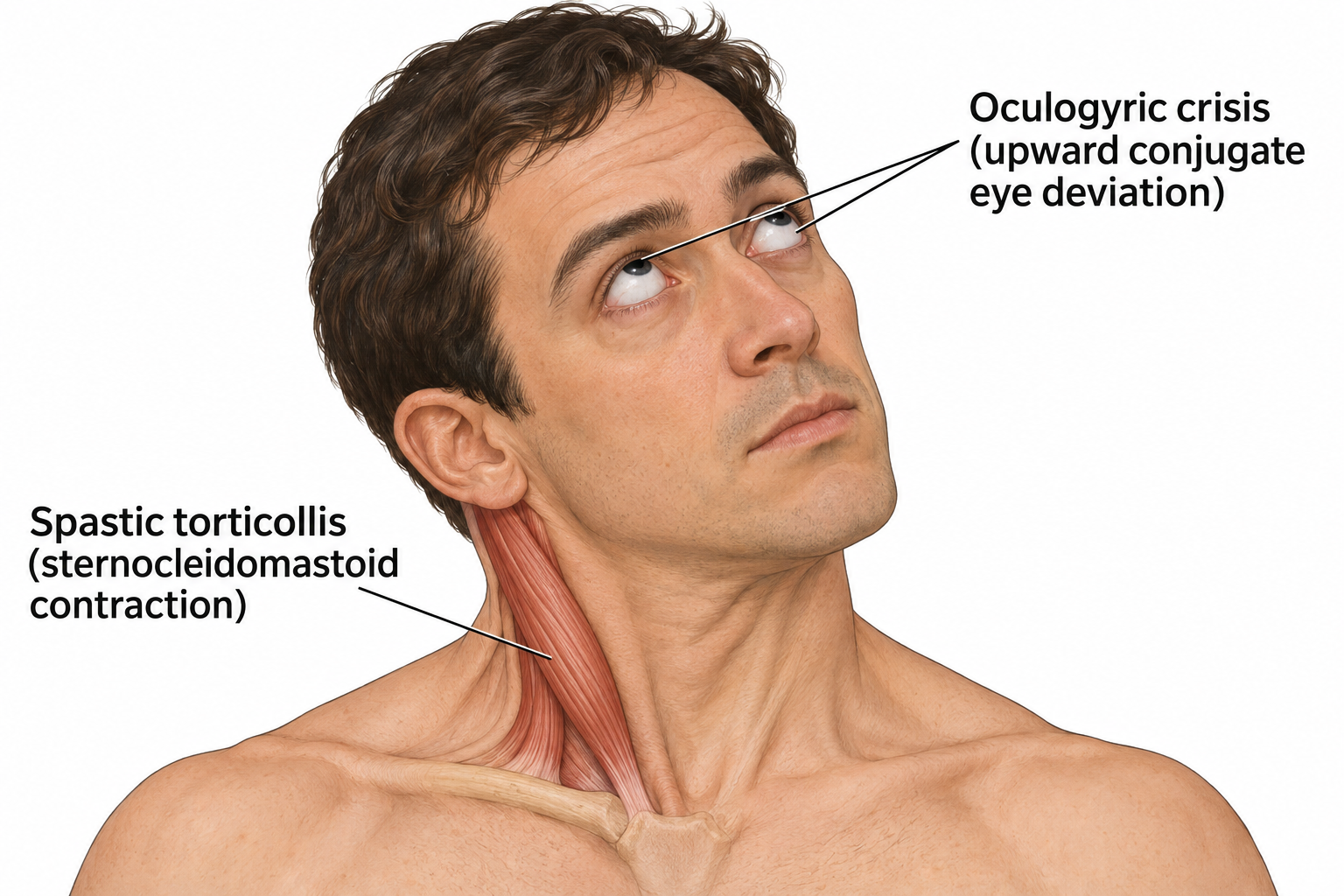
Ninety minutes after receiving an intramuscular injection of haloperidol 5 mg in the psychiatric emergency service, a 21-year-old male develops involuntary upward eye deviation (oculogyric crisis) and severe, painful lateral neck twisting (spastic torticollis). Which acute emergency intervention should the PMHNP order immediately?
Show answer & explanation
Correct answer: B
Acute dystonic reactions are extrapyramidal emergencies treated promptly with anticholinergics/antihistamines like IM diphenhydramine or benztropine.
- Question 4Advanced
Plan · Manage psychiatric emergencies and crises
An outpatient PMHNP evaluates a 50-year-old recently divorced male who states, "I have bought a loaded revolver, written goodbye letters to my children, and plan to shoot myself as soon as I leave this building." When informed that he requires immediate hospitalization, the patient stands up, refuses voluntary admission, and insists on walking out to his car. Which clinical and legal action is mandatory for the PMHNP?
Show answer & explanation
Correct answer: B
Imminent suicidal intent with access to lethal means mandates involuntary emergency hospitalization to preserve life when voluntary consent is refused.
- Question 5Intermediate
Evaluate · Monitor for and manage side effects and adverse events
In accordance with the American Diabetes Association (ADA) and American Psychiatric Association (APA) consensus guidelines for metabolic monitoring in patients prescribed second-generation antipsychotics, at what scheduled intervals should fasting blood glucose (or HbA1c) and lipid profiles be assessed?
Show answer & explanation
Correct answer: B
ADA/APA consensus guidelines specify metabolic monitoring at baseline, 12 weeks, and annually (with lipids repeated at least every 5 years if normal).
- Question 6Intermediate
Evaluate · Monitor for and manage side effects and adverse events
A 46-year-old patient taking lithium carbonate 600 mg twice daily presents to the clinic with coarse bilateral hand tremors, persistent vomiting, severe ataxia, slurred speech, and confusion. Laboratory evaluation reveals a serum lithium level of 2.2 mEq/L (therapeutic range: 0.6–1.2 mEq/L). Which management action should the PMHNP execute immediately?
Show answer & explanation
Correct answer: B
Lithium levels > 2.0 mEq/L represent moderate-to-severe toxicity with ataxia and CNS signs, requiring drug cessation and emergent medical care.
Ready for the real thing?
The full PMHNP-C simulator has every exam-style question, timed mode, and instant scoring.