
CTRN Sample Questions & Answers
Free Certified Transport Registered Nurse (CTRN) practice questions with worked answers and explanations. See how the ExamJungle simulator prepares you — then jump into the full test.
Launch the full CTRN simulator →Showing 6 of 12 free samples.
- Question 1Beginner
General Principles of Ground Transport Nursing Practice · Emergency vehicle operations
True or False: National ambulance collision data indicate that enacting a mandatory policy requiring a complete stop at all red lights and stop-controlled intersections significantly reduces intersection crash injury rates compared to merely slowing down.
Show answer & explanation
Correct answer: A
Mandating a full stop at negative-right-of-way intersections drastically lowers collision and injury rates, as intersections represent the highest crash risk zone.
- Question 2Intermediate
General Principles of Ground Transport Nursing Practice · Emergency vehicle operations
The critical care ground ambulance arrives at a multi-vehicle highway crash site. According to emergency vehicle lighting standards, which visual warning configuration should the driver select once the vehicle is safely parked across traffic lanes to protect responders?
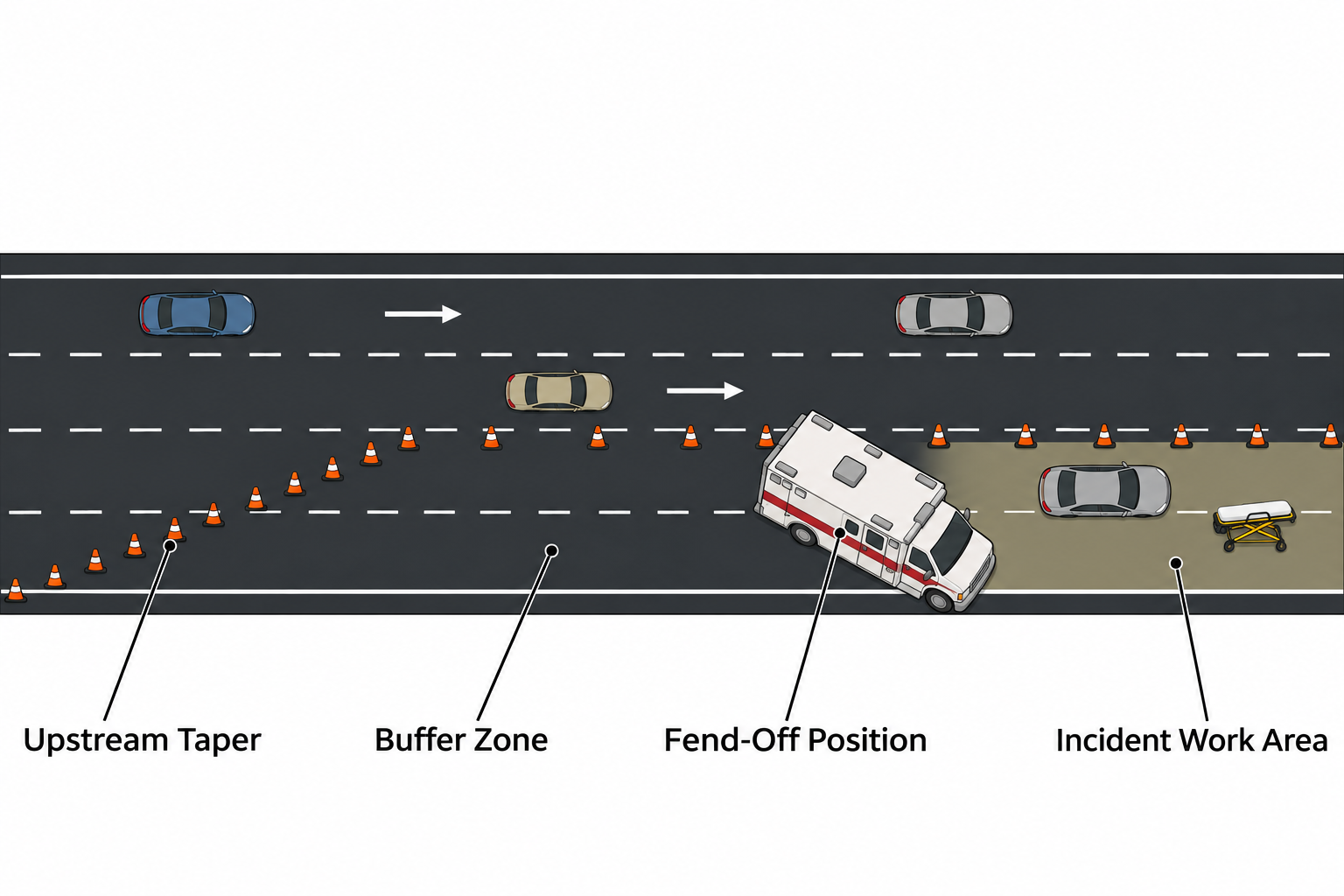
Show answer & explanation
Correct answer: D
Stationary scene lighting reduces blinding glare and disorienting strobe patterns while clearly marking the obstruction to oncoming traffic.
- Question 3Intermediate
General Principles of Ground Transport Nursing Practice · EMTALA
A rural community hospital emergency department physician contacts a specialized tertiary medical center to transfer an unstable patient with acute aortic dissection. The receiving tertiary facility accepts the patient but states that transfer acceptance is strictly conditional on utilizing the receiving facility's own contracted rotor-wing service rather than the referring hospital's dedicated critical care ground transport team. Under EMTALA regulations, how must this situation be handled?
Show answer & explanation
Correct answer: D
Under EMTALA, the transferring physician dictates the appropriate mode and personnel to minimize transit risk; an accepting facility cannot mandate a specific carrier.
- Question 4AdvancedSelect 2
General Principles of Ground Transport Nursing Practice · EMTALA
Under the Emergency Medical Treatment and Labor Act (EMTALA), which TWO conditions permit the interfacility transfer of an individual with an unstable emergency medical condition? (Select TWO)
Show answer & explanation
Correct answers: C, E
EMTALA permits transfer of an unstable patient if the patient requests it in writing after receiving risk disclosures, or if a physician certifies benefits exceed risks.
flowchart TD A[Unstable EMC] --> B{Valid Transfer Pathways} B --> C[Patient Written Request] B --> D[Physician Benefit-Risk Certification]A signed physician certification verifying that medical benefits outweigh transfer risks is an authorized statutory pathway for unstable patient transfers.
- Question 5Intermediate
Resuscitation Principles · Rapid Sequence Induction
A critical care transport nurse prepares to perform Rapid Sequence Induction (RSI) on an adult trauma patient with impending respiratory failure. A team member suggests applying continuous cricoid pressure (Sellick maneuver) during laryngoscopy. Based on current airway resuscitation guidelines, what is the primary reason this practice is no longer routinely recommended?
Show answer & explanation
Correct answer: D
Cricoid pressure impedes intubation, causes airway distortion, interferes with supraglottic airway placement, and fails to stop passive regurgitation.
- Question 6Intermediate
Resuscitation Principles · Rapid Sequence Induction
The transport team is preparing to intubate a 4-year-old child in severe septic shock. A local provider suggests administering atropine 0.04 mg IV as routine premedication to prevent vagally mediated bradycardia. What is the transport nurse's most appropriate response regarding this intervention?
Show answer & explanation
Correct answer: C
Current pediatric ALS guidelines do not support routine atropine premedication; doses below 0.1 mg can cause central anticholinergic paradoxical bradycardia.
Ready for the real thing?
The full CTRN simulator has every exam-style question, timed mode, and instant scoring.