
CHST Sample Questions & Answers
Free Construction Health and Safety Technician® (CHST®) practice questions with worked answers and explanations. See how the ExamJungle simulator prepares you — then jump into the full test.
Launch the full CHST simulator →Showing 6 of 12 free samples.
- Question 1Intermediate
Hazard and Risk Identification and Control · Common hazards and controls associated with fall protection, arrest, and restraint equipment
When selecting and rigging a personal fall arrest system (PFAS) utilizing a full-body harness under 29 CFR 1926.502, what is the maximum arresting force that may be imposed on an employee during fall arrest?
Show answer & explanation
Correct answer: B
29 CFR 1926.502(d)(16) limits the maximum arresting force on an employee using a full-body harness to 1,800 pounds. The 900-pound limit previously applied only to body belts, which are banned in PFAS.
- Question 2Intermediate
Hazard and Risk Identification and Control · Common hazards and controls associated with fall protection, arrest, and restraint equipment
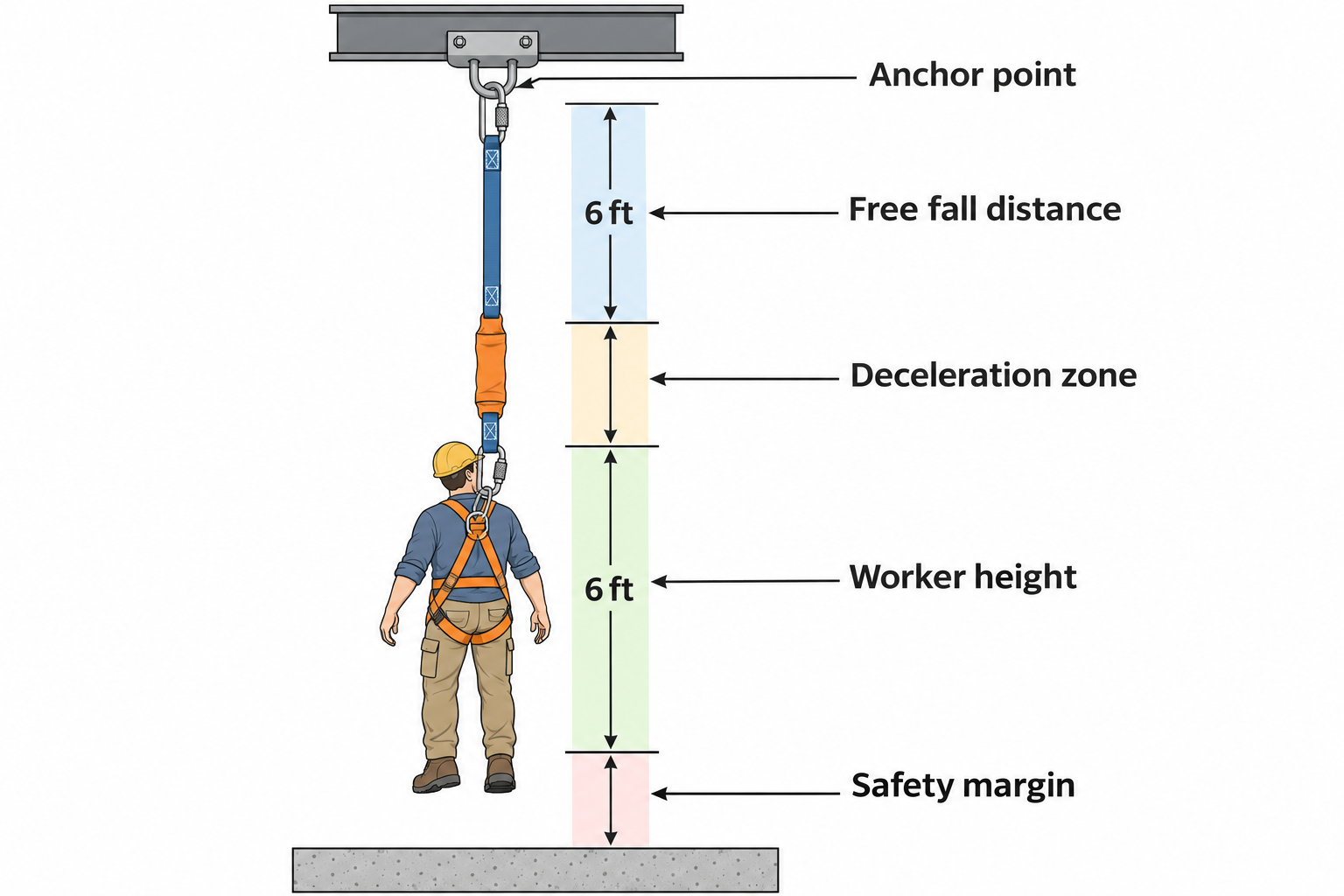
A structural ironworker is evaluating total fall clearance requirements before attaching a standard 6-foot shock-absorbing lanyard to an overhead I-beam anchorage. What is the maximum deceleration distance that the shock-absorbing mechanism is legally permitted to deploy under 29 CFR 1926.502?
Show answer & explanation
Correct answer: B
Under 29 CFR 1926.502(d)(16), personal fall arrest systems must bring an employee to a complete stop and limit total deceleration distance to no more than 3.5 feet.
- Question 3AdvancedSelect 2
Hazard and Risk Identification and Control · Common hazards and controls associated with fall protection, arrest, and restraint equipment
Under 29 CFR 1926.502, which TWO criteria meet OSHA requirements for an anchorage used to support a personal fall arrest system? (Select TWO)
Show answer & explanation
Correct answers: C, E
Anchorages must support at least 5,000 lbs per worker, or be engineered by a qualified person with a safety factor of 2 (29 CFR 1926.502(d)(15)). Scaffold rails rated at 200 lbs are inadequate.
- Question 4Intermediate
Hazard and Risk Identification and Control · Common hazards and controls associated with working in confined spaces
Before workers enter an unventilated vault classified as a permit-required confined space under 29 CFR 1926 Subpart AA, atmospheric testing must be performed. In what mandatory sequence must direct-reading atmospheric testing be conducted, and why?
flowchart TD Start([Initiate Atmospheric Testing]) --> Step1[Step 1: ?] Step1 --> Step2[Step 2: ?] Step2 --> Step3[Step 3: ?] Step3 --> Finish([Issue Entry Permit])Show answer & explanation
Correct answer: A
OSHA 1926.1207 dictates testing oxygen first, then flammables, then toxics. Combustibility sensors depend on sufficient oxygen to produce accurate readings.
- Question 5Beginner
Hazard and Risk Identification and Control · Common hazards and controls associated with working in confined spaces
True or False: Under 29 CFR 1926 Subpart AA, a direct-reading atmospheric monitor is acceptable for pre-entry evaluation of a permit-required confined space as long as its field calibration check shows an accuracy tolerance within ±20 percent of the known test gas concentration.
Show answer & explanation
Correct answer: A
Under 29 CFR 1926 Subpart AA, direct-reading atmospheric testing equipment must be calibrated according to manufacturer instructions with a minimum accuracy of +/-10 percent, not +/-20 percent.
- Question 6Intermediate
Hazard and Risk Identification and Control · Common hazards and controls associated with silica exposure
A masonry contractor equips all workers cutting concrete block outdoors with handheld power saws fitted with an integrated, commercially built continuous water feed system that satisfies all manufacturer requirements in Table 1 of 29 CFR 1926.1153. What administrative duty does this full compliance eliminate?
Show answer & explanation
Correct answer: D
Employers who fully implement Table 1 controls are exempt from conducting personal air monitoring and measuring against the PEL (29 CFR 1926.1153(c)). Written plans and competent persons are still required.
Ready for the real thing?
The full CHST simulator has every exam-style question, timed mode, and instant scoring.