
CDCES Sample Questions & Answers
Free Certified Diabetes Care and Education Specialist (CDCES) - Certification Examination for Diabetes Care and Education Specialists practice questions with worked answers and explanations. See how the ExamJungle simulator prepares you — then jump into the full test.
Launch the full CDCES simulator →Showing 6 of 12 free samples.
- Question 1Intermediate
Assessment · Mental health wellbeing (adjustment to diagnosis, coping ability, etc.)
A specialist is evaluating an adult with long-standing type 1 diabetes who expresses feelings of exhaustion, guilt, and emotional detachment regarding daily glucose tracking and carbohydrate counting. Which assessment tool specifically differentiates diabetes distress from major depressive disorder?
Show answer & explanation
Correct answer: C
The PAID scale evaluates emotional distress specific to diabetes self-care, distinguishing diabetes distress from general depression.
- Question 2IntermediateSelect 2
Assessment · Mental health wellbeing (adjustment to diagnosis, coping ability, etc.)
According to clinical guidelines, routine screening for psychosocial challenges and diabetes distress should occur at specific touchpoints. Which TWO clinical situations indicate an immediate need for psychosocial re-screening? (Select TWO)
Show answer & explanation
Correct answers: B, D
Persistent failure to meet treatment targets frequently signals underlying diabetes distress, depression, or coping barriers.
Regimen intensification and complication emergence represent critical stress points requiring focused psychosocial evaluation.
- Question 3Intermediate
Assessment · Monitoring and data collection (glucose, ketones, weight, dietary intake, activity, etc.)
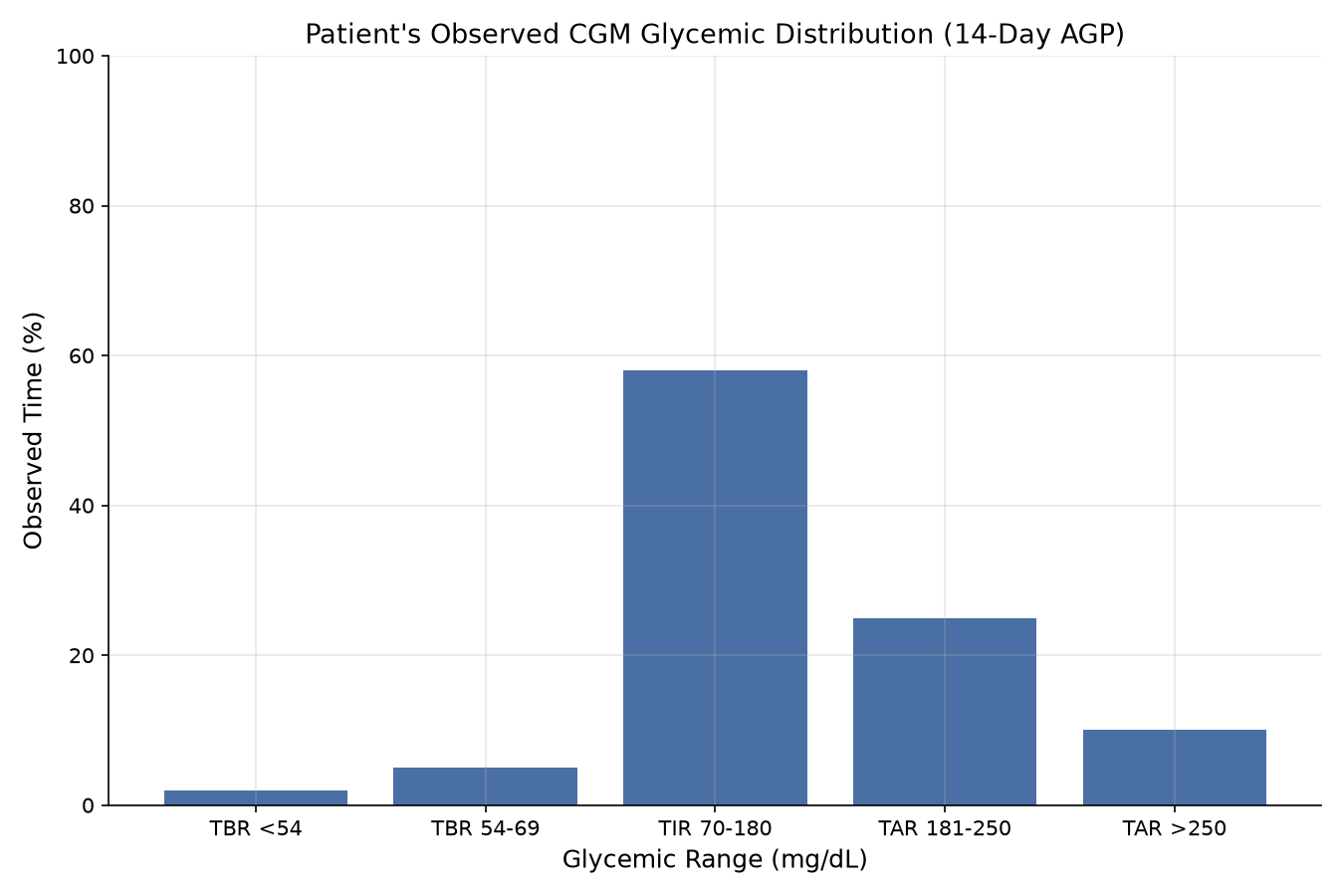
A specialist is analyzing a continuous glucose monitoring (CGM) Ambulatory Glucose Profile report for a 38-year-old nonpregnant adult with type 1 diabetes. In accordance with international consensus benchmarks, what is the target percentage for Time in Range (70–180 mg/dL)?
Show answer & explanation
Correct answer: B
For nonpregnant adults with diabetes, the standard consensus target for Time in Range (70–180 mg/dL) is greater than 70%.
- Question 4Beginner
Assessment · Monitoring and data collection (glucose, ketones, weight, dietary intake, activity, etc.)
To confirm that continuous glucose monitoring (CGM) metrics are clinically valid for making therapeutic decisions, what minimum wear duration and percentage of active sensor data collection are required?
Show answer & explanation
Correct answer: B
A minimum of 14 consecutive days of wear with at least 70% of active data is standard to generate an accurate AGP profile.
- Question 5Intermediate
Assessment · Monitoring and data collection (glucose, ketones, weight, dietary intake, activity, etc.)
A 78-year-old individual with long-standing type 2 diabetes and mild cognitive impairment utilizes a continuous glucose monitor (CGM). When reviewing the 14-day AGP report, which glycemic consensus targets represent the recommended goal for this older, high-risk adult?
Show answer & explanation
Correct answer: A
For older or complex adults at high risk of hypoglycemia, the consensus goal is relaxed to TIR >50% and TBR (<70 mg/dL) <1%.
- Question 6Beginner
Assessment · Literacy, numeracy, health literacy, and digital literacy
When developing written self-management materials to accommodate low health literacy across diverse clinical populations, the reading level should not exceed the _____ grade.
Show answer & explanation
Correct answer: C
Health literacy guidelines recommend designing patient educational literature at or below a 6th-grade reading level.
Ready for the real thing?
The full CDCES simulator has every exam-style question, timed mode, and instant scoring.