
300-515 Sample Questions & Answers
Free Implementing Cisco Service Provider VPN Services (SPVI) practice questions with worked answers and explanations. See how the ExamJungle simulator prepares you — then jump into the full test.
Launch the full 300-515 simulator →Showing 8 of 17 free samples.
- Question 1IntermediateSelect 2
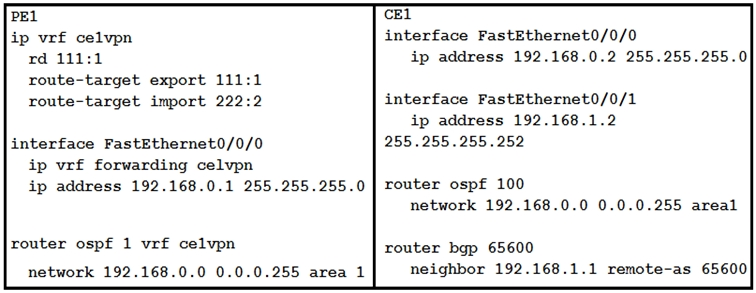
Refer to the exhibit. If the two devices are operating normally, which two conclusions can you draw from this configuration? (Choose two.)
Show answer & explanation
Correct answers: A, C
- Question 2IntermediateSelect 2
Which two frames can be configured on an Ethernet flow point? (Choose two.) A.of a specific VLANB.with different type of service valuesC.with identical type of service valueD.with different class of service valuesE.with no tags
Show answer & explanation
Correct answers: A, E
- Question 3Intermediate
In an Ethernet Virtual Circuit environment, which restriction do bridge domains have when STP is running? A.The STP mode must be RSTP or PVST+B.Bridge domains must be mapped to a different VLAN.C.The STP mode must be MSTPD.Bridge domains must belong to different MST instances.
Show answer & explanation
Correct answer: C
- Question 4Intermediate
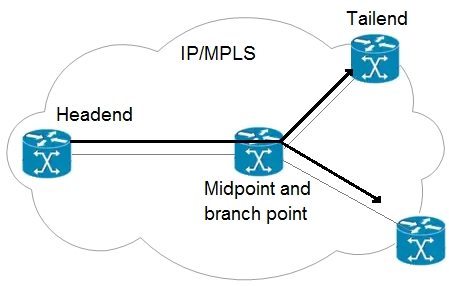
Refer to the exhibit. An engineer is implementing an MPLS P2MP TE solution. Which type of router can serve as the midpoint router and the tailend router in thisP2MP TE network implementation? A.headendB.sourceC.transitD.bud
Show answer & explanation
Correct answer: D
- Question 5Advanced
Layer 3 VPNs · Describe Inter-AS L3VPNs
A Senior Network Architect is designing a high-scale Inter-AS L3VPN solution between two large service providers, SP-A (AS 65100) and SP-B (AS 65200). The design requirements specify that the Autonomous System Boundary Routers (ASBRs) must NOT store VPNv4 routes due to memory constraints. Furthermore, the solution must scale to support thousands of VPNs without requiring per-VPN configuration on the ASBRs. Which Inter-AS option satisfies these specific constraints?
Show answer & explanation
Correct answer: C
Inter-AS Option C uses a multihop MP-eBGP session directly between PEs (or Route Reflectors) in different autonomous systems to exchange VPNv4 routes. The ASBRs only exchange labeled IPv4 routes (BGP-LU) to provide reachability to the PE loopbacks. This allows the ASBRs to function without storing any VPNv4 routes, satisfying the memory constraint requirement.
- Question 6Intermediate
Layer 2 VPNs · Describe EVPN concepts
During a troubleshooting session of an EVPN-VXLAN deployment, an engineer captures BGP updates to verify MAC address propagation. They observe a specific route type containing the MAC address '0050.569a.4b12' and the IP address '192.168.10.50' in the NLRI. Which EVPN Route Type is being observed?
Show answer & explanation
Correct answer: C
EVPN Route Type 2 is the MAC/IP Advertisement route. It is responsible for advertising MAC addresses (for L2 forwarding) and optionally IP addresses (for ARP suppression and IRB) of hosts connected to the EVPN fabric.
- Question 7Advanced
Layer 3 VPNs · Describe CSC concepts
A service provider is deploying a Carrier Supporting Carrier (CSC) architecture where the customer carrier is also running MPLS. When a packet traverses the backbone carrier's core (P routers), how many MPLS labels will be in the label stack, assuming Penultimate Hop Popping (PHP) is enabled and no Traffic Engineering is used?
Show answer & explanation
Correct answer: A
In a CSC environment where the customer is sending labeled traffic, the stack typically consists of: Top Label (Backbone IGP/LDP transport), Middle Label (Backbone VPN label advertised by CSC-PE to reach Customer-PE), and Bottom Label (Customer's internal VPN label). Thus, inside the backbone, there are 3 labels.
- Question 8Intermediate
Layer 2 VPNs · Implement Ethernet Operations, Administration, and Maintenance
An engineer is implementing Ethernet OAM on a Provider Edge router to monitor a point-to-point E-Line service. They need to configure a mechanism that continuously monitors the delay and delay variation (jitter) of the service to ensure SLA compliance. Which Y.1731 message type should be configured?
Show answer & explanation
Correct answer: D
Y.1731 defines DMM (Delay Measurement Message) and DMR (Delay Measurement Reply) specifically for measuring one-way or two-way frame delay and frame delay variation (jitter).
Ready for the real thing?
The full 300-515 simulator has every exam-style question, timed mode, and instant scoring.