
350-601 Sample Questions & Answers
Routing, switching and overlay protocols tie with policies for UCS rack and blade servers for the top weight, alongside iSCSI, FCoE and Fibre Channel storage, scripting and orchestration tools, and compute plus storage security.
Launch the full 350-601 simulator →Showing 10 of 20 free samples.
- Question 1Select 2
A user retrieves data in XML format from a Cisco APIC device by submitting a GET request on TCP port 443. Which of the following technologies are most likely in use? (Choose two.)
Show answer & explanation
Correct answers: B, E
REST API and HTTPS are the technologies most likely in use. The GET request indicates a REST API call being made to retrieve data, and TCP port 443 confirms HTTPS (HTTP Secure) is being used for encrypted communication. XML format is a common data format returned by REST APIs when querying Cisco APIC. JSON would be an alternative format, HTTP would use port 80 (not 443), and SOAP API typically uses different request methods and XML structures.
HTTPS is confirmed by the use of TCP port 443, which is the standard secure HTTP port that provides encrypted communication between the client and the APIC device. This ensures secure transmission of the XML data being retrieved.
- Question 2
During the APIC cluster discovery process, LLDP is used for which of the following tasks?
Show answer & explanation
Correct answer: C
Link-Layer Discovery Protocol (LLDP) is used for discovering private IP addresses during the Cisco APIC cluster discovery process. LLDP enables APIC controllers to discover each other and exchange private IP address information for cluster formation. This allows the APICs to establish secure tunnels and coordinate cluster operations without relying on public IP addresses or external discovery mechanisms.
- Question 3Select 2
In which of the following formats does a REST API produce output? (Choose two.)
Show answer & explanation
Correct answers: A, D
REST APIs commonly produce output in XML format, which is a structured markup language that uses tags to define data elements and provides hierarchical data representation. XML is widely supported by web services and APIs, making it a standard format for data exchange. CSV and HTML are not standard REST API output formats, and binary formats are typically not used for REST API responses.
REST APIs frequently produce output in JSON (JavaScript Object Notation) format, which is a lightweight, human-readable data interchange format. JSON has become the preferred format for many REST APIs due to its simplicity, native support in web browsers and programming languages, and smaller payload size compared to XML. Binary and CSV formats are not standard REST API output formats.
- Question 4
Which of the following is a cloud computing deployment model that shares infrastructure with multiple organizations that have common needs?
Show answer & explanation
Correct answer: B
Community is a cloud computing deployment model that shares infrastructure with multiple organizations that have common needs, concerns, or compliance requirements. Unlike public clouds that serve any customer, community clouds are restricted to specific groups with shared interests such as government agencies, healthcare organizations, or financial institutions. Hybrid clouds combine multiple deployment models, and public/private clouds do not specifically address shared infrastructure among organizations with common needs.
- Question 5
Which of the following type of communication is not governed by contracts in an ACI fabric?
Show answer & explanation
Correct answer: A
Communication between members of the same endpoint group (EPG) is not governed by contracts in a Cisco ACI fabric. By default, members of an EPG can communicate freely with each other without requiring contracts, as they are considered to be in the same security domain. Contracts are only required for inter-EPG communication, communication between different bridge domains, and external network access. This intra-EPG communication uses the bridge domain forwarding behavior.
- Question 6
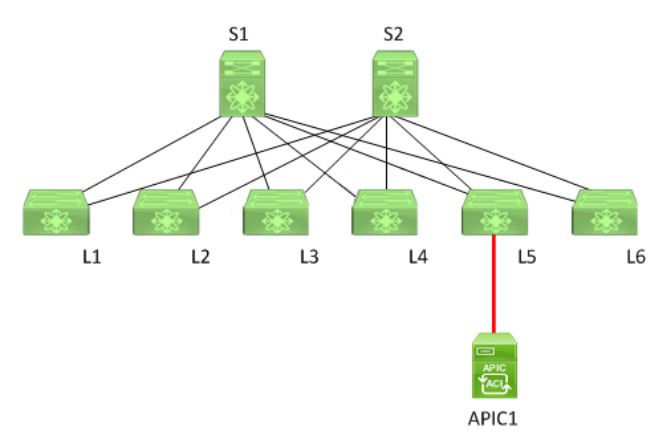
You manage the Cisco ACI fabric in the following figure: S2 has just been discovered by APIC1. Only one leaf switch has been discovered and registered with APIC1 so far. No other spine switches have been discovered. Which of the following switches will most likely be discovered next?
Show answer & explanation
Correct answer: B
Based on the network topology, S1 will most likely be discovered next because ACI fabric discovery follows a systematic pattern where spine switches are discovered through their direct connections. After S2 spine switch is discovered by APIC1, the fabric discovery process continues by finding adjacent spine switches that connect to the same leaf switches. S1 is the logical next spine switch in the discovery sequence as it shares connectivity with the same fabric infrastructure.
- Question 7
You want to implement GSLB. Which of the following are you most likely to deploy?
Show answer & explanation
Correct answer: D
Most likely, you will deploy a Cisco Global Site Selector (GSS) device if you want to implement Global Server Load Balancing (GSLB). Cisco GSS provides intelligent DNS-based load balancing across geographically distributed data centers, optimizing user traffic routing based on server availability, proximity, and network conditions. The other options (ASA firewall, CSM module, and CSS appliance) provide different types of load balancing or security functions but are not specifically designed for global server load balancing.
- Question 8
Which of the following is true of Cisco FabricPath edge ports?
Show answer & explanation
Correct answer: D
Cisco FabricPath edge ports are classic Ethernet ports that connect end devices to the FabricPath fabric. These ports function as standard Layer 2 Ethernet interfaces and maintain compatibility with existing Ethernet devices and protocols. FabricPath uses Layer 3 routing combined with Layer 2 switching internally within the fabric, but edge ports present a traditional Ethernet interface to connected devices. Core ports connect FabricPath switches together, while edge ports provide device connectivity.
- Question 9
Which of the following is best described as the atomic units of work in Cisco UCS Director Orchestrator?
Show answer & explanation
Correct answer: E
Tasks are best described as the atomic units of work in Cisco UCS Director Orchestrator. Tasks represent the smallest executable units that perform specific operations within workflows, such as provisioning a VM, creating a VLAN, or configuring storage. These tasks can be combined into workflows to automate complex multi-step processes. Templates, policies, and workflows are higher-level constructs that utilize tasks as their basic building blocks.
- Question 10
Which OTV failure isolation feature ensures that BPDUs are not forwarded across the overlay?
Show answer & explanation
Correct answer: C
OTV STP isolation feature ensures that Bridge Protocol Data Units (BPDUs) are not forwarded across the overlay network. This feature is enabled by default and prevents spanning tree topology changes in one data center from affecting the spanning tree domain in another data center. By suppressing BPDUs, OTV maintains independent STP domains on each site while allowing data traffic to flow across the overlay. ARP suppression, MAC learning suppression, and broadcast suppression serve different isolation purposes.
Ready for the real thing?
The full 350-601 simulator has every exam-style question, timed mode, and instant scoring.