
1Y0-240 Sample Questions & Answers
Free Citrix NetScaler 12 Essentials and Traffic Management practice questions with worked answers and explanations. See how the ExamJungle simulator prepares you — then jump into the full test.
Launch the full 1Y0-240 simulator →Showing 6 of 12 free samples.
- Question 1
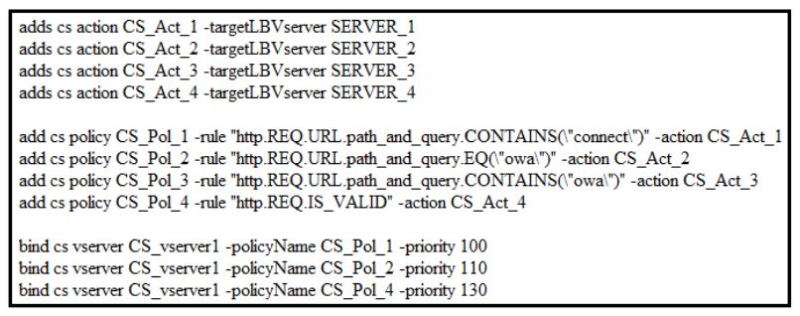
Scenario: A Citrix Administrator observes that when the client gets redirected to the URL www.citrix.com/owa/search?q-userbame, an HTTP 503 response is received from the Content Switching vServer.
How will the administrator correct the issue?
The relevant configuration is as follows:
Show answer & explanation
Correct answer: D
Based on the Content Switching configuration shown in the image, binding CS_POL_3 with priority 90 will resolve the HTTP 503 error. The image shows CS_Pol_3 has a rule for URL paths containing "owa" that targets SERVER_3, but CS_Pol_3 is not currently bound to the Content Switching vserver. When clients access www.citrix.com/owa/search, they receive HTTP 503 because no policy matches the "owa" path. Binding CS_POL_3 provides the missing policy to route owa traffic to SERVER_3, while unbinding other policies would not resolve the core routing issue.
- Question 2
A Citrix Administrator needs to match the host name ‘www.example.com’ in all HTTP requests.
Which expression, when used, meets this requirement?Show answer & explanation
Correct answer: A
HTTP.REQ.HOSTNAME.EQ("www.example.com") correctly matches the exact hostname in HTTP request headers for traffic management policies. The HTTP.REQ namespace evaluates incoming client requests, HOSTNAME extracts the Host header value, and EQ performs exact string comparison. The other options are incorrect because they use malformed syntax, target HTTP responses (HTTP.RES) instead of requests, or use CONTAINS which would match partial hostnames rather than the specific requirement.
- Question 3
What is the first thing a Citrix Administrator should create when creating a Server Certificate for Citrix ADC to secure traffic?
Show answer & explanation
Correct answer: C
A Certificate Signing Request (CSR) is the first step in creating a server certificate for Citrix ADC, as it contains the public key and organizational details needed by the Certificate Authority. The CSR generation process automatically creates the private key pair and formats the request for CA submission. While certificate key-pairs and private keys are involved, they are created as part of the CSR process, and certificate revocation lists are used for certificate validation, not creation.
- Question 4
Scenario: A Citrix Administrator would like to grant access to a Junior Administrator on the Citrix ADC. The administrator would like to grant full access to everything except the following:
Shell Access
User Configuration access
Partition Configuration accessWhich pre-existing command policy would meet the needs of the scenario?
Show answer & explanation
Correct answer: D
The Sysadmin role provides comprehensive administrative access while restricting shell access, user configuration, and partition management - ideal for Junior Administrator permissions. Sysadmin users can manage applications, load balancing, SSL certificates, and network configurations without full superuser privileges. Unlike Superuser (full access), Network (limited scope), or Operator (read-only), Sysadmin meets the specific requirement for broad access while excluding the three restricted areas.
- Question 5
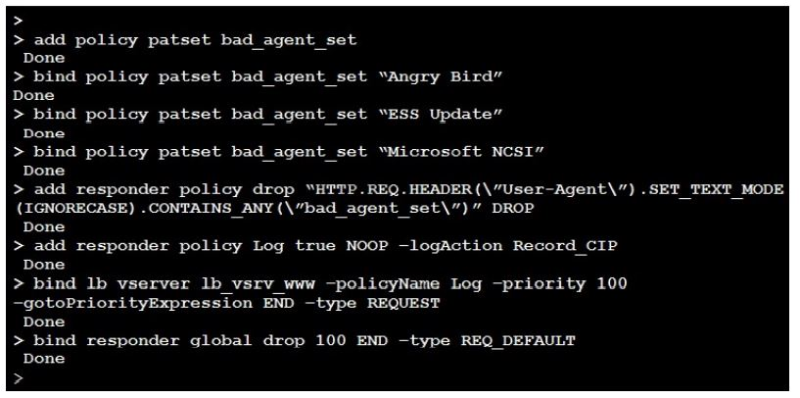
Scenario: A Citrix Administrator used the commands in the screenshot to apply the user-agent check to all the vServers. However, the administrator observed that it is NOT being applied to the vServer lb_vsrv_www.
View the screenshot of the command-line interface below.
What can be causing this issue?
Show answer & explanation
Correct answer: D
Based on the command-line screenshot, two responder policies are bound to the same vServer lb_vsrv_www, causing policy conflicts. The image shows the Log responder policy bound to lb_vsrv_www at priority 100 for REQUEST type, while the global drop policy is also bound with different binding parameters. Multiple responder policies on the same vserver with overlapping conditions prevent proper policy evaluation, causing the user-agent check to not be applied correctly. Pattern sets, logging actions, and global binding types are configured correctly but the dual policy binding is the root cause.
- Question 6
Scenario: A Citrix Administrator is troubleshooting a Citrix ADC issue. The administrator goes to the command line and from the Shell, tails the ns.log to view the log in real time to find the issue. After a few minutes, the administrator noticed that the logs stopped scrolling and the issue wasmissed.
How can troubleshooting continue using the ns.log?Show answer & explanation
Correct answer: D
The ns.log file has reached its 100 KB size limit during real-time monitoring, causing the tail command to stop displaying new log entries. Citrix ADC rotates log files when they reach the maximum size to prevent disk space issues. The administrator should press CTRL+C to stop the current tail command and then issue "tail -f ns.log" to resume monitoring the newly rotated log file. This is normal log rotation behavior, not a service failure or client-side viewing issue.
Ready for the real thing?
The full 1Y0-240 simulator has every exam-style question, timed mode, and instant scoring.