
CSSLP Sample Questions & Answers
Free Certified Secure Software Lifecycle Professional (CSSLP) practice questions with worked answers and explanations. See how the ExamJungle simulator prepares you — then jump into the full test.
Launch the full CSSLP simulator →Showing 9 of 19 free samples.
- Question 1
Which of the following types of signatures is used in an Intrusion Detection System to trigger on attacks that attempt to reduce the level of a resource or system, or to cause it to crash?
Show answer & explanation
Correct answer: C
Explanation:
Following are the basic categories of signatures: Informational (benign): These types of signatures trigger on normal network activity. For example: ICMP echo requests The opening or closing of TCP or UDP connections Reconnaissance: These types of signatures trigger on attacks that uncover resources and hosts that are reachable, as well as any possible vulnerabilities that they might contain. For example: Reconnaissance attacks include ping sweeps DNS queries Port scanning Access: These types of signatures trigger on access attacks, which include unauthorized access, unauthorized escalation of privileges, and access to protected or sensitive data. For example:
Back Orifice A Unicode attack against the Microsoft IIS NetBus DoS: These types of signatures trigger on attacks that attempt to reduce the level of a resource or system, or to cause it to crash. For example: TCP SYN floods The Ping of Death Smurf Fraggle Trinoo Tribe Flood Network - Question 2Select 4
ISO 27003 is an information security standard published by the International Organization for Standardization (ISO) and the International Electrotechnical Commission (IEC). Which of the following elements does this standard contain? Each correct answer represents a complete solution. Choose all that apply.
Show answer & explanation
Correct answers: A, C, E, F
A, C, E, F -- Explanation:
ISO 27003 is an information security standard published by the International Organization for Standardization (ISO) and the International Electrotechnical Commission (IEC). It is entitled as "Information Technology - Security techniques - Information security management system implementation guidance". The ISO 27003 standard provides guidelines for implementing an ISMS (Information Security Management System). It mainly focuses upon the PDCA method along with establishing, implementing, reviewing, and improving the ISMS itself. The ISO 27003 standard contains the following elements: Introduction Scope Terms and Definitions CSFs (Critical success factors) Guidance on process approach Guidance on using PDCA Guidance on Plan Processes Guidance on Do Processes Guidance on Check Processes Guidance on Act Processes Inter-Organization Co-operation Answer: B is incorrect. This element is included in the ISO 27005 standard. Answer: D is incorrect. This element is included in the ISO 27006 standard.A, C, E, F -- Explanation:
ISO 27003 is an information security standard published by the International Organization for Standardization (ISO) and the International Electrotechnical Commission (IEC). It is entitled as "Information Technology - Security techniques - Information security management system implementation guidance". The ISO 27003 standard provides guidelines for implementing an ISMS (Information Security Management System). It mainly focuses upon the PDCA method along with establishing, implementing, reviewing, and improving the ISMS itself. The ISO 27003 standard contains the following elements: Introduction Scope Terms and Definitions CSFs (Critical success factors) Guidance on process approach Guidance on using PDCA Guidance on Plan Processes Guidance on Do Processes Guidance on Check Processes Guidance on Act Processes Inter-Organization Co-operation Answer: B is incorrect. This element is included in the ISO 27005 standard. Answer: D is incorrect. This element is included in the ISO 27006 standard.A, C, E, F -- Explanation:
ISO 27003 is an information security standard published by the International Organization for Standardization (ISO) and the International Electrotechnical Commission (IEC). It is entitled as "Information Technology - Security techniques - Information security management system implementation guidance". The ISO 27003 standard provides guidelines for implementing an ISMS (Information Security Management System). It mainly focuses upon the PDCA method along with establishing, implementing, reviewing, and improving the ISMS itself. The ISO 27003 standard contains the following elements: Introduction Scope Terms and Definitions CSFs (Critical success factors) Guidance on process approach Guidance on using PDCA Guidance on Plan Processes Guidance on Do Processes Guidance on Check Processes Guidance on Act Processes Inter-Organization Co-operation Answer: B is incorrect. This element is included in the ISO 27005 standard. Answer: D is incorrect. This element is included in the ISO 27006 standard.A, C, E, F -- Explanation:
ISO 27003 is an information security standard published by the International Organization for Standardization (ISO) and the International Electrotechnical Commission (IEC). It is entitled as "Information Technology - Security techniques - Information security management system implementation guidance". The ISO 27003 standard provides guidelines for implementing an ISMS (Information Security Management System). It mainly focuses upon the PDCA method along with establishing, implementing, reviewing, and improving the ISMS itself. The ISO 27003 standard contains the following elements: Introduction Scope Terms and Definitions CSFs (Critical success factors) Guidance on process approach Guidance on using PDCA Guidance on Plan Processes Guidance on Do Processes Guidance on Check Processes Guidance on Act Processes Inter-Organization Co-operation Answer: B is incorrect. This element is included in the ISO 27005 standard. Answer: D is incorrect. This element is included in the ISO 27006 standard. - Question 3
Certification and Accreditation (C&A or CnA) is a process for implementing information security. Which of the following is the correct order of C&A phases in a DITSCAP assessment?
Show answer & explanation
Correct answer: C
Explanation:
C&A consists of four phases in a DITSCAP assessment. These phases are the same as NIACAP phases. The order of these phases is as follows: 1.Definition: The definition phase is focused on understanding the IS business case, the mission, environment, and architecture. This phase determines the security requirements and level of effort necessary to achieve Certification & Accreditation (C&A). 2.Verification: The second phase confirms the evolving or modified system's compliance with the information. The verification phase ensures that the fully integrated system will be ready for certification testing. 3.Validation: The third phase confirms abidance of the fully integrated system with the security policy. This phase follows the requirements slated in the SSAA. The objective of the validation phase is to show the required evidence to support the DAA in accreditation process. 4.Post Accreditation: The Post Accreditation is the final phase of DITSCAP assessment and it starts after the system has been certified and accredited for operations. This phase ensures secure system management, operation, and maintenance to save an acceptable level of residual risk. - Question 4
You work as a project manager for BlueWell Inc. You with your team are using a method or a (technical) process that conceives the risks even if all theoretically possible safety measures would be applied. One of your team member wants to know that what is a residual risk. What will you reply to your team member?
Show answer & explanation
Correct answer: D
Explanation:
Residual risks are generally smaller risks that remain in the project after larger risks have been addressed. The residual risk is the risk or danger of an action or an event, a method or a (technical) process that still conceives these dangers even if all theoretically possible safety measures would be applied. The formula to calculate residual risk is (inherent risk) x (control risk) where inherent risk is (threats vulnerability). Answer: B is incorrect. This is not a valid statement about residual risks. Answer: C is incorrect. This is not a valid statement about residual risks. Answer: A is incorrect. This is not a valid statement about residual risks. - Question 5
In which of the following phases of the SDLC does the software and other components of the system faithfully incorporate the design specifications and provide proper documentation and training?
Show answer & explanation
Correct answer: C
Explanation:
In the programming and training phase of the SDLC, the software and other components of the system faithfully incorporate the design specifications, and proper documentation and training are provided. Answer: D is incorrect. During the initiation phase, the need for a system is expressed and the purpose of the system is documented. Answer: A is incorrect. During the design phase, systems requirements are incorporated into design. This phase specifies to include controls that support the auditing of the system. Answer: B is incorrect. During the evaluation and acceptance phase, the system and data are validated, all the control requirements and the user requirements are met by the system. - Question 6
Drop the appropriate value to complete the formula.
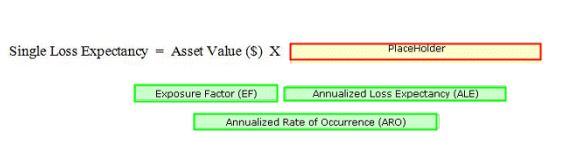
Show answer & explanation
Correct answer: A
A
- Question 7
You are the project manager of QSL project for your organization. You are working with your project team and several key stakeholders to create a diagram that shows how various elements of a system interrelate and the mechanism of causation within the system. What diagramming technique are you using as a part of the risk identification process?
Show answer & explanation
Correct answer: D
Explanation:
In this example you are using a system or process flowchart. These can help identify risks within the process flow, such as bottlenecks or redundancy. Answer: A is incorrect. A cause and effect diagram, also known as an Ishikawa or fishbone diagram, can reveal causal factors to the effect to be solved. Answer: B is incorrect. An influence diagram shows causal influences, time ordering of events and relationships among variables and outcomes. Answer: C is incorrect. Predecessor and successor diagramming is not a valid risk identification term. - Question 8Select 3
You work as a Security Manager for Tech Perfect Inc. You want to save all the data from the SQL injection attack, which can read sensitive data from the database and modify database data using some commands, such as Insert, Update, and Delete. Which of the following tasks will you perform? Each correct answer represents a complete solution. Choose three.
Show answer & explanation
Correct answers: B, C, D
B, C, D -- Explanation:
The methods of mitigating SQL injection attacks are as follows: 1.Create parameterized queries by using bound and typed parameters. 2.Create parameterized stored procedures. 3.Use a encapsulated library in order to access databases. 4.Minimize database permissions. Answer: A is incorrect. In order to save all the data from the SQL injection attack, you should minimize database permissions.B, C, D -- Explanation:
The methods of mitigating SQL injection attacks are as follows: 1.Create parameterized queries by using bound and typed parameters. 2.Create parameterized stored procedures. 3.Use a encapsulated library in order to access databases. 4.Minimize database permissions. Answer: A is incorrect. In order to save all the data from the SQL injection attack, you should minimize database permissions.B, C, D -- Explanation:
The methods of mitigating SQL injection attacks are as follows: 1.Create parameterized queries by using bound and typed parameters. 2.Create parameterized stored procedures. 3.Use a encapsulated library in order to access databases. 4.Minimize database permissions. Answer: A is incorrect. In order to save all the data from the SQL injection attack, you should minimize database permissions. - Question 9
Which of the following methods determines the principle name of the current user and returns the jav a.security.Principal object in the HttpServletRequest interface?
Show answer & explanation
Correct answer: A
Explanation:
The getUserPrincipal() method determines the principle name of the current user and returns the java.security.Principal object. The java.security.Principal object contains the remote user name. The value of the getUserPrincipal() method returns null if no user is authenticated. Answer: C is incorrect. The getRemoteUser() method returns the user name that is used for the client authentication. The value of the getRemoteUser() method returns null if no user is authenticated. Answer: B is incorrect. The isUserlnRole() method determines whether the remote user is granted a specified user role. The value of the isUserlnRole() method returns true if the remote user is granted the specified user role; otherwise it returns false. Answer: D is incorrect. The getCallerPrincipal() method is used to identify a caller using a java.security.Principal object. It is not used in the HttpServletRequest interface.
Ready for the real thing?
The full CSSLP simulator has every exam-style question, timed mode, and instant scoring.