
DP-201 Sample Questions & Answers
Free Designing an Azure Data Solution practice questions with worked answers and explanations. See how the ExamJungle simulator prepares you — then jump into the full test.
Launch the full DP-201 simulator →Showing 6 of 12 free samples.
- Question 1
A company is planning on setting up an Azure SQL database. The database will be used to store sensitive data. Below are the requirements for the data store:
Only the application accessing the data can perform the encryption
The client application must have the access keys for encrypting and decrypting the data
The data must not appear in plaintext in the database
The strongest encryption method must be used on the database
The application should be able to search on select data values
Which of the following would you use as the encryption method for Searchable data?
Show answer & explanation
Correct answer: B
Explanation:
The strongest encryption technique is to use Always Encrypted. This will encrypt the data at rest.
If you need to perform a search on the data, you need to use deterministic encryption The Microsoft documentation mentions the following: Selecting Deterministic or Randomized Encryption The Database Engine never operates on plaintext data stored in encrypted columns, but it still supports some queries on encrypted data, depending on the encryption type for the column.
Always Encrypted supports two types of encryption: randomized encryption and deterministic encryption.
• Deterministic encryption always generates the same encrypted value for any given plain text value. Using deterministic encryption allows point lookups, equality joins, grouping and indexing on encrypted columns. However, it may also allow unauthorized users to guess information about encrypted values by examining patterns in the encrypted column, especially if there's a small set of possible encrypted values, such as True/False, or North/South/East/West region. Deterministic encryption must use a column collation with a binary2 sort order for character columns. • Randomized encryption uses a method that encrypts data in a less predictable manner.
Randomized encryption is more secure, but prevents searching, grouping, indexing, and joining on encrypted columns.
Since this is clearly mentioned in the Microsoft documentation, all other options are incorrect -- Reference:
https://docs.microsoft.com/en-us/sql/relational-databases/security/encryption/always-encrypted- database-engine?view=sql-server-ver15 - Question 2
A company is planning on setting up an Azure SQL database. The database will be used to store sensitive data. Below are the requirements for the data store:
Only the application accessing the data can perform the encryption
The client application must have the access keys for encrypting and decrypting the data
The data must not appear in plaintext in the database
The strongest encryption method must be used on the database
The application should be able to search on select data values
Which of the following would you use as the encryption method for Non-Searchable data?
Show answer & explanation
Correct answer: A
Explanation:
The strongest encryption technique is to use Always Encrypted. This will encrypt the data at rest.
For non-searchable data, you can make use of randomized encryption for the strongest possible encryption:
Selecting Deterministic or Randomized Encryption The Database Engine never operates on plaintext data stored in encrypted columns, but it still supports some queries on encrypted data, depending on the encryption type for the column.
Always Encrypted supports two types of encryption: randomized encryption and deterministic encryption.
• Deterministic encryption always generates the same encrypted value for any given plain text value. Using deterministic encryption allows point lookups, equality joins, grouping and indexing on encrypted columns. However, it may also allow unauthorized users to guess information about encrypted values by examining patterns in the encrypted column, especially if there's a small set of possible encrypted values, such as True/False, or North/South/East/West region. Deterministic encryption must use a column collation with a binary2 sort order for character columns. • Randomized encryption uses a method that encrypts data in a less predictable manner.
Randomized encryption is more secure, but prevents searching, grouping, indexing, and joining on encrypted columns.
Since this is clearly mentioned in the Microsoft documentation, all other options are incorrect -- Reference: https://docs.microsoft.com/en-us/sql/relational-databases/security/encryption/always-encrypted- database-engine?view=sql-server-ver15 - Question 3
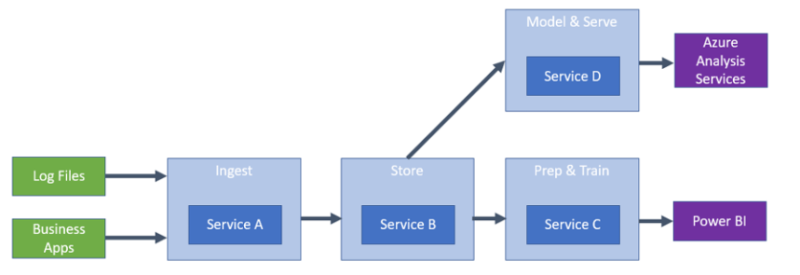
A company is planning on building a solution that would contain the below layers:
You have to decide on which services will be used for each layer.
Which of the following would you choose as the service to use Service A?
Show answer & explanation
Correct answer: B
B
- Question 4
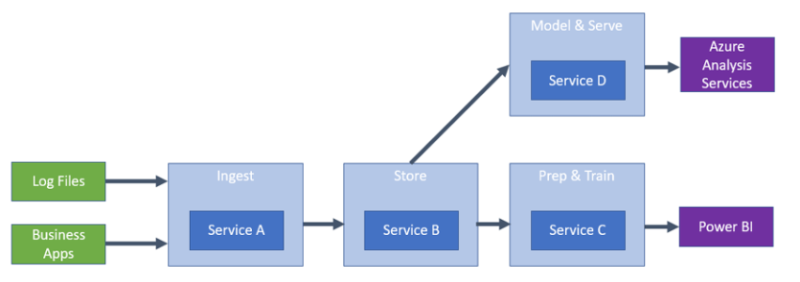
A company is planning on building a solution that would contain the below layers:
You have to decide on which services will be used for each layer.
Which of the following would you choose as the service to use Service B?
Show answer & explanation
Correct answer: A
A
- Question 5
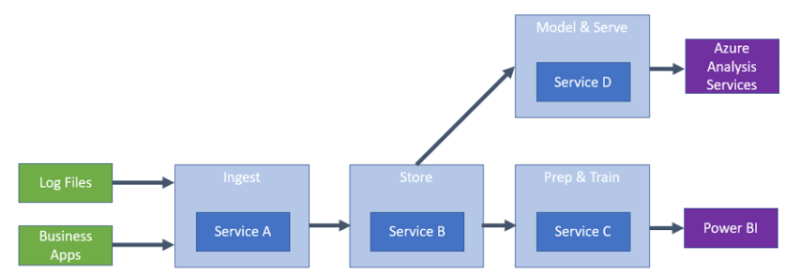
A company is planning on building a solution that would contain the below layers
You have to decide on which services will be used for each layer.
Which of the following would you choose as the service to use Service C?
Show answer & explanation
Correct answer: C
C
- Question 6
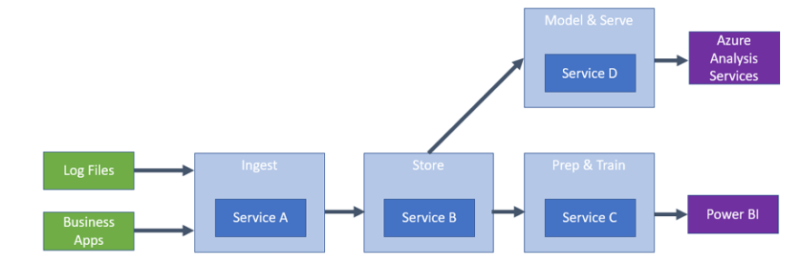
A company is planning on building a solution that would contain the below layers
You have to decide on which services will be used for each layer.
Which of the following would you choose as the service to use Service D?
Show answer & explanation
Correct answer: D
D
Ready for the real thing?
The full DP-201 simulator has every exam-style question, timed mode, and instant scoring.