
T1-T8 Sample Questions & Answers
Free ASE Medium-Heavy Truck Certification Tests (T1-T8) practice questions with worked answers and explanations. See how the ExamJungle simulator prepares you — then jump into the full test.
Launch the full T1-T8 simulator →Showing 6 of 12 free samples.
- Question 1AdvancedSelect 2
Gasoline Engines · Fuel, Air Induction, and Exhaust Systems Diagnosis and Repair
A gasoline-powered medium-duty truck utilizing a return-type fuel injection system exhibits abnormally high fuel pressure at idle. Which TWO of the following conditions can cause this high fuel pressure? (Select TWO)
Show answer & explanation
Correct answers: D, E
Without intake manifold vacuum pulling against the regulator spring at idle, the regulator defaults to maximum unreferenced fuel rail pressure. A restricted fuel return line blocks discharge to the tank, forcing rail pressure upward.
A restriction in the return line creates backpressure downstream of the regulator valve, which prevents bypassed fuel from returning to the tank and drives operating rail pressure above specification.
- Question 2Intermediate
Diesel Engines · Fuel System Diagnosis and Repair
A Class 7 truck equipped with a hydraulic electronic unit injector (HEUI) diesel engine cranks at normal cranking speed but fails to start. Scan tool diagnostics confirm active engine RPM synchronization, but Injection Control Pressure (ICP) reaches only 210 psi during cranking against a commanded value of 1,100 psi.
Based on HEUI operational requirements, what is the reason for this engine no-start condition?
flowchart TD A[Engine Cranks] --> B{RPM Sync Confirmed?} B -->|Yes| C[Check ICP Pressure] B -->|No| D[Check Cam/Crank Sensors] C --> E{ICP >= Threshold?} E -->|No: 210 psi| F[Inhibit Injector Firing] E -->|Yes: > 500 psi| G[ECM Enables Injection Pulses]Show answer & explanation
Correct answer: D
HEUI systems require approximately 500 psi of hydraulic injection control pressure (ICP) to overcome the injector internal intensifier spring before the ECM will command fuel injection. 210 psi prevents injection actuation.
- Question 3Intermediate
Diesel Engines · Engine Block Diagnosis and Repair
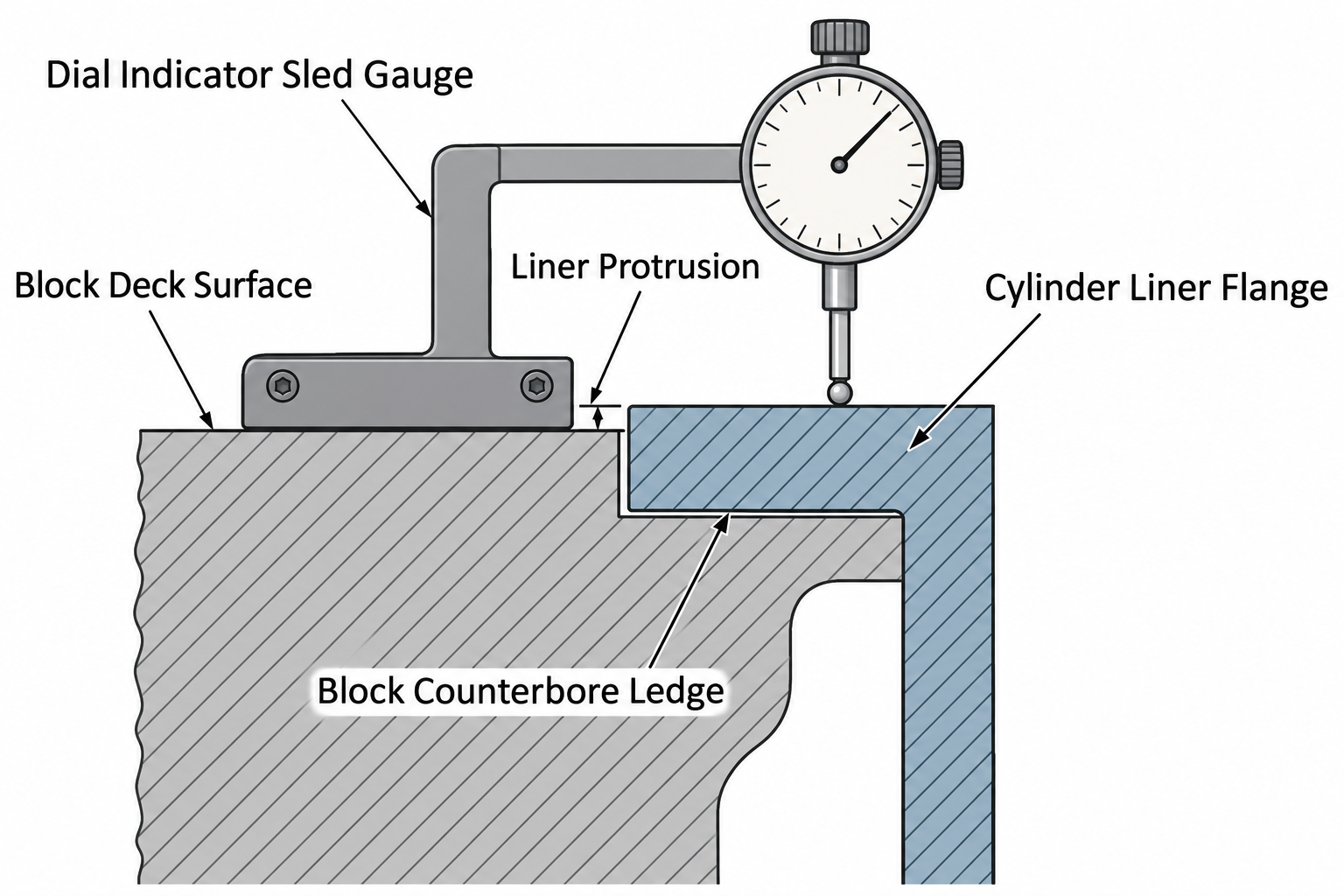
A diesel technician is installing wet cylinder liners into a heavy-duty engine block during an in-frame rebuild. Using a dial indicator sled gauge, the technician measures liner protrusion above the engine block deck to be 0.001 in., which is below the OEM specification of 0.003–0.005 in. How should the technician adjust the cylinder liner protrusion to specification?
Show answer & explanation
Correct answer: A
Wet cylinder liner protrusion is adjusted by selecting and placing precision metal shims of the required thickness underneath the liner seating flange in the engine block counterbore. Head gaskets do not adjust liner-to-deck protrusion.
- Question 4Intermediate
Diesel Engines · General Engine Diagnosis
A heavy-duty diesel tractor emits excessive, dense black exhaust smoke and runs roughly immediately upon cold morning startup. After 10 minutes of engine operation at highway speed, the exhaust smoke clears and idle stabilizes. What is the most likely cause?
Show answer & explanation
Correct answer: B
Black exhaust smoke is unburned, over-fueled carbon soot. A fuel injection nozzle needle that sticks open cold drips unatomized fuel directly into the cylinder; thermal expansion frees the needle as operating temperature rises.
- Question 5Advanced
Diesel Engines · Air Induction and Exhaust Systems Diagnosis and Repair
A Class 8 tractor powered by a 13-liter turbocharged diesel engine is dispatched to a maintenance facility due to complaints of low pulling power on grades and an audible air hissing noise from the engine compartment under load.
The technician connects a diagnostic scan tool and performs a loaded chassis dynamometer test. Maximum turbocharger boost pressure achieves only 16 psi (specification is 30–32 psi). Mass airflow readings and fuel rail pressures match commanded target parameters, and no DTCs are present in ECM memory.
A thorough physical inspection of the exhaust system reveals heavy black soot tracking around the exhaust manifold mounting flanges forward of the turbocharger turbine inlet.
What is the root cause of the low power and reduced boost pressure?
Show answer & explanation
Correct answer: A
Turbochargers derive rotational energy from high-velocity exhaust gas pressure and thermal expansion. An exhaust manifold leak ahead of the turbine wheel dumps drive pressure, preventing the compressor from generating target boost.
- Question 6Intermediate
Drive Train · Clutch Diagnosis and Repair
A Class 8 line-haul tractor equipped with a 15.5-inch two-plate pull-type clutch engages smoothly while in motion. However, with the truck stationary and the engine idling, shifting from neutral into first gear or reverse produces severe gear grinding unless the driver waits a prolonged period. Which component is the most likely cause of this gear clash?
Show answer & explanation
Correct answer: A
The clutch brake stops the transmission input shaft from spinning when the clutch pedal is pushed to the floor while stationary. If worn or missing, the shaft freewheels with inertia, causing gear clash when selecting 1st or reverse.
Ready for the real thing?
The full T1-T8 simulator has every exam-style question, timed mode, and instant scoring.