
L2 Sample Questions & Answers
Free Electronic Diesel Engine Diagnosis Specialist practice questions with worked answers and explanations. See how the ExamJungle simulator prepares you — then jump into the full test.
Launch the full L2 simulator →Showing 6 of 12 free samples.
- Question 1Intermediate
Electronic Engine Controls Diagnosis · B.2 Check and record diagnostic trouble codes (DTCs), freeze frame/snapshot, and/or operational data; interpret live data; download/save electronic control module (ECM) data (image); determine further
A technician connects a diagnostic scan tool to the 9-pin in-cab data link connector of the Composite Vehicle Type 4. The scan tool communicates normally with the ECM, TCM, and BCM across the public network, but it cannot access live operational data from the Variable Geometry Turbocharger (VGT) actuator, EGR valve, or DEF Quality/Level/Temperature module. Where should the diagnostic scan tool be connected to communicate directly with these emissions and turbo control components?
Show answer & explanation
Correct answer: D
On the Composite Vehicle Type 4, aftertreatment modules, the EGR valve, and the VGT actuator reside on a private J1939 data link accessed via a 3-pin connector in the engine compartment.
- Question 2Intermediate
Electronic Engine Controls Diagnosis · B.2 Check and record diagnostic trouble codes (DTCs), freeze frame/snapshot, and/or operational data; interpret live data; download/save electronic control module (ECM) data (image); determine further
In heavy-duty electronic diesel engine diagnosis under SAE J1939 standards, an active diagnostic trouble code consists of a Suspect Parameter Number (SPN) and a _____ that defines the specific electrical, mechanical, or operational failure mode.
Show answer & explanation
Correct answer: C
J1939 DTCs pair a Suspect Parameter Number (SPN), identifying the component or system, with a Failure Mode Identifier (FMI), specifying the type of fault (e.g., short, open, out of range).
- Question 3Advanced
Electronic Engine Controls Diagnosis · B.2 Check and record diagnostic trouble codes (DTCs), freeze frame/snapshot, and/or operational data; interpret live data; download/save electronic control module (ECM) data (image); determine further
A heavy-duty diesel engine logs a low fuel rail pressure DTC. The recorded freeze frame snapshot shows:
• Engine Speed: 1650 RPM
• Vehicle Speed: 58 MPH
• Engine Load: 88%
• Commanded Rail Pressure: 24,000 psi
• Actual Fuel Rail Pressure: 14,200 psi
• Fuel Volume Control Solenoid Command: 85% duty cycle
• Fuel Temperature: 95° FWhat does this freeze frame snapshot indicate regarding fuel system performance?
Show answer & explanation
Correct answer: D
Under 88% load, actual rail pressure is 9,800 psi below commanded target despite an 85% volume command, confirming high-pressure fuel delivery shortfall rather than a sensor offset.
- Question 4Intermediate
Electronic Engine Controls Diagnosis · B.5 Use diagnostic tool, digital multimeter (DMM), or digital storage oscilloscope (DSO) to inspect or test computerized engine control system sensors, actuators, circuits and electronic control modul
A technician connects a digital storage oscilloscope (DSO) and a current probe to an electronic fuel injector circuit on the Composite Vehicle Type 4, as shown in the figure. Prior to running dynamic waveform captures, the technician disconnects the injector harness to verify the internal solenoid coil integrity with a digital multimeter (DMM). What is the specified baseline resistance range for a serviceable fuel injector coil on this vehicle?
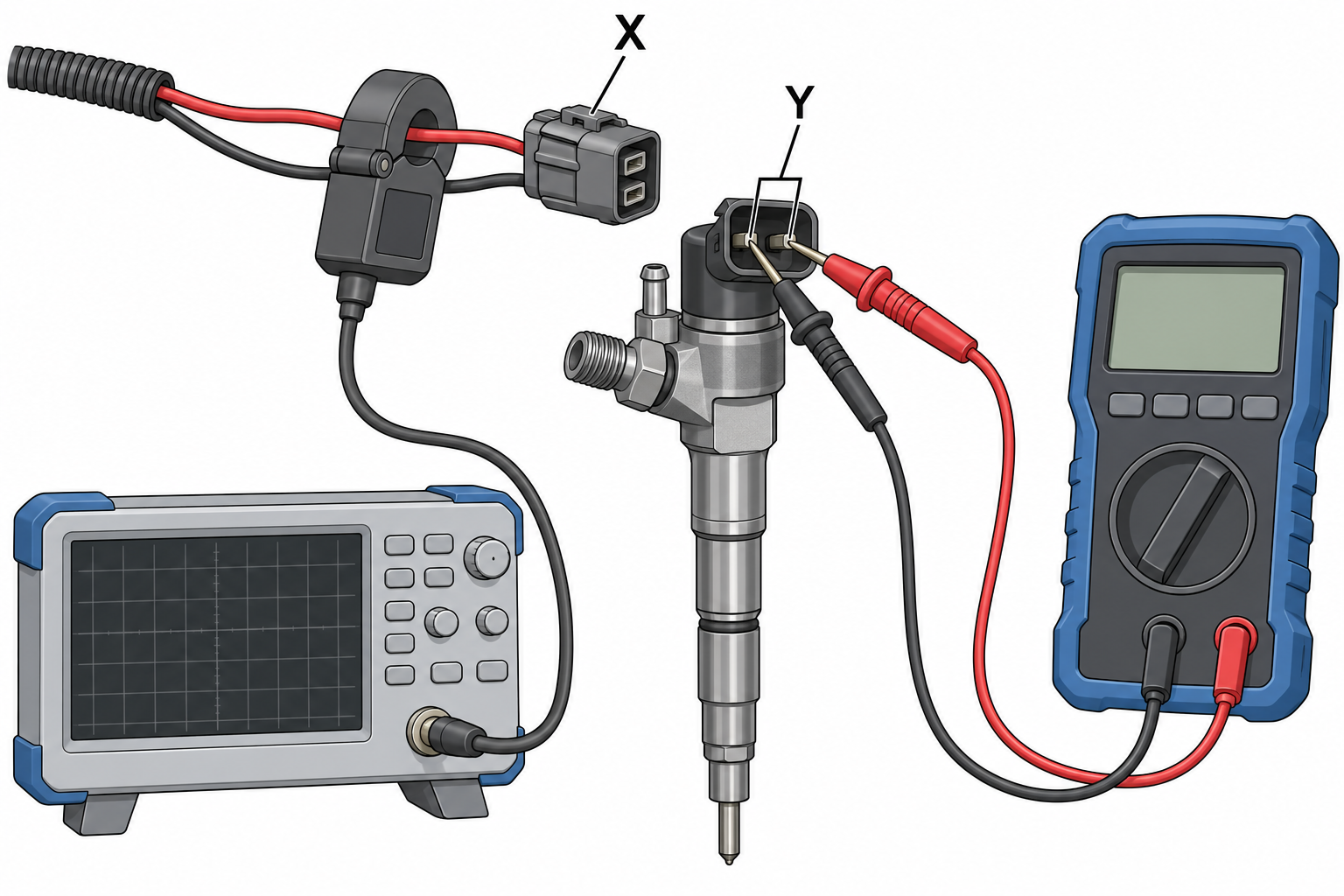
Show answer & explanation
Correct answer: C
The high-pressure common rail fuel injector coils on the Composite Vehicle Type 4 have a low resistance specification of 2.0 Ω ± 0.5 Ω to allow rapid magnetic field saturation.
- Question 5AdvancedSelect 2
Electronic Engine Controls Diagnosis · B.5 Use diagnostic tool, digital multimeter (DMM), or digital storage oscilloscope (DSO) to inspect or test computerized engine control system sensors, actuators, circuits and electronic control modul
A diagnostic specialist is inspecting computerized engine control circuits using both a digital multimeter (DMM) and a digital storage oscilloscope (DSO). Which TWO specific diagnostic capabilities make the DSO superior to a standard DMM when troubleshooting intermittent electronic sensor and actuator faults? (Select TWO)
Show answer & explanation
Correct answers: A, C
DSOs sample millions of times per second, graphing transient glitches and microsecond dropouts that standard DMMs average out or miss completely.
A DSO displays a real-time visual trace showing signal shape, amplitude, rise time, and duty cycle concurrently across an adjustable time base.
- Question 6Beginner
Electronic Engine Controls Diagnosis · B.5 Use diagnostic tool, digital multimeter (DMM), or digital storage oscilloscope (DSO) to inspect or test computerized engine control system sensors, actuators, circuits and electronic control modul
The ECM on the Composite Vehicle Type 4 supplies regulated reference voltage to multiple three-wire analog engine sensors, including the Accelerator Pedal Position (APP) sensors and the Barometric Pressure (BARO) sensor. What is the regulated reference voltage value provided by the ECM?
Show answer & explanation
Correct answer: D
The ECM contains an internal voltage regulator that steps vehicle supply voltage down to a steady, regulated 5.0 VDC sensor reference supply.
Ready for the real thing?
The full L2 simulator has every exam-style question, timed mode, and instant scoring.