
A1-A9 Sample Questions & Answers
Free ASE Automobile & Light Truck Certification Tests (A1-A9) practice questions with worked answers and explanations. See how the ExamJungle simulator prepares you — then jump into the full test.
Launch the full A1-A9 simulator →Showing 6 of 12 free samples.
- Question 1Advanced
Engine Repair · General Engine Diagnosis
A 2021 full-size light-duty truck equipped with a 5.3L V8 engine is brought into the service department. The driver reports a sudden loss of engine power while towing on the highway, accompanied by a flashing Malfunction Indicator Lamp (MIL) and an audible mechanical ticking from the engine compartment that increases in frequency with engine speed. The vehicle now runs rough at idle and stalls occasionally when coming to a stop.
The technician connects a scan tool and retrieves diagnostic trouble code P0301 (Cylinder 1 Misfire Detected) along with P3401 (Cylinder 1 Deactivation/Intake Valve Control Circuit/Open). Freeze frame data shows the misfire occurred at 2,400 RPM under a 72% engine calculated load. A cylinder power balance test confirms that cylinder #1 contributes zero torque to crankshaft rotation. A manual cranking compression test yields 0 psi on cylinder #1, while cylinders #3, #5, and #7 all measure between 175 and 180 psi.
Next, the technician removes the driver-side valve cover and cranks the engine while inspecting valvetrain movement. The intake valve rocker arm on cylinder #1 fails to actuate entirely, remaining stationary, while the pushrod rotates freely and exhibits excessive clearance beneath the rocker arm. What corrective action is required?
Show answer & explanation
Correct answer: B
A stationary rocker arm with excessive pushrod clearance and 0 psi compression on a displacement-on-demand engine indicates a collapsed cylinder deactivation (AFM/DFM) roller lifter that failed to lock into its high-lift state.
- Question 2Intermediate
Automatic Transmission/Transaxle · Transmission/Transaxle Diagnosis
A rear-wheel-drive 6-speed automatic transmission slips excessively during the 2–3 upshift under light acceleration, but operates properly in 1st, 2nd, and reverse gears. The transmission control module (TCM) stores diagnostic trouble code P0733 (Gear 3 Incorrect Ratio). Line pressure testing confirms that main line pressure remains within factory specifications across all ranges.
Review the hydraulic clutch apply logic shown below:
flowchart LR A[Gear Range] --> B[Clutch Apply Requirements] B --> C["1st: Forward Clutch + Low/Reverse Brake"] B --> D["2nd: Forward Clutch + 2-6 Brake"] B --> E["3rd: Forward Clutch + 3-5-Reverse Clutch"] B --> F["4th: Forward Clutch + 4-5-6 Clutch"] B --> G["Reverse: 3-5-Reverse Clutch + Low/Reverse Brake"]Given this hydraulic application schedule, which component is the most likely cause of the 2–3 shift flare and slippage?
Show answer & explanation
Correct answer: B
The 3-5-Reverse clutch is newly applied in 3rd gear. If its piston seal leaks, line pressure drops in that circuit, causing shift flare into 3rd gear. Forward clutch is common to 1st, 2nd, and 3rd, so it would slip in all forward gears.
- Question 3IntermediateSelect 2
Automatic Transmission/Transaxle · Transmission/Transaxle Diagnosis
A technician is checking the automatic transmission fluid (ATF) level on a late-model vehicle that does not feature a conventional dipstick tube. The transmission case utilizes a bottom check plug (standpipe). Which TWO conditions must be verified before removing the level check plug to ensure an accurate fluid level measurement? (Select TWO)
Show answer & explanation
Correct answers: A, B
Non-dipstick transmissions require the vehicle to be level and the fluid within an exact scan tool temperature range because ATF expands significantly as it heats; the engine must idle in Park or Neutral during check.
- Question 4Advanced
Automatic Transmission/Transaxle · Transmission/Transaxle Diagnosis
A vehicle equipped with an electronically controlled 8-speed automatic transmission exhibits harsh garage shifts into DRIVE and REVERSE, as well as violent upshifts through all forward gears. When checking scan tool live data, the technician notes that transmission fluid temperature reads -40°C (-40°F) continuously, even after a 30-minute test drive. Which of the following explains why the transmission shifts so harshly?
Show answer & explanation
Correct answer: A
An open ATF temperature sensor circuit reports -40°C/-40°F. The TCM enters fail-safe mode and commands maximum electronic pressure control (EPC) line pressure to prevent clutch burn-up in cold fluid, causing harsh shifts.
- Question 5Intermediate
Automatic Transmission/Transaxle · Transmission/Transaxle Diagnosis
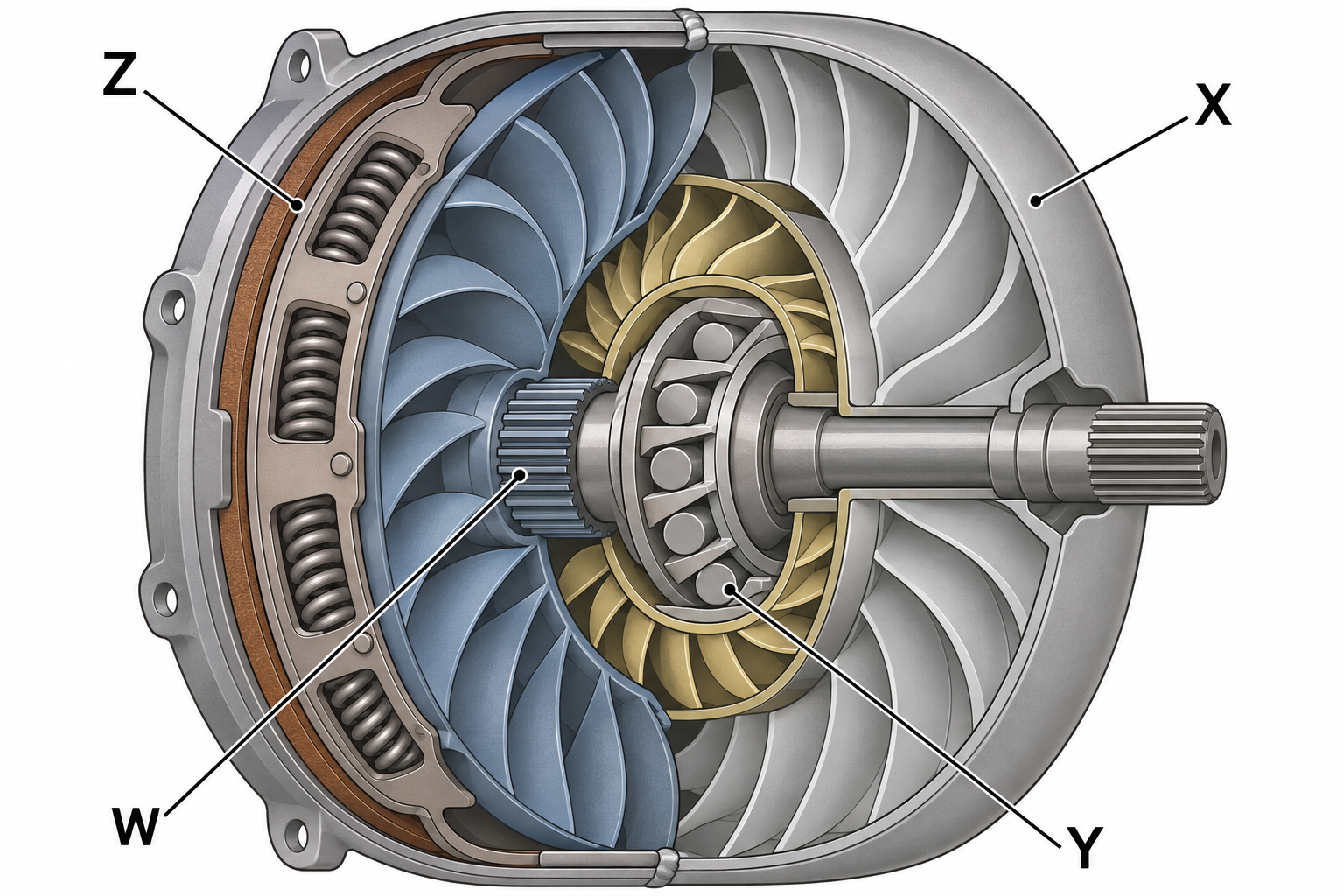
A vehicle equipped with a torque converter automatic transmission exhibits severely sluggish acceleration from a dead stop up to approximately 30 mph. However, above 35–40 mph and while cruising on the highway, engine performance and vehicle acceleration are completely normal. During a stall test, engine RPM is significantly below manufacturer specification. Referring to the internal torque converter components in the figure, which labeled component has failed?
Show answer & explanation
Correct answer: C
The stator redirects fluid from the turbine back into the impeller to multiply torque below coupling speed. If the stator one-way clutch freewheels in both directions, torque multiplication drops to 1:1, killing low-speed power.
- Question 6Intermediate
Manual Drive Train and Axles · Clutch Diagnosis and Repair
After installing a brand-new clutch kit (clutch disc, pressure plate, and throwout bearing) on a rear-wheel-drive vehicle, the driver complains of a severe, violent shudder and chatter when releasing the clutch pedal from a stop in 1st gear. Once fully engaged in gear, there is no slippage under full engine load. Which of the following installation errors or component defects is the most likely cause of this clutch chatter?
Show answer & explanation
Correct answer: C
Clutch chatter during engagement is primarily caused by an uneven or glazed flywheel friction surface, severe heat checking/hard spots, or oil/grease contamination on the disc facings, causing erratic grabbing during slip.
Ready for the real thing?
The full A1-A9 simulator has every exam-style question, timed mode, and instant scoring.