
L3 Sample Questions & Answers
Free Light Duty Hybrid/Electric Vehicle Specialist practice questions with worked answers and explanations. See how the ExamJungle simulator prepares you — then jump into the full test.
Launch the full L3 simulator →Showing 6 of 12 free samples.
- Question 1Intermediate
High-Voltage (HV) Battery System · A.6 Diagnose high-voltage (HV) battery pack malfunctions.
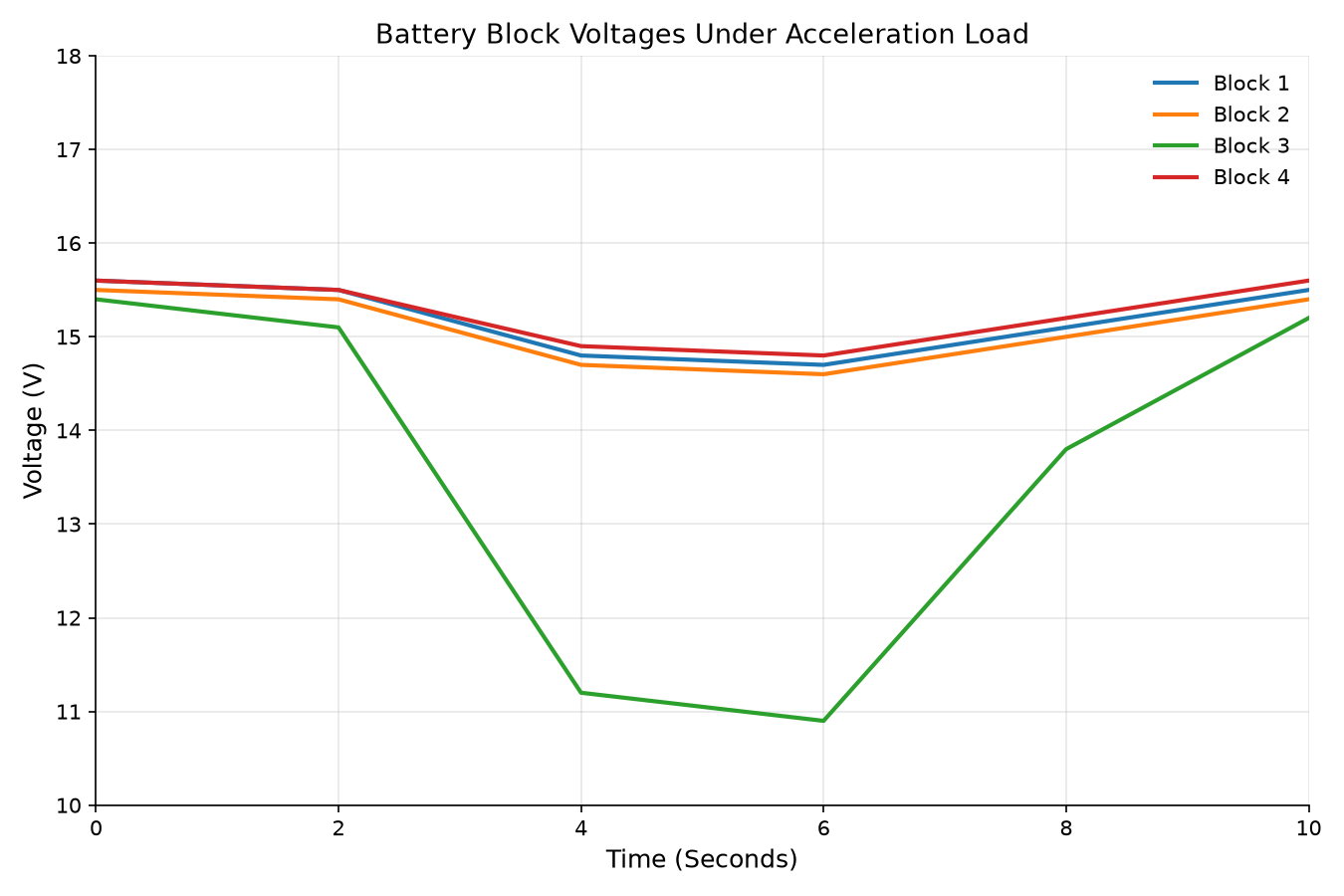
A hybrid vehicle illuminates the Electric Drive System Warning lamp and logs a battery pack deterioration fault code. During diagnostic road testing under aggressive wide-open-throttle acceleration, the technician records individual battery block voltages on a scan tool. Based on the graph shown in the figure, which condition explains the stored fault?
Show answer & explanation
Correct answer: B
Block 3 shows excessive voltage drop under high discharge load compared to the other blocks, indicating degraded capacity or high internal cell resistance within that module.
- Question 2Beginner
High-Voltage (HV) Battery System · A.6 Diagnose high-voltage (HV) battery pack malfunctions.
True or False: In ASE electrified vehicle technical standards, any vehicle electrical circuit that operates at an electrical potential greater than 60 VDC or greater than 30 VAC is classified as high voltage.
Show answer & explanation
Correct answer: A
By ASE L3 specifications, high-voltage vehicle electrical systems are defined as any circuit operating above 60 VDC or 30 VAC; systems at or below these values are low voltage.
- Question 3Intermediate
High-Voltage (HV) Battery System · A.8 Test, diagnose, and repair high-voltage leaks/loss of isolation.
An electrified passenger vehicle with push-button start powers into the POWER ON operational mode without incident. However, when the driver depresses the brake pedal and presses the start button, the vehicle refuses to enter the READY TO DRIVE mode. Scan tool interrogation reveals a stored "High Voltage Loss-of-Isolation" diagnostic trouble code. Which failure is the most probable cause of this concern?
Show answer & explanation
Correct answer: A
Compromised cable insulation creates a leakage path to chassis ground, triggering a loss-of-isolation DTC and blocking READY TO DRIVE. A removed MSD sets an interlock DTC; a dead 12V battery prevents POWER ON entirely.
flowchart TD A[HV Insulation Breach] --> B[Current Leaks to Chassis] B --> C[Loss-of-Isolation DTC] C --> D[Blocks READY TO DRIVE] - Question 4AdvancedSelect 2
High-Voltage (HV) Battery System · A.8 Test, diagnose, and repair high-voltage leaks/loss of isolation.
A specialist is testing an isolated high-voltage orange cable harness using a megohmmeter (insulation resistance tester) after a vehicle collision. According to electrical safety standards and FMVSS 305 guidelines, which TWO statements represent correct testing procedures and evaluation criteria for loss-of-isolation testing? (Select TWO)
Show answer & explanation
Correct answers: B, D
Insulation testing with a megohmmeter (applying 250 V to 1000 V) requires testing between the inner conductor and chassis ground, as well as between shielding and inner conductor to identify leakage paths.
- Question 5Intermediate
Internal Combustion Engine · B.2 Determine if the internal combustion engine (ICE) is in CRANK mode or RUN mode.
A Type-1 power-split hybrid vehicle will enter the READY TO DRIVE mode, but the internal combustion engine (ICE) fails to run. During diagnostic cranking, scan tool live data indicates that engine speed reaches 950 RPM while motor-generator 1 (MG1) is spinning, yet the engine stalls immediately as soon as MG1 stops rotating. Which scan tool parameter confirmation proves that the engine is stuck in CRANK mode rather than operating under self-sustained RUN mode?
Show answer & explanation
Correct answer: D
In Type-1 systems, MG1 spins the ICE up to firing speed (~1,000 RPM) during CRANK mode. Fuel injection pulse width and ignition confirmation determine if the engine has transitioned into independent RUN mode.
- Question 6Intermediate
Internal Combustion Engine · B.2 Determine if the internal combustion engine (ICE) is in CRANK mode or RUN mode.
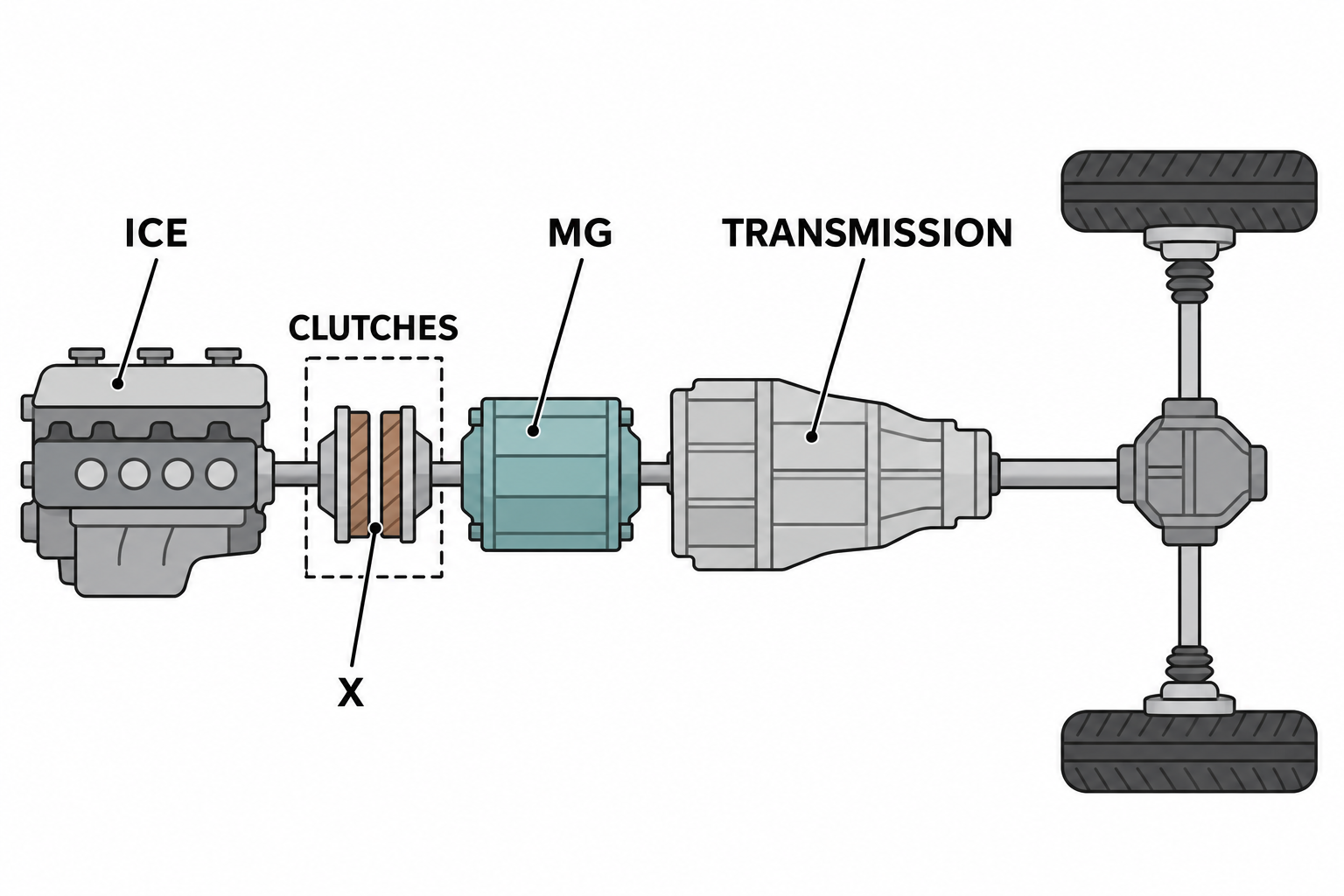
The diagram in the figure illustrates the powertrain layout of an ASE Type-4 hybrid-drive parallel system. What is the specific mechanical function of the component labeled X?
Show answer & explanation
Correct answer: C
In a Type-4 parallel hybrid, decoupling clutch C0 (labeled X) disengages to allow electric-only propulsion by the MG. Engaging C0 connects the running MG or engine to transmit torque or restart the ICE.
Ready for the real thing?
The full L3 simulator has every exam-style question, timed mode, and instant scoring.