
AMB-BC Sample Questions & Answers
Free Ambulatory Care Nursing Certification (AMB-BC) practice questions with worked answers and explanations. See how the ExamJungle simulator prepares you — then jump into the full test.
Launch the full AMB-BC simulator →Showing 6 of 12 free samples.
- Question 1Intermediate
Assess and Evaluate · Preventative care/health promotion
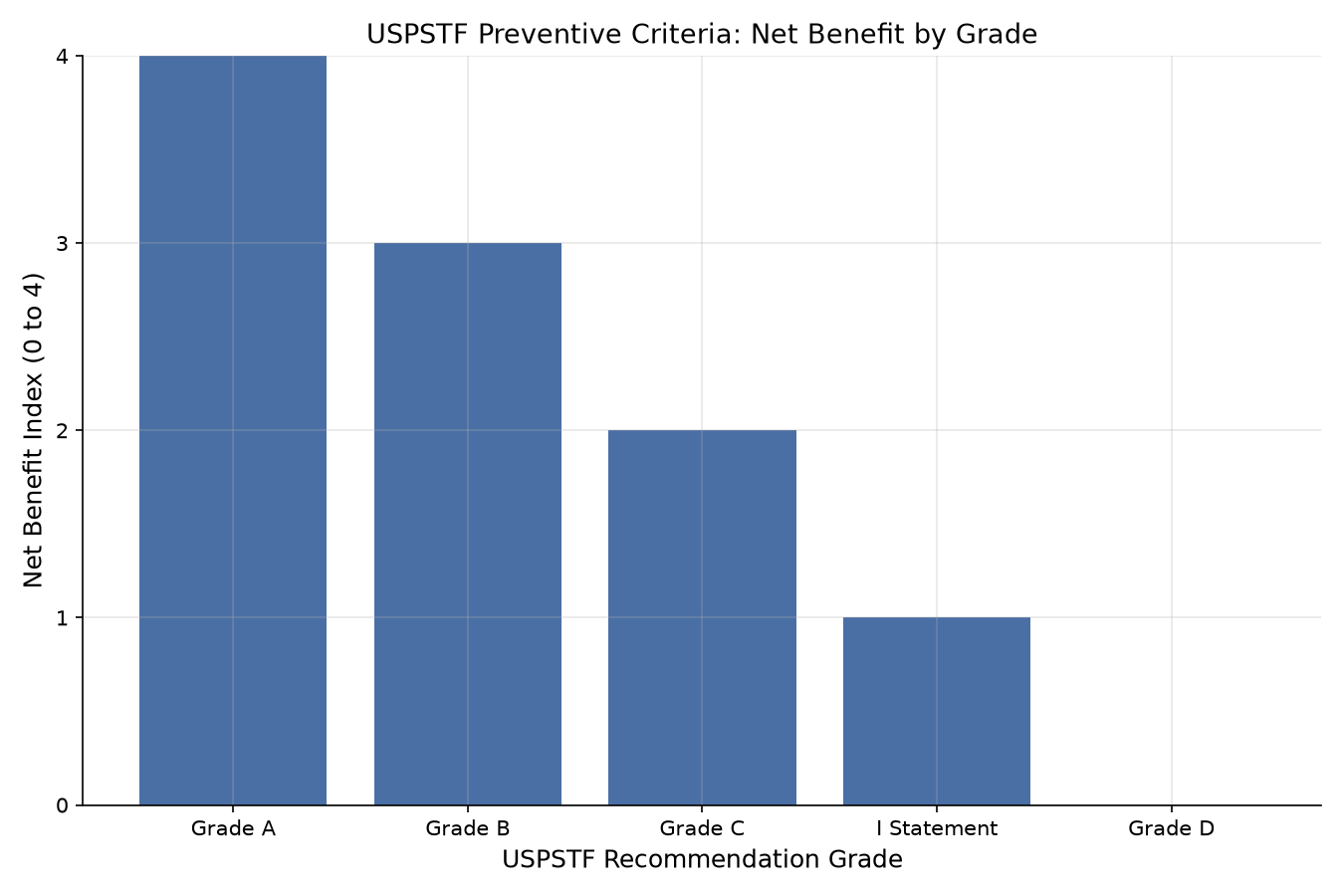
An ambulatory care nurse reviews preventive screening guidelines to identify eligible primary care patients for targeted vascular screening. Based on U.S. Preventive Services Task Force (USPSTF) Grade B recommendations as displayed in the preventive criteria chart, which individual meets the indications for a one-time screening ultrasound for abdominal aortic aneurysm (AAA)?
Show answer & explanation
Correct answer: A
USPSTF recommends one-time ultrasound screening for abdominal aortic aneurysm specifically in men aged 65 to 75 who have ever smoked tobacco (Grade B).
- Question 2Beginner
Assess and Evaluate · Preventative care/health promotion
During a routine 9-month well-child examination in a primary care pediatric clinic, the nurse examines an infant whose two mandibular central incisors recently erupted. According to USPSTF Grade B recommendations for oral health in infants and children up to age 5, which clinical action should the primary care team execute?
Show answer & explanation
Correct answer: D
USPSTF Grade B guidelines direct primary care clinicians to apply fluoride varnish to the primary teeth of all infants and children starting at the time of initial tooth eruption.
- Question 3Advanced
Assess and Evaluate · Preventative care/health promotion
A large community health center launches a comprehensive multi-tiered population health campaign across three surrounding urban neighborhoods. The health center serves over 24,000 enrolled patients across primary care, behavioral health, and occupational medicine divisions.
The ambulatory quality committee designs four simultaneous clinical initiatives to address health disparities in chronic illness: childhood immunization tracking, asymptomatic prediabetes screening at local community centers, an intensive post-cerebrovascular stroke gait re-education and constraint-induced therapy program, and annual mammography screening reminders.
The registered nurse leading the population outreach team reviews the operational taxonomy of preventive healthcare. Which of the four deployed clinical interventions represents tertiary prevention?
Show answer & explanation
Correct answer: A
Tertiary prevention focuses on rehabilitation, disability reduction, and restorative care for individuals with diagnosed chronic disease or established impairment.
- Question 4Advanced
Assess and Evaluate · Triage (eg, in-person, virtual, telehealth)
An ambulatory care walk-in triage nurse evaluates an adult patient brought in by acquaintances after suspected acute toxic chemical ingestion and heavy alcohol consumption. The patient exhibits slurred speech, marked combativeness, and severe tachypnea with accessory muscle retractions. Based on emergency triage prioritization standards, which physiological assessment takes precedence?
Show answer & explanation
Correct answer: D
Airway patency and ventilatory adequacy always supersede behavioral or toxicological evaluations during triage to prevent rapid hypoxic decompensation.
flowchart TD A[Triage Presentation] --> B{Airway / Breathing Stable?} B -->|No| C[Immediate Resuscitation & 911] B -->|Yes| D[Assess Hemodynamics & Neuro] - Question 5Intermediate
Assess and Evaluate · Triage (eg, in-person, virtual, telehealth)
A registered nurse staffs the centralized telephone and patient portal triage queue for an integrated multi-specialty ambulatory health center on a Monday morning. The triage dashboard displays four pending clinical encounters requiring nursing evaluation and disposition.
Encounter 1 is an electronic portal message from a 42-year-old female noting a mild pruritic rash on both forearms after starting amoxicillin two days ago for sinusitis. Encounter 2 is an incoming telephone call from a 66-year-old male with known coronary artery disease reporting a 90-minute sensation of severe mid-epigastric burning and jaw tightness accompanied by profuse diaphoresis. Encounter 3 is a phone inquiry from a 29-year-old female reporting dysuria and urinary frequency for 24 hours without fever or flank pain. Encounter 4 is a portal request from a 54-year-old male requesting an urgent refill of hydrochlorothiazide.
Applying standardized ambulatory telephone triage protocols, which encounter requires the nurse's immediate direction for emergency medical services (EMS/911) dispatch?
Show answer & explanation
Correct answer: D
Epigastric discomfort radiating to the jaw with diaphoresis in a patient with coronary disease represents acute coronary syndrome, mandating immediate 911 activation.
- Question 6Intermediate
Assess and Evaluate · Triage (eg, in-person, virtual, telehealth)
During a virtual video telehealth triage encounter, a parent contacts the ambulatory pediatric nurse regarding their 2-year-old child. The nurse observes audible inspiratory stridor while the child is resting quietly on the parent's lap, accompanied by pronounced suprasternal and subcostal retractions. What is the nurse's priority disposition?
Show answer & explanation
Correct answer: D
Stridor at rest with chest retractions indicates critical upper airway compromise (such as severe croup), requiring urgent emergency hospital evaluation rather than clinic delays.
Ready for the real thing?
The full AMB-BC simulator has every exam-style question, timed mode, and instant scoring.