
300-410 Sample Questions & Answers
Layer 3 troubleshooting is the heaviest section, covering administrative-distance issues, route-map filtering, loop prevention, control-plane policing alongside AAA-driven device protections, MPLS, single-hub DMVPN, and SNMP or logging diagnostics.
Launch the full 300-410 simulator →Showing 10 of 20 free samples.
- Question 1
Which show command displays entries in a router's Border Gateway Protocol (BGP) table?
Show answer & explanation
Correct answer: A
The show ip bgp command displays the BGP routing table entries, including network prefixes, next-hop addresses, AS paths, and other BGP path attributes. This is the standard command to view BGP table contents and learned routes. The other options are incorrect: show ip bgp table and show ip bgp topology are not valid Cisco IOS commands, while show ip bgp summary displays BGP neighbor relationships and session status rather than actual BGP table entries.
- Question 2
When an EIGRP router starts, it sends a hello packet out of all interfaces.
Which type of packet do neighboring routers send in response?
Show answer & explanation
Correct answer: D
Explanation:
When an EIGRP router starts, it sends hello packets out of each interface. Neighboring routers respond with update packets. These update packets are sent reliably, and must be acknowledged with an ACK packet from the EIGRP router.
EIGRP makes neighbor relationships simple. If a router hears a hello from a new neighbor, it sends that neighbor updates for all routes that it knows. This is different from Open Shortest Path First (OSPF), which has a complex series of rules governing how neighbor relationships are formed and how databases are synchronized. When changes to the network occur in OSPF, updates packets route reliable change information only to the affected routes.
Queries and replies in EIGRP only occur when a router loses a route to a network and is actively seeking a replacement route.
Objective: Layer 3 Technologies Sub-Objective: Describe EIGRP packet types -- References: Internetworking Technology Handbook > Enhanced Interior Gateway Routing Protocol (EIGRP) > EIGRP Packet Types - Question 3Select 2
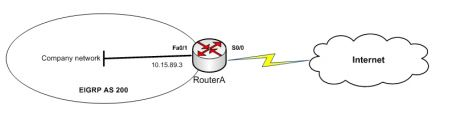
You manage the company network, as shown in the network diagram below:
You executed the following command on RouterA:
routerA(config)# ip route 0.0.0.0 0.0.0.0 S0/0
routerA(config)# router eigrp 200 routerA(config-router)# redistribute static metric 1000 1 255 1 1500Which of the following statements are TRUE about the given set of commands? (Choose two.)
Show answer & explanation
Correct answers: A, C
A, C -- Explanation:
The given set of commands creates a static default route on RouterA and redistributes this route into the EIGRP company network. The ip route 0.0.0.0 0.0.0.0 S0/0 command executed in the global configuration mode creates a static default route on the router. The ip route command allows you to specify a static route. The redistribute static metric 1000 1 255 1 1500 command then redistributes the static default route into the EIGRP autonomous system (AS) 200. This implies that the EIGRP network identifies the default route as an external route, and traffic to all unknown destination subnets will be diverted to the default route.
Alternatively, default routes can be advertised into EIGRP networks by either of the following methods: • Using the network 0.0.0.0 command on the router • Using the ip summary-address eigrp 200 0.0.0.0 0.0.0.0 command on the router
A summary default route is not created on RouterA in the scenario. If the ip summary-address eigrp 200 0.0.0.0 0.0.0.0 command was used on RouterA, then a summary default route would be created.
The summary default route points to the 0.0.0.0 network with the nullO interface as the next-hop interface. Summary default routes are helpful for providing remote networks with a default route.
The default route is advertised to the EIGRP network because the redistribute command was executed. This command is used to advertise the default route to the EIGRP network.
Objective: Layer 3 Technologies Sub-Objective: Configure and verify default routing -- References: Cisco > Support > Technology Support > IP > IP Routing > Design > Design TechNotes > Configuring a Gateway of Last Resort Using IP Commands Cisco > Support > Technology Support > IP > IP Routing > Technology Information > Technology White Paper > Enhanced Interior Gateway Routing ProtocolA, C -- Explanation:
The given set of commands creates a static default route on RouterA and redistributes this route into the EIGRP company network. The ip route 0.0.0.0 0.0.0.0 S0/0 command executed in the global configuration mode creates a static default route on the router. The ip route command allows you to specify a static route. The redistribute static metric 1000 1 255 1 1500 command then redistributes the static default route into the EIGRP autonomous system (AS) 200. This implies that the EIGRP network identifies the default route as an external route, and traffic to all unknown destination subnets will be diverted to the default route.
Alternatively, default routes can be advertised into EIGRP networks by either of the following methods: • Using the network 0.0.0.0 command on the router • Using the ip summary-address eigrp 200 0.0.0.0 0.0.0.0 command on the router
A summary default route is not created on RouterA in the scenario. If the ip summary-address eigrp 200 0.0.0.0 0.0.0.0 command was used on RouterA, then a summary default route would be created.
The summary default route points to the 0.0.0.0 network with the nullO interface as the next-hop interface. Summary default routes are helpful for providing remote networks with a default route.
The default route is advertised to the EIGRP network because the redistribute command was executed. This command is used to advertise the default route to the EIGRP network.
Objective: Layer 3 Technologies Sub-Objective: Configure and verify default routing -- References: Cisco > Support > Technology Support > IP > IP Routing > Design > Design TechNotes > Configuring a Gateway of Last Resort Using IP Commands Cisco > Support > Technology Support > IP > IP Routing > Technology Information > Technology White Paper > Enhanced Interior Gateway Routing Protocol - Question 4
Which show command displays the status of all of a router's Border Gateway Protocol (BGP) connections in a concise format?
Show answer & explanation
Correct answer: B
The show ip bgp summary command displays the status of all BGP neighbor connections in a concise tabular format, showing neighbor IP addresses, AS numbers, connection states, up/down time, and prefix counts. This command provides a quick overview of all BGP sessions and their current status. The other options are incorrect: show ip bgp displays the BGP routing table rather than connection status, show ip bgp connections is not a valid command, and show ip bgp neighbors summary has incorrect syntax.
- Question 5
Your company has a policy of creating all configurations in text files,
checking the files, and then applying the configurations to the devices. Your assistant has presented you with the following partial configuration that she plans to execute on a router:interface S0/0/1
ipv6 address 2001:610:FFFF:1::1/64ipv6 ospf 100 area 0
ipv6 router ospf 100 router-id 10.1.1.6The configuration is supposed to accomplish the following:
• Enable IPv6 routing
• Assign a router ID
• Assign an IPv6 address to the interface
• Place the interface in OSPF area 0Which step does this configuration NOT complete?
Show answer & explanation
Correct answer: A
Explanation:
The configuration indicates all steps are complete except for globally enabling IPv6 routing. If that had been done, the configuration output would have reflected it under the interface as follows:
interface S0/0/1 ipv6 address 2001:610:FFFF:1::1/64 ipv6 ospf 100 area 0 ipv6 enable ipv6 router ospf 100 router-id 10.1.1.6
Prior to configuring OSPFv3 on an interface, it must be enabled globally. OSPFv3 is an OSPF version specific to IPv6. The following commands will globally enable OSPF v3. It will then be reflected by the ipv6 enable statement under the interface when viewing the configuration as shown in the fourth line of the output above.
Router5(config)# ipv6 unicast-routing Router5(config)# ipv6 ospf 100 Router5(config-rtr)# router-id 10.1.1.6
The problem is not the router ID. The configuration in the scenario does assign a router ID, as indicated by these lines:
ipv6 router ospf 100 router-id 10.1.1.6
The problem is not the IPv6 address. The configuration does assign an IPv6 address to the interface, as indicated by these lines:
interface S0/0/1 ipv6 address2001:610:FFFF:1::1/64
OSPF area 0 is not the problem. The configuration does place the interface in OSPF area 0, as indicated by these lines - Question 6Select 2
Which statements about BGP policy-based routing are true? (Choose two.)
Show answer & explanation
Correct answers: A, C
BGP policy-based routing is performed on a routers inbound interface, where incoming packets are examined and routing decisions are made based on defined policies before normal routing table lookups occur. Policy-based routing can indeed select the next-hop based on packet characteristics like source address, allowing administrators to override default routing decisions. The incorrect options are wrong because policy-based routing does not alter the final destination address of packets (it changes the path, not the destination), and it affects local routing decisions rather than influencing path selection in downstream autonomous systems.
Policy-based routing can select the next-hop based on the packets source address, enabling administrators to route traffic differently based on where it originates rather than just its destination. This is implemented on the routers inbound interface where packets are first received and policy decisions are applied. The incorrect statements are wrong because policy-based routing modifies the forwarding path rather than changing packet destinations, and it operates locally on the router rather than influencing routing decisions in remote autonomous systems.
- Question 7
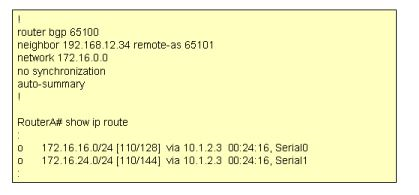
The exhibit contains portions of RouterA's BGP configuration and IP routing table.
Which IP network addresses, that were not learned using BGP, will be present in BGP advertisements from RouterA?
Show answer & explanation
Correct answer: A
Explanation:
The auto-summary command can affect which networks, identified by using the network command, will be advertised. Using the existing BGP configuration, the router will not announce the 172.16.16.0/24 subnet. Instead, it will announce the classful address 172.16.0.0/16 when the IP routing table maintained by the IGP contains any subnet of that classful address.
The network command directly affects what network is advertised in BGP. If the network command does not also include a network mask, and if auto-summary is enabled, the classful address of 172.16.0.0/16 is advertised any time that the router learns about a 172.16.0.0 subnet via its Interior Gateway Protocol (IGP), such as OSPF or EIGRP. In the exhibit, the routing table does contain entries of the 172.16.16.0/24 and 172.16.24.0/24 subnets that were learned by using the IGP.
If auto-summary is disabled by using the no auto-summary command, only networks in the routing table that are exact matches to the network commands are advertised. For example, to have the router announce only the 172.16.16.0/24 subnet learned via its IGP, you should alter the network command's IP address and include the subnet mask as follows:
network 172.16.16.0 mask 255.255.255.0
A combination of network statements and route statements can be used to advertise a subset of networks that exist. Examine the output shown below:
router bgp 68410 network 192.168.24.0 255.255.252.0 neighbor 172.16.8.5 remote-as 68441 ip route 192.168.24.0 255.255.252.0 null 0
The router is configured to advertise a summary route to the network 192.168.24.0 255.255.252.0. Consider the following networks:
192.168.24.0/24
192.168.25.0/24
192.168.26.0/24
192.168.32.0/24
If this router was connected to those networks, and received a packet destined for 192.168.25.1, it would successfully route the packet because the summary address (where the summarization is the result of the mask 255.255.252.0) is designed to include all of the subnets above except for 192.168.32.0/24. Therefore, all subnets except 192.168.32.0/24 will be advertised by the network and ip route statements with the summary mask.
Note: Whenever changes are made to a routing policy or to an access list that is used by a routing policy, the change will not be reflected in the routing tables of the receiving routers until the BGP session has been cleared with the clear ip bgp command.
The BGP synchronization rule specifies that networks will not be advertised or used via iBGP unless it also has been learned through an IGP. If synchronization is disabled, iBGP will advertise a - Question 8
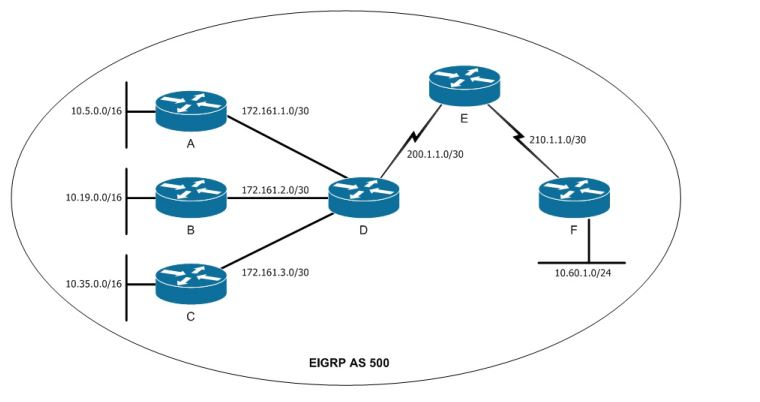
An EIGRP network is configured with default settings for all the routers, shown in the exhibit. Traffic is not routing correctly.
What commands need to be run, and on which router should it be run?
Show answer & explanation
Correct answer: C
Explanation:
The no auto-summary command should be run on Routers A, B, C and F. When discontinuous networks exist in the network, as in this one, the auto summarization feature will prevent proper routing.
Auto summarization is enabled by default.
Discontinuous networks are subnets of a classful parent network address not located in the same area of the network. Because Routers A, B, C and F will all advertise a 10.0.0.0/8 network Router D will not only think that the 10.0.0.0/8 network is on two different directions it will be unable to discern the individual subnets connected to each, leading to connectivity issues. Executing the no auto-summary command on those three routers will allow them to advertise subnets, clearing up the routing confusion created by auto summarization.
The ip summary-address eigrp 500 172.16.0.0.0 255.255.0.0 command should not be run on Router D. This will manually configure the same summarization that is already occurring automatically, and will not solve the issue.
The auto-summary command should not be run on Router D. This function is already being performed automatically and is the source of the routing problem. It should be disabled instead.
Objective: Layer 3 Technologies Sub-Objective: Configure and verify manual and autosummarization with any routing protocol --
References: Cisco > Support > Technology Support > IP > IP Routing > Technology Information > Technology Whitepaper > Enhanced Interior Gateway Routing Protocol > Document ID: 16406 > Summarization - Question 9
Which of the following translation mechanisms has the following characteristics?
• Translates 1 to 1
• Translates IPv6 to IPv6
• Translates only the prefix
• Is deployed at the network edgeShow answer & explanation
Correct answer: C
Explanation:
Network Prefix Translation (NPTv6) is a stateless method of translating the prefix of a received IPv6 address to another prefix without changing the host portion of the IPv6 address. Its mappings are 1 to 1, and it translates only the prefix of the address.
NAT64 translates from IPv6 to IPv4 and vice versa. It does not translate from IPv6 to IPv6.
NAT44 translates from IPv4 to IPv4. It does not translate from IPv6 to IPv6.
There is IPv4 version of Network Prefix Translation, called NPTv4. IT does not translate from IPv6 to IPv6.
Objective: Infrastructure Services Sub-Objective: Describe IPv6 NAT -- References: RFC 6296 > IPv6-to-IPv6 Network Prefix Translation Cisco > Publications and Merchandise > The Internet Protocol Journal > Issues > Volume 14, Number 2, June 2011 > IPv6 Site Multihoming - Question 10
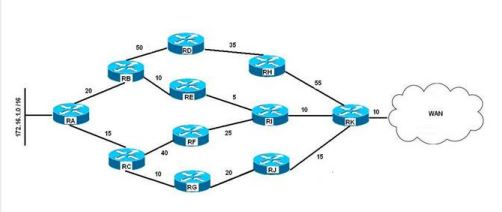
You are the network administrator for a large software organization. You designed the LAN in the organization's main building for connecting the internal LAN to a WAN as shown below:
You have configured EIGRP with the variance parameter set to 3 on all the routers to enable unequal load balancing from the 172.16.1.0 network to the WAN. The delay configured on each of the routers is shown in the LAN diagram, and the K values are set as follows:
Which of the following paths are entered into the routing tables as a result of the unequal load balancing configured on the routers? (Choose all that apply.)
Show answer & explanation
Correct answer: B
B
Ready for the real thing?
The full 300-410 simulator has every exam-style question, timed mode, and instant scoring.