
350-401 Sample Questions & Answers
Wireless infrastructure alongside Layer 2 and Layer 3 fundamentals make up nearly a third of the weighting, plus enterprise and SD-WAN design principles, device and network virtualization, security access controls, assurance diagnostics, and Python scripting.
Launch the full 350-401 simulator →Showing 10 of 20 free samples.
- Question 1
You issue the ping 192.168.1.1 size 1600 command on a Cisco device that is configured with the default system MTU. All pings succeed.
Which of the following is most likely true? (Select the best answer.)Show answer & explanation
Correct answer: B
The pings were sent to the destination in a fragmented fashion. Since the default system MTU on Cisco devices is typically 1500 bytes and the ping size is 1600 bytes, the packets exceed the MTU and must be fragmented to succeed. Without the DF bit set, fragmentation is allowed and the pings succeed. The other options are incorrect: MTU of 1600 is not default, DF bit prevents fragmentation (would cause failure), and 1600 bytes exceeds default MTU values.
- Question 2
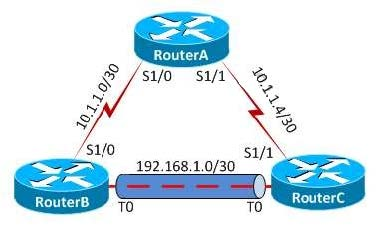
You administer the network in the exhibit below.
All routers are configured to the system MTU defaults.
You issue the ping 192.168.1.2 size 1500 dfbit command from RouterB, but the ping fails.
Which of the following is most likely the cause of the failure? (Select the best answer.)
Show answer & explanation
Correct answer: A
Most likely, the Generic Routing Encapsulation (GRE) tunnel MTU is 1476 bytes. GRE tunneling adds 24 bytes of overhead to packets (20-byte IP header + 4-byte GRE header). With a standard Ethernet MTU of 1500 bytes, the effective tunnel MTU becomes 1476 bytes. Since the ping size is 1500 bytes with DF bit set, it exceeds the tunnel MTU and cannot be fragmented, causing the ping to fail. The other options are incorrect as they do not account for GRE tunneling overhead.
- Question 3
Which of the following statements is true regarding OSPF connections over a virtual link? (Select the best answer.)
Show answer & explanation
Correct answer: D
Only routing updates are tunneled in OSPF virtual links. Virtual links are logical connections that carry OSPF routing information between areas when a non-backbone area cannot directly connect to Area 0. Unlike GRE tunnels, virtual links do not encapsulate all traffic - they only tunnel OSPF routing updates and LSA exchanges. The other options are incorrect: virtual links do not encapsulate regular traffic, do not add tunnel headers to data packets, and the transit area cannot be a stub area (stub areas cannot have virtual links).
- Question 4
Which of the following is not a GRE tunnel state on a Cisco device? (Select the best answer.)
Show answer & explanation
Correct answer: B
Down/up is not a valid GRE tunnel state on Cisco devices. The valid GRE tunnel states are: Up/up (tunnel is operational), Up/down (tunnel interface is up but line protocol is down), Administratively down/down (tunnel is shutdown), and Reset/down (tunnel is being reset). The Down/up state does not exist because if the interface is down, the line protocol cannot be up. The other options are all legitimate tunnel states that can occur during tunnel operations.
- Question 5
Which of the following statements is true regarding OSPF connections over a GRE tunnel? (Select the best answer.)
Show answer & explanation
Correct answer: A
Traffic is encapsulated and decapsulated by tunnel endpoints when using OSPF over GRE tunnels. GRE tunneling encapsulates the original packets (including OSPF traffic) with GRE and IP headers at the source endpoint, then decapsulates them at the destination endpoint. This allows OSPF to operate over networks that do not natively support multicast or direct connectivity. The other options are incorrect: tunnel headers do create overhead, transit areas can be stub areas in regular OSPF, and all traffic (not just routing updates) is tunneled in GRE.
- Question 6
Which of the following does not cause a GRE tunnel endpoint on a Cisco device to enter the Up/down state? (Select the best answer.)
Show answer & explanation
Correct answer: D
The tunnel source being a loopback interface does not cause a GRE tunnel to enter Up/down state. Using a loopback interface as the tunnel source is actually a best practice because loopback interfaces are always up and provide stable tunnel endpoints. The other options do cause Up/down state: no route to tunnel destination prevents tunnel establishment, missing IP address on tunnel interface causes protocol down, and recursive routing (destination through tunnel itself) creates routing loops that bring the tunnel down.
- Question 7
Which of the following cannot be used to connect an OSPF nonbackbone area to the backbone area?(Select the best answer.)
Show answer & explanation
Correct answer: C
The trunk configuration mode interface command enables Network Time Protocol (NTP) when used with Cisco Discovery Protocol (CDP). In network management, CDP helps discover neighboring Cisco devices and their capabilities. However, the trunk configuration mode specifically enables NTP synchronization features when CDP is operational, ensuring proper time coordination across network devices. The other configuration modes do not provide this specific NTP integration capability.
- Question 8
A GRE tunnel is configured between RouterB and RouterA, The GRE tunnel sources on each router are loopback interface IP addresses. The GRE tunnel destinations on each router are publicly routable IP addresses and are accessible by each tunnel source router.
After you attempt to bring up the tunnel, which of the following states will the tunnel endpoint on RouterB most likely enter? (Select the best answer.)
Show answer & explanation
Correct answer: E
The show interface command displays detailed interface information including speed, duplex, and error statistics for network troubleshooting. This command provides comprehensive interface status, configuration details, traffic counters, and error information necessary for diagnosing network connectivity issues. The show version, show running-config, and show protocols commands provide different types of system information but not the detailed interface-specific data needed for interface troubleshooting.
- Question 9
You issue the show ip ospf neighbor command on a Cisco router after OSPF has converged. The router has a single OSPF neighbor. The output indicates that the OSPF neighbor relationship is in the 2WAY/ DROTHER state.
Which of the following is true? (Select the best answer.)Show answer & explanation
Correct answer: B
Link-state database synchronization occurs during the ExStart state in OSPF neighbor adjacency formation. During ExStart, OSPF routers negotiate master/slave relationship and begin the process of synchronizing their link-state databases through Database Description (DBD) packets. The Init state establishes initial communication, Full state indicates complete adjacency, and 2-Way state confirms bidirectional communication but precedes database synchronization.
- Question 10
You issue the show ip ospf neighbor command on a Cisco router. The router’s OSPF neighbor state is FULL/-.
Which of the following is most likely true about the OSPF router? (Select the best answer.)
Show answer & explanation
Correct answer: D
OSPF uses wildcard masks in network statements to define which interfaces participate in the OSPF process. The wildcard mask specifies which bits in the IP address should be ignored when matching against configured network addresses. A wildcard mask of 0.0.0.255 means the first three octets must match exactly, while the last octet can be any value. This allows precise control over which interfaces join specific OSPF areas while other mask types would not provide the same network range flexibility.
Ready for the real thing?
The full 350-401 simulator has every exam-style question, timed mode, and instant scoring.